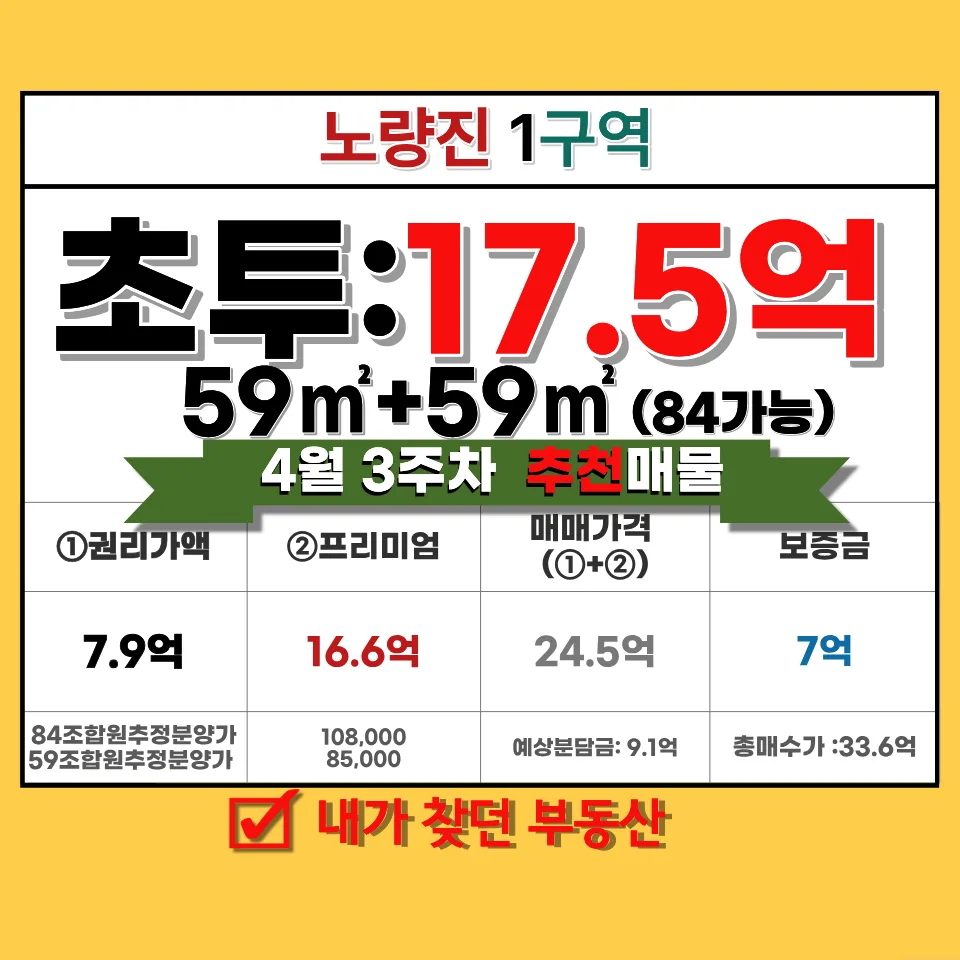
In Seoul's Noryangjin 1 Zone, a 1+1 unit can be converted to an 84㎡ apartment for an estimated initial investment of around $1.3 million USD (1.75 billion KRW). This opportunity is available just before the management disposition approval stage, offering a stable ownership structure. This analysis is based on data from the third week of April 2026.
How Can a Noryangjin 1 Zone 1+1 Unit Convert to 84㎡?
In the Noryangjin 1 Zone redevelopment project, a 1+1 unit typically allows for the application of two 59㎡ units, with the potential to later convert to a larger 84㎡ apartment. This makes it an attractive option for those looking to combine living and investment. The project is currently in a stable phase, just prior to management disposition approval, with the proportional representation ratio at 100.66%, indicating a solid ownership structure. The estimated additional payment (bun-dam-geum) is approximately $67,000 USD (91 million KRW), payable upon move-in. This specific unit is structured around leveraging relocation loans (around $510,000 USD or 700 million KRW), making the initial investment for an 84㎡ unit approximately $1.3 million USD (1.75 billion KRW), which is considered reasonable for securing this size of property.
What Are the Estimated Additional Payments and Total Purchase Price for a Noryangjin 1 Zone 1+1 Unit?

The estimated additional payment for this Noryangjin 1 Zone 1+1 unit is approximately $67,000 USD (91 million KRW). The payment structure involves a 10% down payment, no interim payments, and the remaining balance of $67,000 USD due upon move-in. The total purchase price is calculated as the property's sale price of approximately $1.8 million USD (2.45 billion KRW) minus the existing lease deposit of about $510,000 USD (700 million KRW), resulting in an initial investment of roughly $1.3 million USD (1.75 billion KRW). Adding the estimated additional payment of $67,000 USD (91 million KRW) brings the total cost to approximately $1.37 million USD (2.54 billion KRW). This structure, utilizing a $510,000 USD (700 million KRW) relocation loan, means the lease deposit and loan amount are balanced, minimizing immediate financial strain. Therefore, the effective initial investment for securing an 84㎡ unit is around $1.3 million USD (1.75 billion KRW), presenting a cost-effective way to acquire this size of property.
What Is the Project Status of Noryangjin 1 Zone and Are There Regulations for Purchase?
The Noryangjin 1 Zone project has completed its business execution approval and has finished the pre-sale application phase, currently awaiting management disposition approval. This stage is considered highly stable for redevelopment projects. Importantly, this particular unit is exempt from the land transaction permit requirements and has no mandatory residency period, allowing for a transfer of ownership before management disposition approval. This means buyers can acquire the property during a period with no current regulatory restrictions. Market trends are also favorable, with a noticeable decrease in available units in Noryangjin 1 Zone, leading to a rise in premium prices. As management disposition approval nears, units allowing the 1+1 to 84㎡ conversion are expected to become even rarer.
What Should Be Considered When Reviewing a Noryangjin 1 Zone 1+1 Unit?
When considering a Noryangjin 1 Zone 1+1 unit, several key points require attention. Firstly, the stated additional payments and relocation loan amounts are subject to change based on project progress and market conditions. It is crucial to verify the latest standards with the housing cooperative and financial institutions. Secondly, be aware of potential adjustments to Loan-to-Value (LTV) ratios due to the area being designated as a Speculative Zone. Lastly, while transfers are possible before management disposition approval, conditions may change afterward, necessitating prompt decision-making. Therefore, a thorough review of ownership rights, additional payments, and relocation loan details with a real estate professional is essential. This is not financial advice. Consult a licensed financial advisor.
For more details, check the original source below.