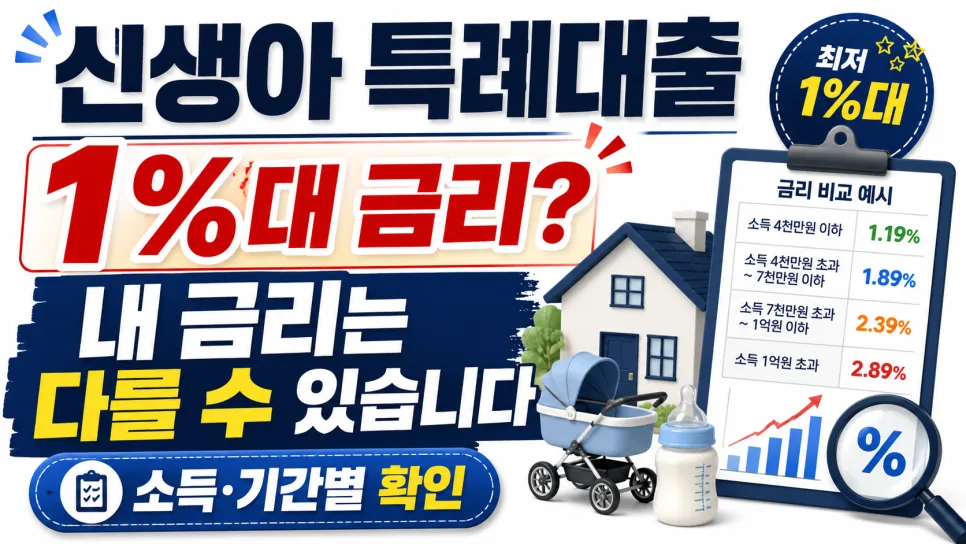
The Newborn Special Loan in Korea offers attractive interest rates starting as low as 1.3% to 1.8%, but these ultra-low rates are not available to everyone. The actual interest you'll pay depends on a complex mix of factors including your income, loan term, and the type of property you're purchasing. It's crucial to understand these variables to avoid unexpected costs.
Newborn Special Loan: Who Qualifies for the Lowest 1% Rates?
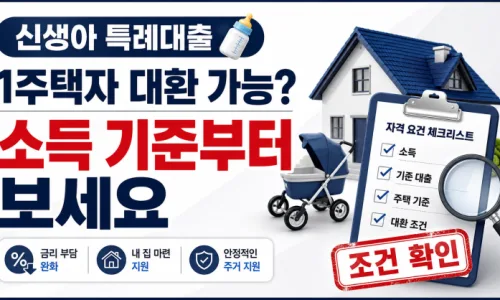
The headline-grabbing feature of the Newborn Special Loan is its sub-2% interest rate. However, this lowest tier is reserved for specific applicants who meet stringent criteria. For the 'Newborn Special Didimdol Loan' (for home purchase), interest rates range from 1.8% to 4.5%. For the 'Newborn Special Butimok Loan' (for jeonse/lease deposits), rates are between 1.3% and 4.3%. For example, based on KB Kookmin Bank's data, a couple with a combined annual income of $15,000 USD (₩20 million KRW) or less, opting for a 10-year term on the Didimdol loan, might qualify for the lowest 1.80% rate. However, if your income is higher or you choose a longer repayment period, the rate can increase significantly. My own experience confirmed this: initially drawn by the low advertised rate, my actual applicable rate was considerably higher once my income and repayment term were factored in.
How Do Income Brackets Affect Newborn Special Loan Rates in the US?

The Newborn Special Loan program operates on a tiered interest rate system based on income, a common practice for government-backed housing assistance programs in many countries, including the US. Lower income brackets receive more favorable interest rates. For the Newborn Special Didimdol Loan, a combined annual household income of $15,000 USD (₩20 million KRW) or less qualifies for the lowest rate of 1.80% for a 10-year term. However, for dual-income households earning between $125,000 USD (₩170 million KRW) and $150,000 USD (₩200 million KRW), the rate jumps to 4.20% for a 10-year term and can reach 4.50% for a 30-year term. A 1% to 3% difference on a loan amount of $75,000 to $150,000 USD can translate to thousands of dollars in monthly interest payments and tens of thousands over the life of the loan. Therefore, accurately assessing your income bracket and its corresponding interest rate is crucial before applying.
What's the Impact of Loan Term on Newborn Special Loan Interest Rates?

Beyond income, the loan term (or maturity period) significantly influences the interest rate for the Newborn Special Loan. The Newborn Special Didimdol Loan offers terms of 10, 15, 20, and 30 years. Generally, longer repayment periods result in higher interest rates, even within the same income bracket. For instance, under the $15,000 USD (₩20 million KRW) income tier, a 10-year term might be 1.80%, but a 30-year term could increase to 2.05%. Similarly, for the $75,000 to $100,000 USD (₩100 million to ₩130 million KRW) income bracket, a 10-year term could be 3.20%, while a 30-year term might rise to 3.50%. This rate difference directly impacts your monthly payments and the total interest paid over time. Opting for a shorter term can lower your overall interest cost but increase your monthly burden, whereas a longer term reduces monthly payments but increases the total interest paid. Carefully balancing these factors based on your financial capacity is essential.
Understanding the 'Special Rate' Period for Newborn Loans

The 'special rate' period for these loans is not indefinite. The Newborn Special Didimdol Loan typically offers the preferential interest rate for an initial 5-year period. This can be extended by an additional 5 years for each subsequent child born, potentially up to a maximum of 15 years. For the Newborn Special Butimok Loan, the initial special rate period is 4 years, extendable by another 4 years per child, up to a maximum of 12 years. After this special rate period concludes, the loan will transition to a standard market interest rate. This means your monthly payments will likely increase. It's vital to budget for this transition and understand what the prevailing market rates might be when your special period ends. Planning for this future increase is a key aspect of responsible borrowing under this program.
Navigating the Nuances: Key Considerations for US Borrowers
While the Newborn Special Loan is a Korean government initiative, understanding its structure offers insights into how similar programs might function elsewhere. For US residents considering property purchase in Korea, or those interested in comparative housing finance, key considerations include the strict income verification, the tiered interest rate system, and the limited duration of special rates. Unlike many US mortgage programs that might offer fixed rates for the entire loan term, these Korean special loans have a defined period of lower rates followed by a shift to market rates. This necessitates careful long-term financial planning. It's also important to note that eligibility and specific terms can vary based on the financial institution administering the loan, similar to how different banks in the US might offer slightly varied terms on conventional mortgages. Always consult with a licensed financial advisor to understand how these loans fit into your broader financial strategy.
For more details, check the original source below.





