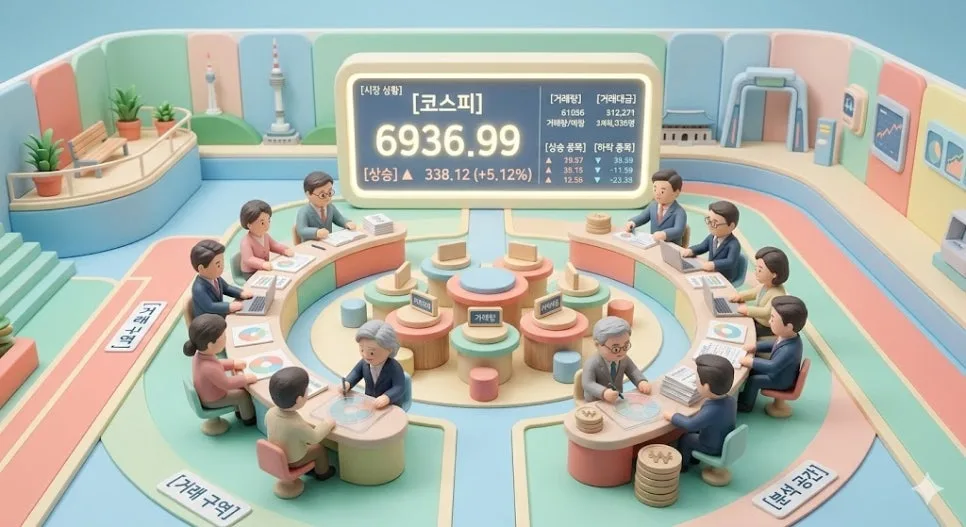
As the KOSPI index approaches the 7000 mark after hitting a record high of 6936.99, individual investors are eager to understand the driving forces and future outlook. This analysis breaks down the reasons behind the 2026 market surge, potential risks, and actionable strategies for individual investors aiming to navigate this new era of the Korean stock market.
What Fueled the KOSPI's Record-Breaking Surge to 6936.99?
On May 4, 2026, the KOSPI index closed at a historic high of 6936.99, marking a significant leap. This achievement wasn't just about the number; it was a confluence of factors, primarily driven by the robust performance of large-cap semiconductor stocks, fueled by immense investor optimism surrounding Artificial Intelligence (AI) investments. The synchronized buying by both foreign and institutional investors provided a powerful tailwind. Companies like SK Hynix and Samsung Electronics led the charge, their gains resonating throughout the market. The anticipation of increased demand for AI servers and high-performance memory chips has created a ripple effect, boosting investor sentiment across related industries, including data centers, power equipment, and material suppliers. This market rally reflects not only individual company performance but also the broader excitement surrounding the entire AI ecosystem.
What Warning Signs Should Individual Investors Watch for After a Record High?
While reaching a record high like 6936.99 is a positive indicator, such peaks also carry inherent risks of market correction. Following a significant daily surge, like the 5%+ jump seen recently, a mix of profit-taking and late-entry buying can create volatility. Therefore, individual investors must pay close attention to several key indicators. Firstly, monitor the sustainability of foreign and institutional net buying trends over several days. Secondly, assess whether the rally's momentum is spreading beyond large-cap semiconductor stocks to other sectors. Lastly, keep an eye on market sentiment indicators such as volatility indexes and short-selling balances. A comprehensive analysis of these signals can help anticipate potential trend reversals and guide investment decisions. Remember, markets can pause even on good news, so a cautious approach is often wiser than hasty decisions.
How Should Individual Investors Navigate the KOSPI 6936.99 Era?
The KOSPI's new record high of 6936.99 signals a time for cool-headed analysis rather than impulsive excitement. This is an opportune moment to re-evaluate your investment portfolio and refine your strategy. Start by categorizing your holdings: identify core stocks with solid fundamentals, thematic stocks driven by current trends, and underperforming stocks that may be clouding your judgment. This categorization will provide a clear basis for deciding which assets to hold and which to divest. Furthermore, a well-thought-out financial plan that considers your investment horizon is crucial. If you need short-term access to funds, it's prudent to avoid over-allocating to stocks and consider more stable investments. For long-term investors, a strategy of gradually increasing holdings in sectors with consistent earnings, through dollar-cost averaging, can be effective. Tailoring your approach to your personal investment goals and financial situation is paramount.
What Common Mistakes Do Individual Investors Make After a KOSPI Peak?
In the euphoria following a KOSPI record high, individual investors often fall into common traps. One frequent mistake is chasing rallies without thorough analysis, leading to buying at inflated prices. Another pitfall is over-concentrating on specific themes, neglecting the broader market trends and diversification principles. Emotional trading, driven by fear of missing out (FOMO) or panic selling, also leads to suboptimal decisions. Recognizing these common errors—chasing performance, narrow thematic focus, and emotional decision-making—is the first step toward avoiding them. Maintaining a disciplined approach, sticking to a well-researched investment plan, and focusing on long-term value are key to navigating market highs successfully.
For more details, check the original source below.