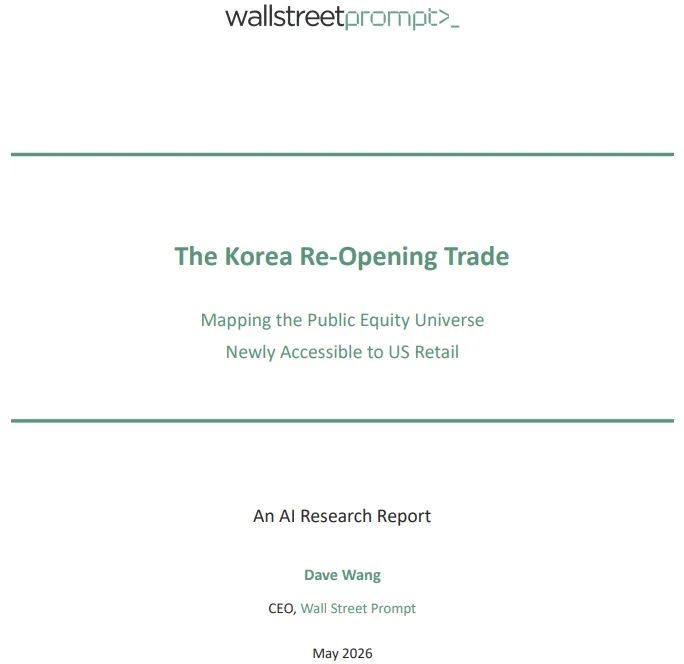
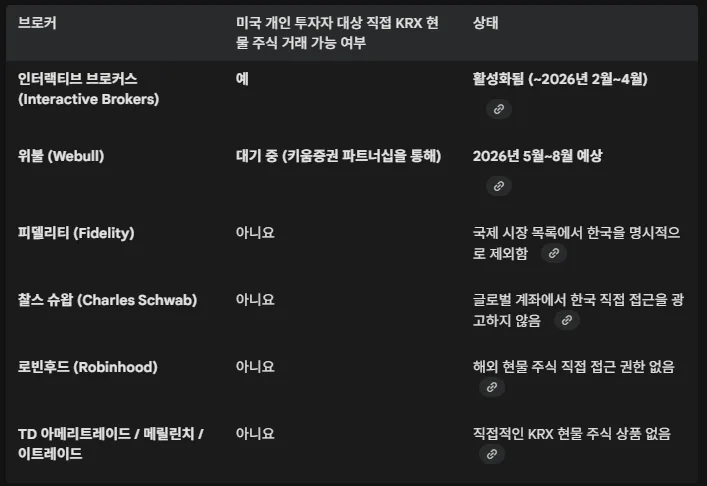
In early 2026, Interactive Brokers (IBKR) launched direct order execution for all stocks on the Korea Exchange (KRX) to US individual investors, opening a new gateway to the Korean stock market. This move is set to reshape the supply and demand dynamics within the Korean market, offering unprecedented access for American retail investors.
What's the Outlook for US Individual Investors in the Korean Stock Market in 2026?
Early in 2026, Interactive Brokers (IBKR) became the first major retail brokerage in the US to offer direct order execution for all stocks on the Korea Exchange (KRX). This signifies a new era of direct access for American individual investors to the Korean market, which was previously hindered by high entry barriers. Webull is also expected to launch a similar service between Q2 and Q3 of 2026, following a partnership with Kiwoom Securities. The 'Omnibus framework' enabling IBKR's service is likely to be adopted by other US brokerages, gradually diversifying the buyer base in the Korean stock market over the coming quarters. This shift emphasizes the importance of a 'positioning' strategy—building stakes before new buyer pools emerge—rather than solely relying on 'valuation' logic.
What Are the Three Key Supply/Demand Catalysts for the Korean Stock Market?
Three factors are poised to create a positive supply and demand environment for the Korean stock market within the next 90 days. Firstly, the planned launch of 24-hour real-time Korean Won (KRW) foreign exchange trading in 2026 will eliminate operational friction for individual investors trading KRX stocks, a mandate from the Financial Services Commission that significantly enhances trading convenience. Secondly, the regular rebalancing of the KOSPI 200 and KOSDAQ 150 indices, scheduled for June 2026, will drive passive fund flows into and out of constituent stocks. Thirdly, the ongoing disclosures from Korea's 'Value-Up Program' are progressively addressing the long-standing governance discount (undervaluation) that has plagued the Korean market. All three events are expected to occur within the reporting period of this analysis, accelerating new demand for Korean equities.
Which Korean Market Sectors Appeal Most to US Individual Investors?
The Korean stock market hosts a dense cluster of sectors that align well with the narrative preferences of individual investors outside the US. Five key sector clusters show a strong correlation with US retail capital's narrative appeal. First, the AI semiconductor sector, where Korea holds a near-monopoly in High Bandwidth Memory (HBM) and boasts a robust supply chain. Second, robotics, with Korea leading the world in industrial robot density, offering investment opportunities in industrial and humanoid robots. Third, the 'K-Defense' sector, representing one of the fastest-growing defense narratives globally. Fourth, K-Content and Gaming, encompassing internationally recognized entertainment, music, and gaming publishers. Finally, EV battery materials, featuring companies involved in battery cells, separators, cathodes, and anodes, directly linked to the global EV supply chain. This analysis identified compelling investment targets across these five sectors.
What is the Foreign Ownership Distribution in the Korean Market and Investment Opportunities?
The distribution of foreign ownership in the Korean market is polarized, with the second group of investment categories being structurally interesting. Large-cap Korean blue-chips, already substantially held by US institutional investors, are thoroughly analyzed by global fund allocators. However, a much broader mid-cap segment within AI semiconductor supply chains, robotics, and defense industries still shows foreign ownership in the single or low double digits. This suggests the existence of untapped investment potential. These stocks often have lower liquidity (float) and less foreign ownership, meaning new buying pressure could lead to significant price appreciation. Therefore, a positioning strategy focused on these mid-cap stocks may prove effective.
What Should US Investors Be Aware of When Investing in the Korean Stock Market?
US individual investors should note several points when directly investing in the Korean stock market. Firstly, even with brokerages like IBKR, currency exchange and transaction fees apply; thoroughly review each brokerage's fee structure. Secondly, the Korean market can be relatively volatile, especially for small and mid-cap stocks, so be mindful of rapid price swings. Thirdly, continuously monitor the impact of policy changes, such as Korea's 'Value-Up Program,' on stock prices. Also, be aware of operational differences due to the time zone gap between US and Korean market opening hours. It is crucial to develop an investment strategy that aligns with your individual risk tolerance and investment goals. Consulting with a financial professional for personalized advice is recommended.
English crawl path
Next English reads from this pilot cluster
Continue through the category hub, latest English stories, and related posts so this translated article is not an isolated URL.
Tags
💬Frequently Asked Questions
What should I check first in Korea Stock Market 2026: New US Investor Opportunities?
Does this Finance article link back to the Korean source?
Where can I find similar English stories?
English discovery path
Explore more English K-culture stories
Keep browsing the indexed English pilot cluster so Google and readers can move between this story, the category hub, and fresh discovery pages.
Original Source
Read the Korean original





