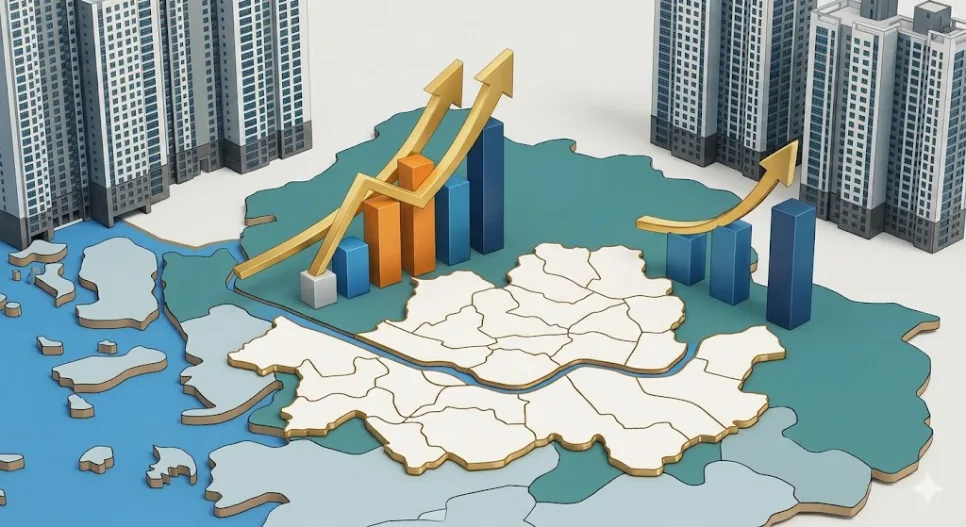
In 2026, a 'catch-up' phenomenon is accelerating in South Korea's real estate market, with areas on the outskirts of Seoul and non-regulated zones narrowing the price gap with prime locations. This analysis explores promising regions and investment strategies driven by deregulation and shifting demand.
What's Driving the 2026 Real Estate Market Shift?
The long-held 'Gangnam Invincibility' myth is fading. In 2026, as the government tightens real estate regulations, capital is increasingly flowing towards the outskirts of Seoul and non-regulated areas within the Seoul Metropolitan Area. Following the 10.15 Real Estate Measures, price increases in Gangnam's three core districts were capped at around 2%, while outer Seoul areas like Dongdaemun and Seongbuk saw gains exceeding 3%, demonstrating the 'catch-up' trend. This isn't just a price correction; it signals that clinging solely to prime locations might mean missing out on profit opportunities. This shift presents new avenues for both primary homebuyers and investors.
Why Are Non-Regulated Seoul Metro Areas Leading the Boom?
The significant price surge in non-regulated areas within the Seoul Metropolitan Area, including Gyeonggi Province and Incheon, is primarily due to their regulatory freedom. With less stringent loan restrictions and more flexible transaction rules, these areas are attracting both investors and genuine homebuyers. Notably, areas like Dongtan, Guri, and Songdo have seen price increases two to three times higher before and after regulatory announcements. For instance, Dongtan in Gyeonggi Province saw its price growth jump from 1.5% to 3.3% post-regulation, while Guri City experienced a similar rise from 1.2% to 3.4%, making them key players in the 'catch-up' phase. This is a natural market response as demand disperses to relatively undervalued surrounding areas due to the high cost of prime locations.
What Are the Real 'Record High' Transaction Examples?
The intense heat of the real estate market, which might seem abstract from numbers alone, is clearly visible in actual transaction cases. In Dongtan, Gyeonggi Province, the 'Dongtan Yeok Sibeom Hanwha Dream & Green' apartment complex (84 sqm unit) recorded a new high, increasing by approximately $250,000 USD (₩330 million) from $850,000 USD (₩1.15 billion) to $1.1 million USD (₩1.48 billion) in just five months. Similarly, in Guri City, the 'Hillstate Guri Station' saw a price jump of about $190,000 USD (₩250 million), from $760,000 USD (₩1 billion) to $950,000 USD (₩1.25 billion). These record-breaking sales are occurring across various regions.
This trend isn't just market hype; it's supported by high resident satisfaction in non-regulated areas with good Seoul accessibility and new constructions, along with robust underlying demand. As long as regulations persist, this 'catch-up' price momentum is likely to continue.
What Scenarios Can We Expect for the Future Real Estate Market?
Many are wondering if it's too late to enter the market now. Real estate experts analyze the current situation not as the peak of a 'balloon effect' but as a process of 'resolving regional disparities.' When the price gap between Gangnam and the outer Seoul areas becomes excessively wide, the market naturally tends to narrow it. However, not all outer areas will rise uniformly. The market is likely to reorient towards areas with clear development plans, such as transportation improvements and new construction projects. Therefore, when investing, it's crucial to check specific details like residency requirements, loan regulations, transportation infrastructure, and upcoming housing supply. This is not financial advice. Consult a licensed financial advisor.
For more details, check the original source below.





