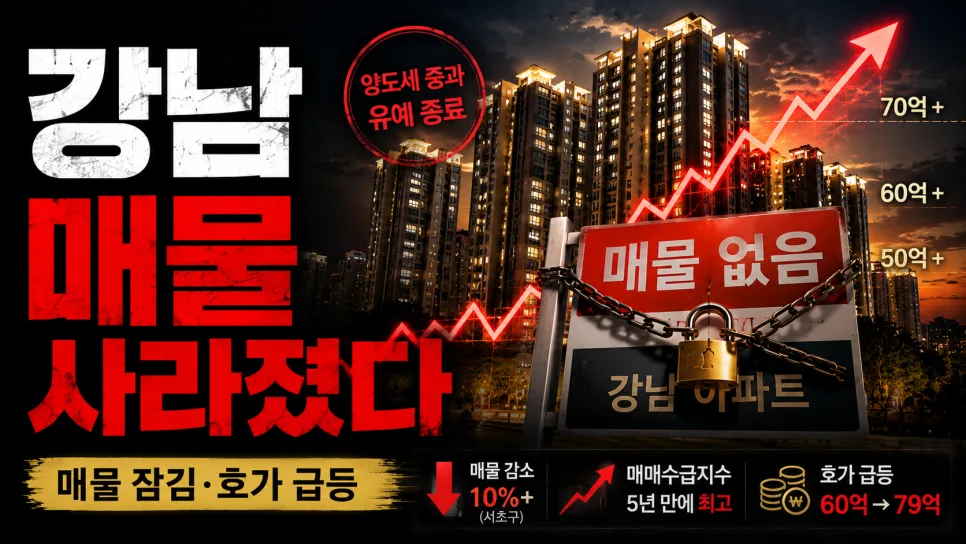
In Seoul's ultra-premium Gangnam district, asking prices for 84-square-meter (approx. 900 sq ft) apartments are now hitting an astounding $5.5 million USD. This dramatic price surge is driven by a complex interplay of factors, including the end of a tax grace period, a significant drop in available listings, and a strengthening seller's market, pushing prices to unprecedented levels in 2026.
What Impact Has the End of the Capital Gains Tax Grace Period Had on Seoul's Gangnam Apartment Market?
The expiration of the capital gains tax grace period for multi-homeowners has been a pivotal shift for the Gangnam apartment market. Prior to this, some homeowners rushed to sell to minimize tax burdens, leading to a temporary increase in distressed sales. However, since the grace period ended in May 2026, this trend has reversed. Sellers who haven't yet sold are now less inclined to list their properties, opting instead to hold onto them. This is particularly true in Seoul's designated speculative zones like Gangnam, Yongsan, and others, where the tax implications can be substantial. Based on market observations, once these pre-expiration 'fire sales' are absorbed, the market is highly likely to reorient itself towards a seller-centric dynamic, where sellers have the upper hand.
Why Are Gangnam Apartment Listings Decreasing While Asking Prices Are Rising?
A scarcity of available properties significantly impacts real estate price trends. When buyers have fewer options, they are often willing to pay more, while sellers, facing less competition, have little incentive to lower their prices. This phenomenon, known as 'listing lock,' is especially pronounced in prime Seoul locations like Gangnam, where properties are scarce and owners often have strong financial backing. Before the tax grace period ended, there was a possibility of price adjustments due to urgent sales. However, with those urgent sales now cleared and fewer new listings appearing, the upward pressure on asking prices has intensified. This isn't solely due to increased buyer demand; it's largely a consequence of reduced seller inventory, shifting negotiation power to sellers. This dynamic limits buyer choices and encourages homeowners to increase their asking prices, potentially leading to higher actual transaction prices.
What Does the Surge in Asking Prices for Core Gangnam Apartments, Like the 84 sqm Banpo Units, Signify?
Fluctuations in asking prices for key properties in Seoul's prime neighborhoods serve as critical indicators of overall market sentiment. When prices rise in prestigious areas such as Banpo, Apgujeong, Daechi, and Dogok, it often triggers a ripple effect, encouraging nearby property owners to raise their own expectations. Notably, in the Banpo area, asking prices for 84-square-meter (approx. 900 sq ft) units have reached staggering figures, sometimes exceeding $5.5 million USD, drawing significant market attention. However, it's crucial to remember that asking prices don't always translate to final sale prices. Investors should always analyze actual transaction data and trading volumes to gauge the true market trend. A few record-high asking prices, especially with low transaction volumes, might not reflect a broader market shift. Furthermore, even within the same building and unit size, prices can vary significantly based on factors like floor level, orientation, view, and specific unit location. When a decrease in listings coincides with rising asking prices, a buyer's negotiating power diminishes, signaling a clear shift towards a seller's market.
What Are the Fundamental Drivers Behind the Price Increases in Gangnam Real Estate?
The price movements in Gangnam apartments are influenced by more than just tax policies. Fundamentally, a combination of limited new construction, rising rental costs, the influx of liquid capital, and a persistent high demand for top-tier schools and amenities drives these increases. Gangnam, in particular, faces severe constraints on new housing supply; while redevelopment projects offer potential, regulatory hurdles and lengthy construction timelines mean substantial new inventory is unlikely in the short term. This supply-demand imbalance can stimulate purchase demand when rental prices climb. Additionally, capital that has seen gains in other markets, such as stocks, may flow into real estate, seeking stability and growth. The preference for owning a single, high-quality property in a desirable location like Gangnam remains strong among affluent buyers. When coupled with expectations of future price appreciation, sellers become more inclined to hold their properties, further tightening the market. Ultimately, the Gangnam real estate market operates on a foundation of strong demand and restricted supply. When tax policies further reduce available listings, the upward pressure on prices intensifies. Individual investment decisions should carefully weigh market conditions against personal financial circumstances, and consulting with a financial advisor is highly recommended.
English crawl path
Next English reads from this pilot cluster
Continue through the category hub, latest English stories, and related posts so this translated article is not an isolated URL.
Tags
💬Frequently Asked Questions
What impact has the end of the capital gains tax grace period had on Seoul's Gangnam apartment market?
Why are Gangnam apartment listings decreasing while asking prices are rising?
What does the surge in asking prices for core Gangnam apartments, like the 84 sqm Banpo units, signify?
What are the fundamental drivers behind the price increases in Gangnam real estate?
English discovery path
Explore more English K-culture stories
Keep browsing the indexed English pilot cluster so Google and readers can move between this story, the category hub, and fresh discovery pages.
Original Source
Read the Korean original





