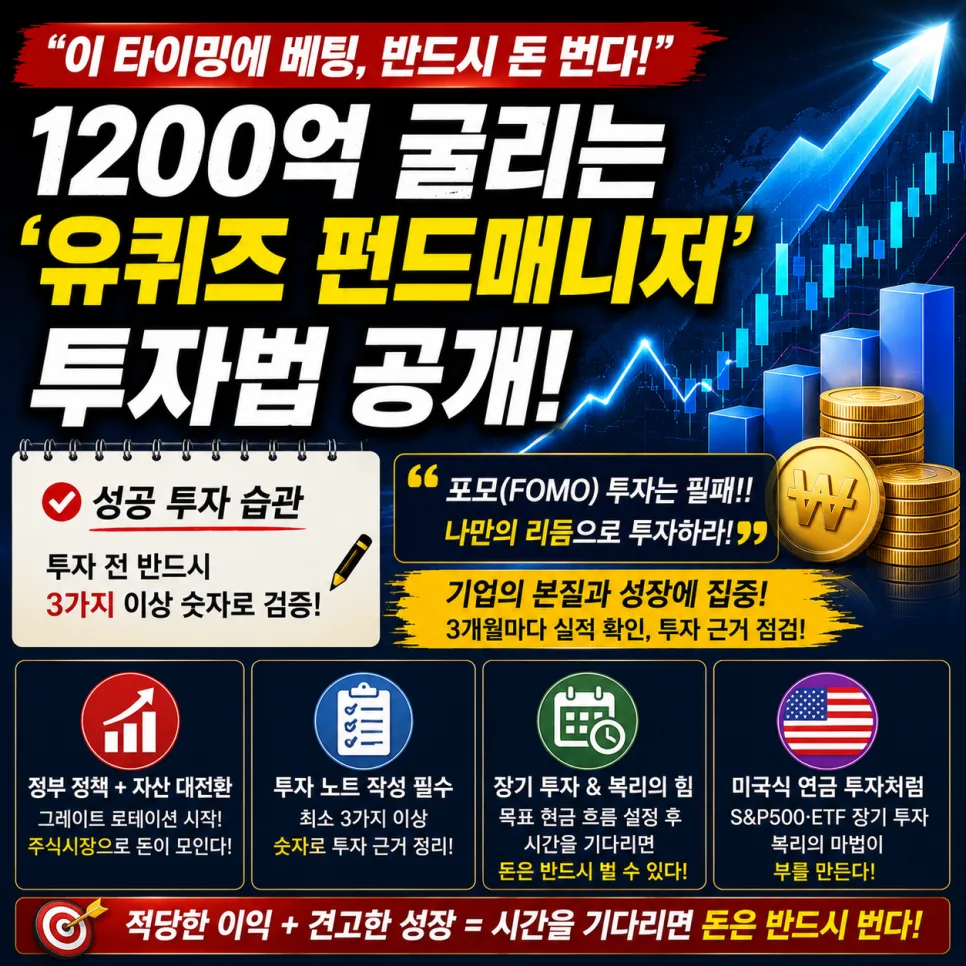
A seasoned fund manager overseeing $80 million (₩120 billion) reveals that the secrets to building wealth are consistent investment journaling and diligently monitoring a company's intrinsic value. By adopting these timeless principles in 2026, you can pave the way for long-term investment success.
Why Do Investors Who Keep Journals Ultimately Make More Money?
Kim Hyun-jun, CEO of The Public Asset Management, who has achieved a cumulative return of 1100% over 16 years, emphasizes 'investment journaling' as the most crucial habit for successful investing. World-renowned investors like Warren Buffett don't just invest based on gut feelings or trends; they meticulously record their investment rationale, backed by at least three verifiable data points. This practice is especially vital in today's volatile market, characterized by rapidly surging thematic stocks. Personally, before any investment, I always compile data on the company's financial statements, growth prospects, and market share. This documentation serves as an anchor, helping me maintain a long-term perspective and resist the urge to react to short-term market fluctuations.
Why Do FOMO Investments Ultimately Lead to Failure?
Kim Hyun-jun identifies 'FOMO (Fear Of Missing Out)' as the most dangerous investment psychology to guard against. He warns that succumbing to the fear of being left behind and impulsively investing based on others' successes often leads to reckless trading and significant losses. This risk is amplified in markets with rapidly rising thematic stocks like AI, semiconductors, and robotics. I've personally experienced substantial losses from 'blindly investing' in certain stocks, swept up by market hype without adequate analysis. Therefore, maintaining a cool head and basing investment decisions on objective analysis is paramount.
What Does It Mean to Invest Based on a Company's Intrinsic Value?
Kim emphasizes that focusing on a company's 'intrinsic value' rather than short-term stock price fluctuations is key to long-term investment success. He advises quarterly reviews of a company's earnings growth, profit structure stability, and business direction sustainability. The focus should be on whether the company is consistently growing and its future outlook, not just daily price movements. I've seen companies with initially sluggish stock prices eventually deliver significant returns due to steady earnings improvements and new business expansions. Understanding a company's fundamentals is the surest way to mitigate risk and pursue stable profits.
What Is the Long-Term Compound Investment Approach Used by US Investors?
Kim notes that while Korean investors tend to be sensitive to individual stocks and short-term news, US investors often favor long-term compound investments, such as S&P 500 ETFs and retirement accounts. This indicates a familiarity with growing assets steadily over time, rather than reacting to daily market volatility. He believes that if this long-term investment culture takes root, the Korean stock market could also realize significant growth potential. I've adopted this US investor approach, focusing on long-term asset allocation rather than short-term market trends. The magic of compounding is the most powerful investment tool that time provides.
For more details, check the original source below.





