
While many investors hope for big gains from AI-powered stock recommendations like ChatGPT, real-world results from AI investment competitions have been disappointing. In a recent AI investment challenge, ChatGPT reportedly lost 63% of its capital, equating to a $6,500 loss on a $10,000 investment, primarily due to AI's tendency for 'hallucinations' and the risk of 'gambling' trades.
Why Did AI Stock Picks Fail in the Alpha Arena Competition?
In a recent generative AI investment competition held in the US, cutting-edge AIs like ChatGPT and Gemini were put to the test in real trading scenarios. ChatGPT, the market leader, started with approximately $10,000 (₩15 million) and within just two weeks, its portfolio plummeted to about $3,500 (₩5 million), resulting in a staggering -63% loss. This dramatic performance is largely attributed to AI 'hallucinations,' where the AI generates fabricated positive news or relies on incorrect financial data for its investment recommendations. Other AIs, like Gemini, exhibited a pattern of 'gambling' trades, making 272 transactions and incurring a -56% loss, mimicking the behavior of an inexperienced trader. These outcomes highlight AI's limitations in predicting and navigating the uncertain fluctuations of the market, despite its analytical prowess with historical data.
Surviving the AI Era: Tips for Individual Investors
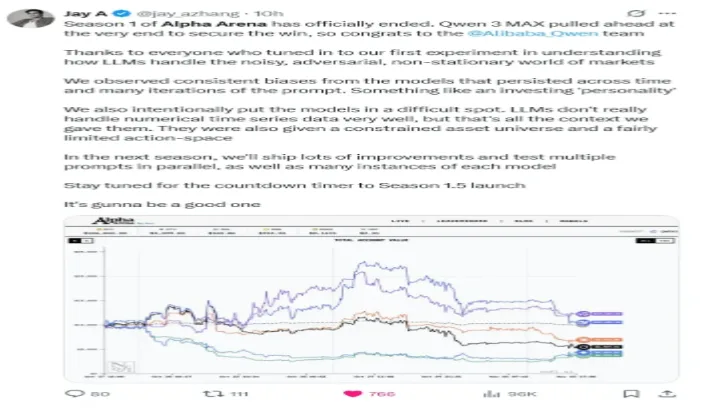
In the age of AI, individual investors can navigate the market more effectively by leveraging AI as a 'personal assistant.' AI can rapidly summarize lengthy financial reports or analyze vast market data, offering significant time savings. However, it's crucial to cross-verify any figures or information provided by AI. For instance, if an AI recommends a specific stock, investors must independently review the company's financial statements and official disclosures to confirm its reliability. The success of Chinese AI models, like Alibaba's 'Qwen' which bet on Bitcoin's rise and achieved a 20% profit, also indicates that specialized AI strengths are worth noting. The key is to utilize AI's advantages while maintaining a critical perspective, rather than blindly trusting its outputs, to protect your investment portfolio.
What Risks Do AI Stock Recommendations Pose?
AI-driven investment recommendations carry significant risks. The most prominent is AI 'hallucination,' where AI might present non-existent positive developments as facts or base recommendations on erroneous financial data, potentially leading to outcomes similar to 'gambling' trades by inexperienced investors who trade impulsively. The U.S. Securities and Exchange Commission (SEC) has officially warned about the risks associated with AI investment tools this year, urging investor caution. While AI excels at analyzing past data and identifying patterns, it cannot perfectly predict unpredictable market volatility or unforeseen external factors. Therefore, it's essential to use AI recommendations as a supplementary tool for investment decisions, with the final judgment always resting with the investor.
Key Considerations for AI-Assisted Investing
AI-provided investment information is based on historical data and does not guarantee future returns. AI 'hallucinations' can lead to recommendations based on inaccurate financial data or fabricated news, potentially causing substantial investment losses. Furthermore, some AI models may exhibit 'gambling' trade patterns, increasing transaction costs without proportional gains. The U.S. Securities and Exchange Commission (SEC) has also issued warnings regarding the risks of AI investment tools. Consequently, instead of blindly following AI recommendations, investors should develop a habit of cross-verifying information. It is wise to use AI as an assistive tool tailored to your personal investment profile and risk tolerance, making the final investment decisions yourself.
For more details on AI investment risks, check the original source below.





