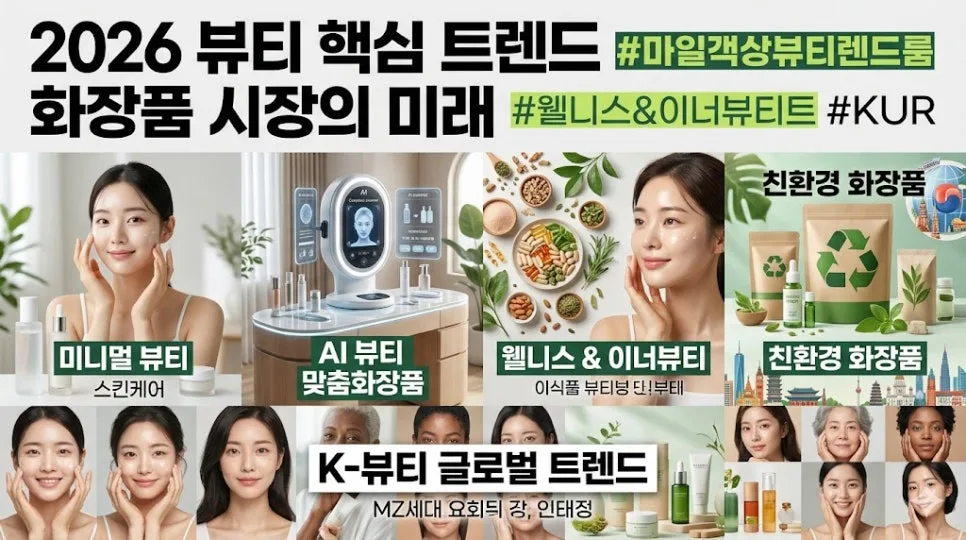
The 2026 beauty market is rapidly reshaping around high-efficacy minimalism, AI-powered personalized cosmetics, and wellness-focused sustainable consumption. Moving beyond the traditional multi-step routines, a trend towards achieving maximum results with fewer products is driving industry-wide changes.
- 2026 beauty market key trends: High-performance minimalism, AI-driven personalized cosmetics, and wellness-centric consumption.
- Minimalist skincare focuses on achieving maximum effect with a few high-performance products, moving away from complex routines.
- AI in beauty enables hyper-personalized cosmetics through skin analysis and data-driven insights.
- Wellness beauty prioritizes inner health, mental well-being, and sustainable consumption over just external appearance.
- K-beauty is establishing itself as a distinct global industry genre, with indie brands making significant strides.
Based on the original Korean blog post and linked source page, translated and summarized by BackToLink for global discovery.
Why the 10-Step Korean Skincare Routine is Evolving in 2026
The biggest shift in the 2026 beauty market is 'high-performance minimalism.' Consumers are increasingly choosing approaches that maximize results with a select few high-efficacy products, moving away from complex, multi-step routines. Trend reports for 2026 highlight a move towards 'performance-driven, minimalist product selection' as a key theme. Multi-functional creams that offer benefits like brightening, wrinkle reduction, and UV protection are rapidly gaining popularity, signaling a clear transition from 'applying a lot' to 'applying smartly.' This reflects a growing consumer need for time-saving solutions and a deeper understanding of their skin, leading to a preference for focusing on essential, core ingredients rather than unnecessary steps.
How AI and Data Are Ushering in the Era of Personalized Cosmetics
The advancement of AI and data analysis technologies has opened the door to a 'hyper-personalization' era in the cosmetics industry. AI-driven skin diagnostics and data analysis are rapidly enabling the widespread adoption of custom cosmetics tailored to an individual's skin type, concerns, and lifestyle. The 2026 market is solidifying these technologies as a core competitive advantage, moving beyond mere trends. The focus is increasingly on creating a more 'human-centric experience' by combining AI technology with expert insights. For example, an app might allow users to take a photo of their skin, which AI then analyzes to recommend optimal ingredients for a custom-formulated, small-batch serum. This precise efficacy verification and personalized recommendation are crucial for enhancing consumer satisfaction and brand loyalty.
Why 'Getting Healthy' is Becoming More Important Than Just 'Getting Pretty' in Beauty
The 2026 beauty market is seeing a strengthened emphasis on 'wellness,' prioritizing inner health alongside external appearance. With growing interest in ingestible beauty products (inner beauty) and the connection between mental health and skin (psychodermatology), cosmetics are evolving beyond simple beauty products to encompass broader lifestyle choices. Furthermore, heightened awareness of climate change and environmental issues has made the use of eco-friendly ingredients, sustainable packaging, and ethical consumption significant factors in purchasing decisions. Products featuring vegan-certified ingredients and packaged in recyclable materials, for instance, are receiving positive consumer feedback. This indicates that consumers are increasingly making responsible choices that consider not only their own health but also the planet's well-being.
How K-Beauty is Being 'Redefined' in the Global Market
K-beauty has transcended its status as a fleeting trend to firmly establish itself as a distinct global industry genre by 2026. Particularly, indie brands are disrupting the traditional large-corporation-dominated market by creating viral marketing sensations through social media platforms like Instagram and TikTok, leading to global sell-outs. Korean cosmetics continue to expand their influence, holding significant market share in key regions such as the US and Japan. This success is a result of combining not just product quality, but also unique concepts, effective marketing strategies, and an accurate understanding of local consumer needs. Moving forward, K-beauty is poised to further evolve, leading global beauty market trends through technological innovation and cultural strengths.
Discover more 2026 beauty market trends here.