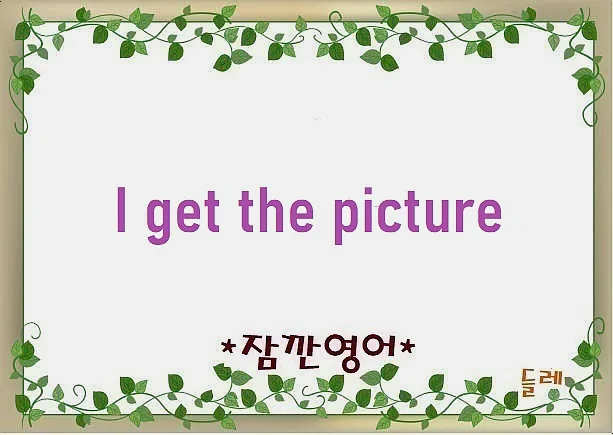
The English phrase 'I get the picture' means more than just understanding; it signifies grasping the entire situation or context, including unspoken elements. In 2026, native English speakers frequently use this idiom to convey they've understood complex scenarios or underlying intentions, going beyond a simple 'I understand.' It's a versatile expression for comprehending the full scope of what's being communicated.
What Exactly Does 'I Get the Picture' Mean? A 2026 Interpretation
Literally translating to 'I see the image,' 'I get the picture' actually means you've mentally visualized and understood the complete situation, context, or intention, even if not explicitly stated. This expression emphasizes 'understanding the whole situation' rather than just absorbing information, giving it a more vivid and conversational feel than 'I understand.' It's particularly useful when you've grasped the full implication of what someone is saying or when you've naturally arrived at a conclusion while listening. While more common in casual conversations than formal writing or meetings, it can convey a soft affirmation like 'I get it' or even signal 'You don't need to explain further, I understand.' The core of this phrase in 2026 remains its focus on the ability to intuitively grasp the overall context.
What Are Other Ways to Say 'I Understand' in English?
English offers various ways to express understanding, each with subtle nuances. The most basic and neutral phrase is 'I understand,' which objectively indicates that you've received and processed information or an explanation. For a more casual and brief way to say you understand, 'I get it' is frequently used; it's more colloquial and friendly than 'I understand.' 'I see what you mean' is used when you understand someone's perspective or intention, carrying a stronger nuance of empathy and agreement with their viewpoint. In contrast, as explained, 'I get the picture' emphasizes grasping the entire situation, context, or hidden meaning beyond simple comprehension. Understanding these subtle differences is key to natural English communication in 2026.
How Is 'I Get the Picture' Used in Real Conversations?
The phrase 'I get the picture' is useful in various conversational scenarios. For instance, after someone explains a complex situation at length, if you grasp the overall flow and outcome, you might say, 'Okay, I get the picture.' It can also be used when someone is about to explain something obvious or redundant, and you want to stop them politely. For example, if a friend is detailing a plan you've already figured out, you could interject with, 'Don't worry, I get the picture!' This shows you've understood the core idea and are ready to move forward. In a professional setting, if your boss is outlining a project's challenges, and you understand the implications for your workload, saying 'I get the picture' signals that you're aware of the task ahead. It's a concise way to confirm comprehension and acknowledge the broader context without needing further elaboration.
When Should You Avoid Using 'I Get the Picture'?
While 'I get the picture' is a useful and common idiom, it's important to know when its casual nature might be inappropriate. Because it's a colloquial expression, it's generally best avoided in formal writing, such as academic essays, business reports, or official emails. Using it in a highly formal meeting or during a presentation to superiors could come across as too informal or even slightly dismissive, depending on the context. For instance, if you're receiving critical feedback or a complex set of instructions in a formal business environment, sticking to 'I understand' or 'I see' would be more professional. In situations where clarity and precision are paramount, and there's no room for ambiguity, a more direct statement of understanding is preferable. Always consider your audience and the setting before opting for this phrase.
For more details, check the original source below.