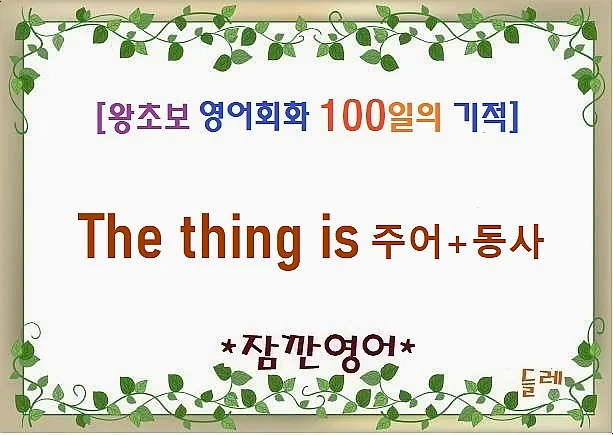
In English conversation, 'The thing is~' is a common phrase used to introduce a key point or important piece of information. While it can literally translate to 'the problem is~' or 'the point is~', it's most effectively used to clarify complex situations or emphasize crucial details. The structure typically follows 'The thing is' followed by a subject and verb, presenting the core message directly.
When and How to Use 'The Thing Is~' in English Conversation (2026)
Beyond just meaning 'problem,' 'The thing is~' in English conversation serves to present the crux of a discussion or a vital piece of information. It's useful for elaborating on an answer to a question or explaining the underlying reason for a situation. Using this phrase signals to the listener that important information is coming, making your message more impactful. Native English speakers frequently use it in various contexts, especially when shifting conversational topics or highlighting a specific fact. The structure 'The thing is + (subject + verb)' sets up the core message that follows. For example, saying 'The thing is, I forgot to call her back' clearly communicates that the main point is the forgotten callback.
Understanding the Nuances and Various Usages of 'The Thing Is~'
'The thing is~' can convey different nuances depending on the context, such as 'the reality is~,' 'the issue is~,' or 'what's important is~.' For instance, 'The thing is, we don't have enough time' highlights the critical issue of insufficient time. Similarly, 'The thing is, I'm really tired today' explains a personal state, perhaps to excuse an action or inaction. These examples showcase the phrase's flexibility in conveying core messages.
When using this phrase, intonation and facial expressions play a role. Emphasizing 'thing' or the core message helps convey the intended meaning. However, overuse can make conversations sound scattered or like excuses, so it's best used judiciously for truly important points.
Distinguishing 'The Thing Is~' from Similar Expressions
Several phrases share similarities with 'The thing is~.' For example, 'The point is~' is often used in more logical or analytical contexts to emphasize the main argument. 'The issue is~' introduces a topic that needs discussion or resolution, while 'The problem is~' directly points to a negative situation or difficulty that requires a solution. Choosing the right phrase depends on the specific message you intend to convey.

For instance, if you're running late for a meeting, saying 'The thing is, I'm stuck in traffic' focuses on the current situation. In contrast, 'The problem is, I didn't set my alarm' identifies the root cause of being late. The choice of expression can subtly alter how the listener perceives the information.
Common Mistakes When Using 'The Thing Is~' and How to Use It Correctly
A common pitfall is overusing 'The thing is~' in every situation, which can disrupt the flow of conversation or dilute the main message. It can also sound like an excuse, especially when explaining negative circumstances. Therefore, it's crucial to assess whether the information truly represents a core point or a significant problem before using the phrase.
Context is key for correct usage. It's most effective when explaining the reason behind a decision, clarifying a complex situation, or resolving a misunderstanding, rather than for simple information delivery. Sometimes, alternatives like 'The point is~' or 'What I mean is~' might sound more natural. Familiarizing yourself with various expressions will enhance your fluency.
For more details, check the original source below.





