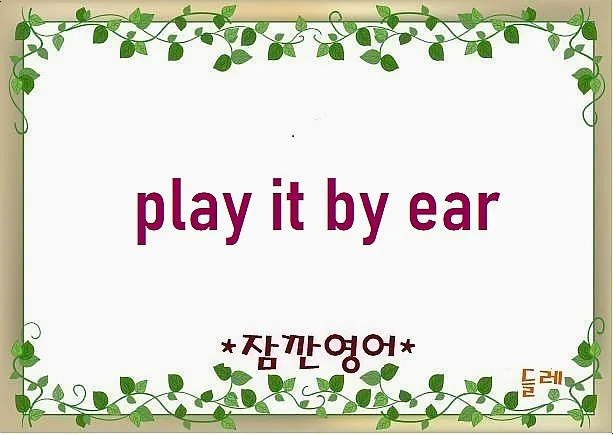
The English idiom 'play it by ear' means to make decisions flexibly based on the situation, rather than sticking to a pre-set plan. Originating from musical improvisation without sheet music, it's now commonly used to describe an adaptable, spontaneous approach to life's challenges.
What Exactly Does 'Play It By Ear' Mean? (2026 Update)
While the literal translation of 'play it by ear' might suggest musical performance, its actual usage in English is much broader. It signifies a decision-making process that's not bound by rigid plans or schedules. Instead, it involves assessing the immediate circumstances and making spontaneous judgments. For instance, when discussing weekend plans, someone might say, 'Let's just play it by ear,' meaning they'll decide closer to the date based on how they feel or what opportunities arise. Similarly, in a meeting, saying 'I'll play it by ear' implies you'll adapt your contribution based on the flow of the discussion. This expression highlights a modern communication style that values adaptability and responsiveness to unexpected situations, rather than strict adherence to a predetermined course of action. Many native English speakers prefer this flexible approach when faced with uncertainty.
What's the Fascinating Origin of 'Play It By Ear'?
The roots of this idiom can be traced back to the world of music. In earlier times, before sheet music was widely accessible or standardized, musicians would often perform by listening to a melody and replicating it on their instruments without written notation. This act of playing music solely by listening and improvising was known as 'playing it by ear.' Over time, this musical concept expanded beyond performance. It evolved to describe any situation in everyday life where individuals adapt and make decisions spontaneously, responding to circumstances as they unfold. This musical background lends the phrase 'play it by ear' a sense of creativity and on-the-spot ingenuity.
What Are Some Real-Life Examples of Using 'Play It By Ear'?
This versatile expression can be applied in numerous scenarios. For example, when making weekend plans with friends, you might suggest, 'We don't have a set itinerary for Saturday; let's just play it by ear.' This indicates a desire for spontaneity and flexibility. In a professional context, if asked about your presentation strategy for an upcoming meeting, you could respond, 'I have some ideas, but I'll play it by ear based on the audience's reaction and the discussion.' This reassures others that you're prepared to adapt. Another common use is when dealing with travel arrangements, where unexpected delays or changes might necessitate a 'play it by ear' approach to navigating the situation. It's a practical way to communicate your willingness to go with the flow and make the best of whatever comes your way.
What Are Similar English Expressions to 'Play It By Ear'?
Several English phrases convey a similar sense of spontaneity and adaptability. 'Improvise' means to create or perform spontaneously without preparation. 'Wing it' is a more informal expression for doing something without proper preparation, relying on luck or instinct. While these terms share common ground, 'play it by ear' specifically emphasizes the act of making decisions based on the unfolding situation, often implying a relaxed or less pressured approach compared to 'winging it.' It suggests a thoughtful, albeit spontaneous, assessment of the current context to guide actions, making it a nuanced choice for communicating flexibility.
For more details, check the original source below.