Many US learners wonder how to clearly and naturally express important decisions in English writing. Especially when explaining past choices and their outcomes, it's crucial to convey your intentions effectively without grammatical errors. This guide breaks down the process into four key steps for better fluency.
English Writing: What Decision Did You Make?
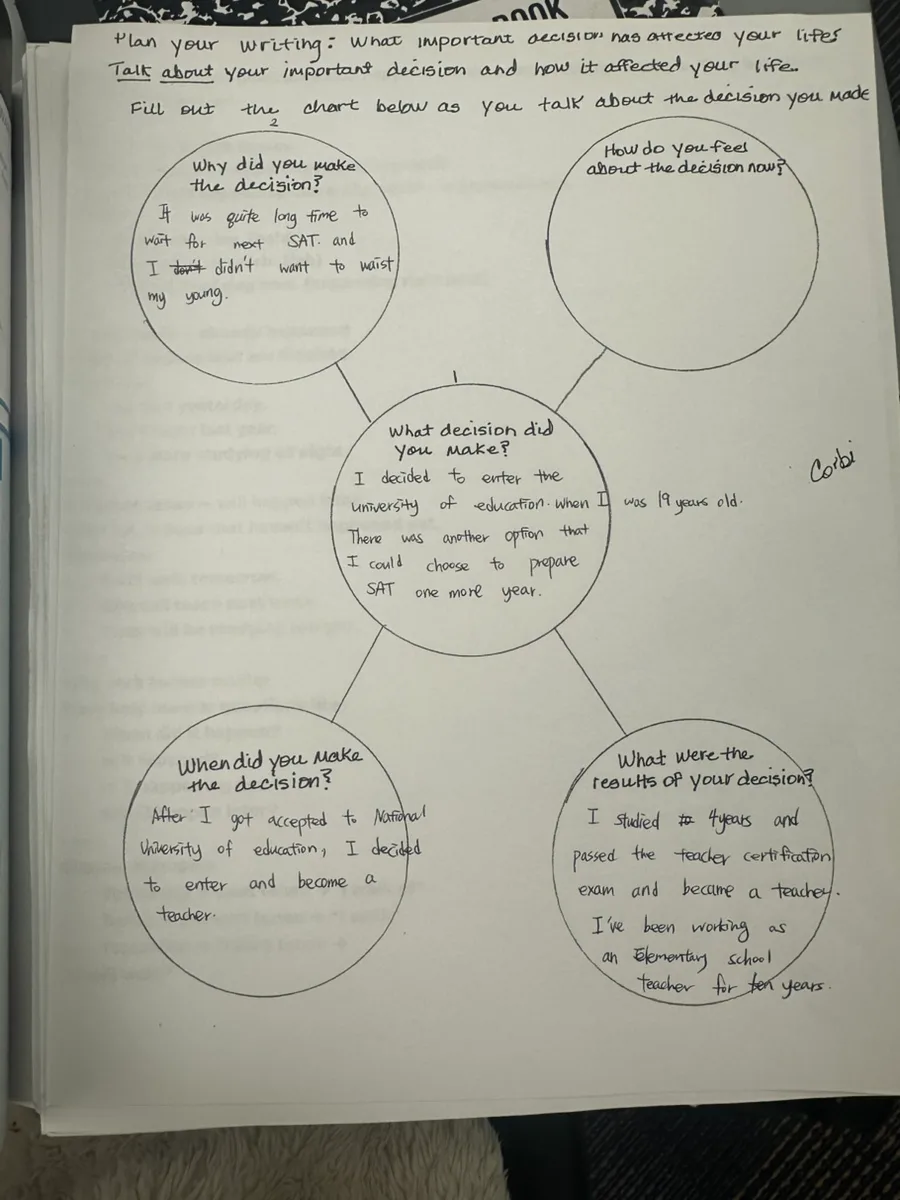
When explaining a significant past decision in English, you need more than just a simple statement of facts. For instance, imagine recounting your decision at age 19 to enter a university of education. You can make your choice more persuasive by clarifying that you had the option to prepare for the SAT for another year. Instead of just saying, 'I decided to enter the university of education,' be precise: 'I decided to enter a university of education.' Pay attention to article usage (like 'a' before 'university') and prepositions (like 'prepare for the SAT' instead of just 'prepare SAT'). Refining this to 'Instead of retaking the SAT, I chose to start university right away' conveys a clearer, more compelling message to your reader.
Reason for the Decision: Why That Choice?
Balancing emotional and logical aspects is key when explaining the reasons behind a major decision. For example, expressing that you didn't want to wait too long for the next SAT and waste your youth requires careful wording. Common errors include using 'quite long time' instead of 'quite a long time,' or 'for next SAT' instead of 'for the next SAT.' Also, 'waist' should be 'waste,' and 'my young' should be 'my youth.' A more polished sentence reads: 'It would have taken quite a long time to wait for the next SAT, and I didn’t want to waste my youth.' The most natural way to convey this is often by focusing on the core idea: 'I didn’t want to spend another year just preparing for the SAT,' clearly showing your desire for efficient time management.
Timing of the Decision: When Did You Decide?
Specifying when you made a decision is essential for narrative flow. If you're explaining your resolve to become a teacher after being accepted into a national university of education, clarity is vital. A sentence like, 'After I got accepted to National University of education, I decided to enter and become a teacher,' needs refinement. Use 'a national university of education' and consider a more natural phrasing than 'decided to enter and become.' A better version is: 'After I was accepted to a national university of education, I decided to enroll and pursue a career as a teacher.' This phrasing highlights not just enrollment but a concrete career goal, demonstrating your conviction.
Outcome of the Decision: What Happened Next?
When describing the results of your decisions, grounding your narrative in specific facts and experiences is crucial. For instance, if you studied for four years, passed the teacher certification exam, and have been working as an elementary school teacher for ten years, present it clearly. Correct common mistakes like 'studied to 4 years' to 'studied for four years.' In essays, it's standard to write numbers as words, so use 'four' instead of '4.' Structuring the sentence clearly is also important: 'I studied for four years, passed the teacher certification exam, and became a teacher. I have been working as an elementary school teacher for ten years.' This clearly showcases your dedication and consistency in your chosen profession.
Tags
💬Frequently Asked Questions
What are the most common mistakes when explaining decisions in English writing?
How can I effectively explain the reason for a decision in English?
What expressions should I use to describe the outcome of a decision in English?
Original Source
Read the Korean original