Mastering practical English phrases from books like 'The Wimpy Kid 3' can significantly boost your conversational skills. Understanding common idioms such as 'take one's anger out on ~' is key to sounding more natural and fluent in everyday English conversations.
What are common English phrases for revenge and anger in 'The Wimpy Kid 3'?
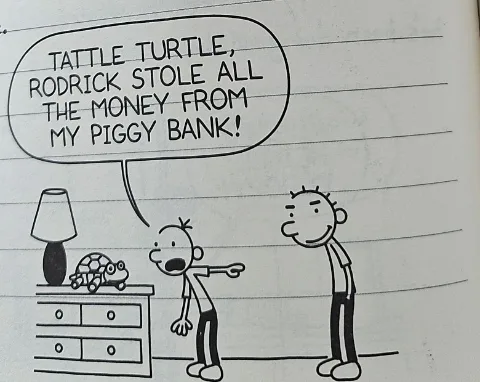
Pages 101-104 of 'The Wimpy Kid 3' feature various English phrases that describe character conflicts and emotional expressions. For instance, 'to get revenge on someone' is expressed as 'get one’s revenge (on ~)', as seen in the example 'He got his revenge on me.' The phrase 'take one's anger out on ~' is frequently used to describe venting frustration onto someone or something else, which is a common scenario in daily life. This idiom is particularly useful for vividly portraying situations where someone redirects their stress or anger towards another target. Reading authentic English materials like 'The Wimpy Kid' series offers a fun and effective way to expand your practical English vocabulary beyond textbook examples.
What are useful English phrases for casual chat and permission in everyday conversation?
In 'The Wimpy Kid 3', you'll also find expressions that capture enjoyable conversations with friends or the approval needed for important decisions. To 'chat casually with someone' can be translated as 'gab with ~', used in sentences like 'She was gabbing with her friends.' to describe relaxed conversations. Furthermore, the concept of 'permission' or 'approval' to proceed with something is often conveyed using the idiom 'green light'. For example, 'They gave me the green light.' signifies that a project or plan has been officially approved. Incorporating these frequently used native expressions into your vocabulary will greatly enhance your English speaking abilities.
How are English phrases for 'telling on someone' and 'futile actions' used in 'The Wimpy Kid 3'?
Certain scenes in 'The Wimpy Kid 3' depict situations where characters try to hide misbehavior or where an action proves to be ineffective. The act of 'telling on someone' is commonly expressed as 'tell on ~', as in the phrase 'Don’t tell on me.', which clearly conveys a child's plea to keep a mistake a secret. Additionally, when emphasizing that an action is unhelpful or serves no purpose, the phrase 'get someone anywhere' is often used in its negative form. For instance, 'It won’t get you anywhere.' means that the action or effort will be fruitless, serving as a critique of inefficient behavior. Understanding the context in which these phrases are used is crucial for accurate comprehension and application.
What should be kept in mind when learning English phrases from 'The Wimpy Kid 3'?
When studying phrases from 'The Wimpy Kid 3', it's essential to go beyond simply memorizing word meanings and focus on understanding how they function within the actual context of a sentence. Expressions like 'should have p.p' are used to convey regret about past actions, as in 'I should have known.', meaning 'I should have been aware.' This structure is highly useful for expressing disappointment or hindsight regarding past decisions. Another valuable phrase is 'That threw me for a second.', which means 'It confused me for a moment' or 'It caught me off guard,' indicating an immediate reaction to an unexpected situation. Engaging with diverse examples in the 'Wimpy Kid' books is an effective way to internalize these expressions. Tailoring your learning approach to your personal English goals and proficiency level, and seeking guidance from language experts if needed, are also beneficial strategies.
Discover more essential phrases from 'The Wimpy Kid 3'.