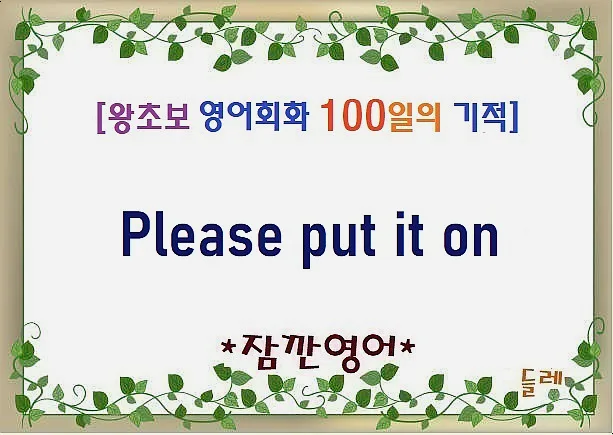
In 2026, 'Please put it on' is the fundamental English phrase used to instruct or suggest wearing an item of clothing or accessory. For instance, 'Put your pants on' is how you'd say '바지 좀 입어.' In specific contexts like seatbelts, more precise phrases like 'Fasten your seat belt' or 'Buckle up' are preferred. Understanding these nuances is key for effective communication.
When and How to Use 'Please Put It On'
'Please put it on' is widely used to encourage or direct someone to wear something. It applies to a variety of items including clothing, hats, glasses, and accessories, making it a versatile phrase for everyday conversations. For example, on a cold day, you might tell a child, 'Please put on your scarf.' It can also be used in a complimentary way, like telling a friend who bought a new outfit, 'It looks great on you! Please put it on.' When speaking, emphasize 'Please,' 'put,' and 'on' for a natural flow, sounding like 'pleez poo-rit-on.' This expression can extend beyond just wearing clothes; it can imply preparing for a specific situation. For instance, you might encourage a colleague before an important presentation by saying, 'Please put it on,' meaning 'Be confident' or 'Be ready.'
'Wear' vs. 'Put On': What's the Difference?
Related Articles
'Wear' and 'put on' are the most common English verbs for dressing. While both relate to clothing, they emphasize different aspects. 'Wear' typically describes a current state or a habit of wearing something. For example, 'I wear glasses' indicates you are currently wearing them, and 'She is wearing a blue dress' describes her current attire. In contrast, 'Put on' emphasizes the action of starting to wear something. 'Please put on your jacket' is a directive to begin the action of putting on the jacket. Therefore, 'Please put it on' specifically refers to the act of wearing. Understanding this distinction allows for more precise and natural English communication. For instance, 'I wore a suit to the party' implies you were dressed in a suit at the party, while 'I put on a suit for the party' means you started the action of dressing in a suit for the event.
Beyond 'Please Put It On': Seatbelt Expressions
While 'Please put it on' can convey the meaning of fastening a seatbelt, more specific and commonly used phrases exist. The most frequent expression is 'Fasten your seat belt,' which precisely instructs the action of securing the belt. A more colloquial and concise alternative is 'Buckle up,' often heard in announcements on airplanes or in cars. For example, flight attendants typically say, 'Please fasten your seat belt' or 'Please buckle up' before takeoff. These phrases are used for clarity in safety-critical situations. Although 'Please put it on' is generally understood, 'Fasten your seat belt' or 'Buckle up' are considered more appropriate for seatbelt usage.
Important Considerations for 'Please Put It On'
'Please put it on' is a useful phrase, but there are a few points to keep in mind. Firstly, it's primarily used for items worn on the body, like clothing or accessories. While you can say 'Put on your shoes,' simply saying 'Please put it on' might confuse the listener about what item to wear. In such cases, specifying the item, like 'Please put on your shoes,' is clearer. Secondly, as 'put on' signifies the action of wearing, using 'wear' is more natural when asking about or describing a current state. For instance, 'Are you wearing a hat?' is more common than 'Are you putting on a hat?' Lastly, depending on the context, 'Please put it on' can sound a bit too direct. In formal settings or when speaking to someone for the first time, more polite alternatives like 'Would you mind putting it on?' or 'Could you please wear this?' are recommended. Considering these nuances will help you choose the most appropriate expression for any situation.
For more details, check the original source below.