
Mastering the English names for facial features is essential for anyone learning Korean or looking to describe appearances more accurately. This 2026 guide breaks down the English terms for everything from your forehead to your chin, providing practical examples for everyday conversation and self-introduction.
What Are the English Names for Major Facial Features?
Our faces are composed of many intricate parts, and knowing the corresponding English terms can significantly enhance your ability to introduce yourself or describe others. Key English facial feature names include: 'forehead' for the area above your eyebrows, 'temple' for the sides of your head, 'nose' for the central feature, and 'nostril' for each nasal opening. We also have 'mouth' for the entire oral cavity, 'lip' for the fleshy parts, and 'ear' for hearing organs. The 'cheekbone' defines the prominence of the cheek, while 'cheek' refers to the fleshy part of the face below the eyes. When referring to the chin, 'chin' typically denotes the protruding part at the bottom of the face, whereas 'jaw' encompasses the entire lower jawbone structure, including the jawline. Familiarizing yourself with these terms will greatly aid in describing appearances in English.
How Are Facial Feature Names Used in English Conversation?
English expressions for facial parts appear frequently in everyday dialogue. For instance, saying 'She has a wide forehead' describes someone with a broad forehead, and 'The boy has a strong jawline' highlights a well-defined jaw. To describe dry lips due to cold weather, you might say, 'Her lips were dry because of the cold weather.' Similarly, the action of rubbing one's temple due to a headache can be expressed as, 'He rubbed his temple because he had a headache.' Practicing the application of these words in real-life scenarios is crucial for fluency.
What Are Common English Expressions for Describing the Face?
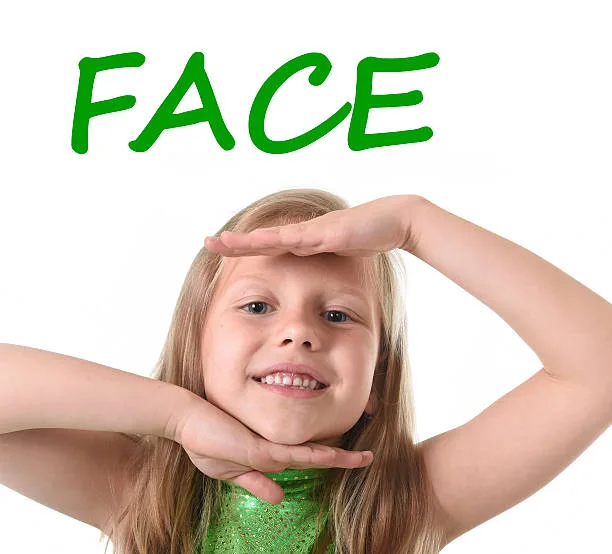
There are various English expressions you can use to describe facial characteristics. For eyebrows, the term is 'eyebrow,' for eyes, it's 'eye,' for eyelashes, it's 'eyelash,' and for the upper or lower part of the eye, it's 'eyelid.' If you want to describe a prominent nose, you could say, 'He has a high nose bridge.' 'Chubby cheeks' describes full cheeks, while a slim or oval face can be referred to as a 'slim face' or 'oval face.' Wrinkles are called 'wrinkles,' moles are 'moles,' and scars are 'scars.' Utilizing these specific terms allows for richer and more precise descriptions of physical appearance.
What Should You Be Mindful of When Learning English Facial Expressions?
When learning English expressions related to facial features, keep a few points in mind. Firstly, understanding the precise meaning and nuance of each word is vital. For example, while both 'chin' and 'jaw' relate to the lower part of the face, they refer to different areas. Secondly, learning how these terms are used in actual conversations through example sentences is highly effective. Seeing them in context aids comprehension far better than rote memorization. Lastly, when describing someone's appearance, always consider the context and situation to avoid causing offense. Be particularly cautious with negative descriptions; opting for positive or neutral phrasing is generally advisable. By keeping these considerations in mind and practicing consistently, you can confidently use English facial expressions.
For more details on English face terminology, check the original source below.





