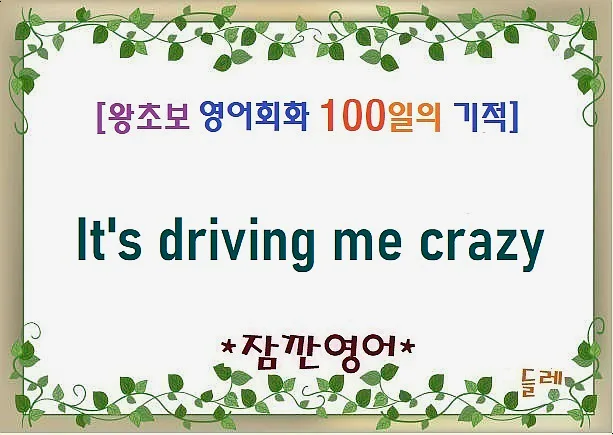
Want to express everyday stress and frustration in Korean? While not a direct Korean phrase, understanding common English expressions like 'It's driving me crazy' is key for learners. This phrase goes beyond a literal translation, conveying intense frustration or mental strain from recurring annoyances. Mastering its usage will significantly boost your conversational English skills, especially when engaging with K-dramas or K-pop lyrics.
What Does 'It's Driving Me Crazy' Really Mean?
The English phrase 'It's driving me crazy' uses the verb 'drive' in a less common sense: to compel someone into a particular state. The structure 'drive + person + adjective' emphasizes that a specific situation or thing is pushing you towards a state of mental distress, annoyance, or extreme frustration. It's not usually about literal insanity, but rather about the cumulative effect of persistent annoyances. For instance, if you're constantly bothered by spam calls, you might say, 'Spam calls are driving me crazy.' This effectively communicates everyday frustrations to English speakers, a skill invaluable for Korean learners immersing themselves in English media.
When Is 'It's Driving Me Crazy' Used?
This versatile expression applies to a wide range of stressful everyday situations. Imagine being unable to sleep due to loud construction noise late at night; you could exclaim, 'This noise is driving me crazy!' to express your displeasure. Similarly, if you're anxiously awaiting important results, saying 'Waiting for the results is driving me crazy' conveys your impatience and stress. It's also useful when someone repeatedly tells the same joke or engages in a behavior that grates on your nerves. Using this phrase clearly communicates your discomfort to others, making it a powerful tool for expressing feelings in English.
What Are Similar English Expressions?
Several other English phrases convey similar sentiments. 'I'm so fed up with this' expresses a strong sense of being tired of a situation, akin to 'I've had enough.' 'This is so annoying' is a more casual way to state irritation. 'I can't stand it anymore' signifies reaching the limit of one's tolerance. While these are related, 'It's driving me crazy' specifically highlights the mental or psychological pressure a situation is exerting. Understanding these nuances helps you choose the most fitting expression for your specific emotional state, enhancing your fluency and naturalness in English conversations.
What Should You Consider When Using 'It's Driving Me Crazy'?
Because 'It's driving me crazy' expresses strong emotions, it's crucial to consider the context and your audience. Overusing it or employing it in inappropriate situations can create a negative impression, making you seem emotionally volatile. For minor inconveniences or small mistakes, using such a strong phrase might seem disproportionate. Additionally, while common in spoken English and informal settings, it's generally advisable to use more formal language in professional writing or official situations. Therefore, always assess the relationship with the listener and the overall atmosphere of the conversation before using this expression to ensure effective and considerate communication.
Learn more English expressions by checking the original source.