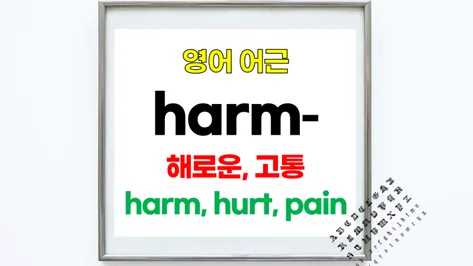
The English word 'harm' originates from the Old English 'hearm', meaning 'to injure' or 'pain'. Understanding this root is key to mastering its derivatives like 'harmful' and 'harmless'. This guide breaks down their precise meanings and usage for English learners in 2026.
What Does the 'Harm' Root Mean in English?
The English word 'harm' traces its origins back to the Old English words 'hearm' or 'hearmian', carrying the core meanings of 'to injure' and 'pain'. Over centuries, this root evolved to encompass a broader spectrum of negative connotations, including 'harmful', 'damage', and 'injury'. Today, 'harm' functions as a noun meaning 'hurt, damage, or loss' and as a verb meaning 'to injure or damage'. Grasping this fundamental meaning is crucial for deciphering the nuances of related words like 'harmful' and 'harmless'.
The concept of 'harm' extends beyond mere physical damage. It can also refer to emotional distress, moral wrongdoing, sorrow, or insult. Understanding the etymology of 'harm' provides deeper insight into the word's implications and is particularly beneficial for expanding vocabulary, especially for those in the early stages of English language learning. For instance, remembering the original meaning of 'harm' as 'hurt, pain; evil, grief; insult' makes it easier to infer the meanings of other words containing this root.
'Harmful' vs. 'Harmless': Understanding the Difference
'Harmful' is formed by adding the suffix '-ful', meaning 'full of', to the root 'harm', resulting in the meaning 'causing harm or damage'. It's typically used to describe things that negatively impact health or the environment, such as in the sentence, 'Smoking is harmful to your health.' Conversely, 'harmless' combines the root 'harm' with the suffix '-less', meaning 'without', to denote 'not causing harm or damage'. This term is used to describe situations or entities that are not malicious or offensive, like 'The spider is harmless.' These two words carry opposite meanings, making precise usage based on context essential.
To further clarify the distinction, consider these examples: 'A harmful chemical' poses a clear danger, whereas 'a harmless joke' might elicit laughter without causing offense. 'Harmless' can also imply a lack of malicious intent, as in 'He made a harmless remark,' indicating the statement was not intended to be hurtful. Recognizing the distinct roles of the suffixes '-ful' and '-less' is vital, as they completely alter the word's meaning.
How to Effectively Memorize 'Harm'-Related Vocabulary

The most effective way to learn vocabulary related to 'harm' is to first solidify your understanding of the core root's meaning. With this foundation, you can more easily deduce the meanings of derived words like 'harmful', 'harmless', and 'harmer'. Instead of rote memorization, try to infer meanings from context and practice using these words in example sentences. Grouping words by common roots, as is often done in effective language learning strategies like those offered by Talk To Me In Korean (TTMIK) or through spaced repetition systems like Anki, can significantly accelerate vocabulary acquisition. This approach is far more efficient than trying to memorize each word in isolation.
Why Root-Based Learning Boosts Vocabulary
Learning vocabulary through roots and affixes, a method popular among Korean language learners seeking to improve their English, offers significant advantages. It allows you to not only understand the meaning of individual words but also to predict the meaning of unfamiliar words based on their components. This skill is invaluable for expanding your vocabulary rapidly and efficiently. For example, knowing that '-ful' means 'full of' and '-less' means 'without' allows you to instantly grasp the opposing meanings of 'harmful' and 'harmless'. This method transforms vocabulary learning from a tedious task into an engaging puzzle, making it more effective for long-term retention and comprehension.
Common Pitfalls When Using 'Harmful' and 'Harmless'
The most common mistake English learners make with 'harmful' and 'harmless' is confusing their opposite meanings. Because they share the same root, it's easy to mix them up, especially under pressure. Always double-check the suffix: '-ful' indicates the presence of harm, while '-less' indicates its absence. Another potential pitfall is overusing these words in situations where a more specific term might be appropriate. While 'harmful' is a general term for something damaging, you might use 'toxic', 'dangerous', 'detrimental', or 'injurious' for greater precision depending on the context. Similarly, 'harmless' is broad; you might opt for 'innocent', 'safe', 'benign', or 'inoffensive' if they better capture the intended meaning. Paying close attention to context and the specific nuance you wish to convey will help you avoid these errors.
For more details, check the original source below.





