
Mastering English determiners, including articles like 'a,' 'an,' and 'the,' is crucial for fluency. In 2026, understanding these essential words will elevate your Korean language learning journey, making your English sound more natural and precise to native speakers. This guide breaks down determiners, from basic articles to possessives, offering expert insights for learners.
What Are Determiners and Why Are They Important for Korean Learners?
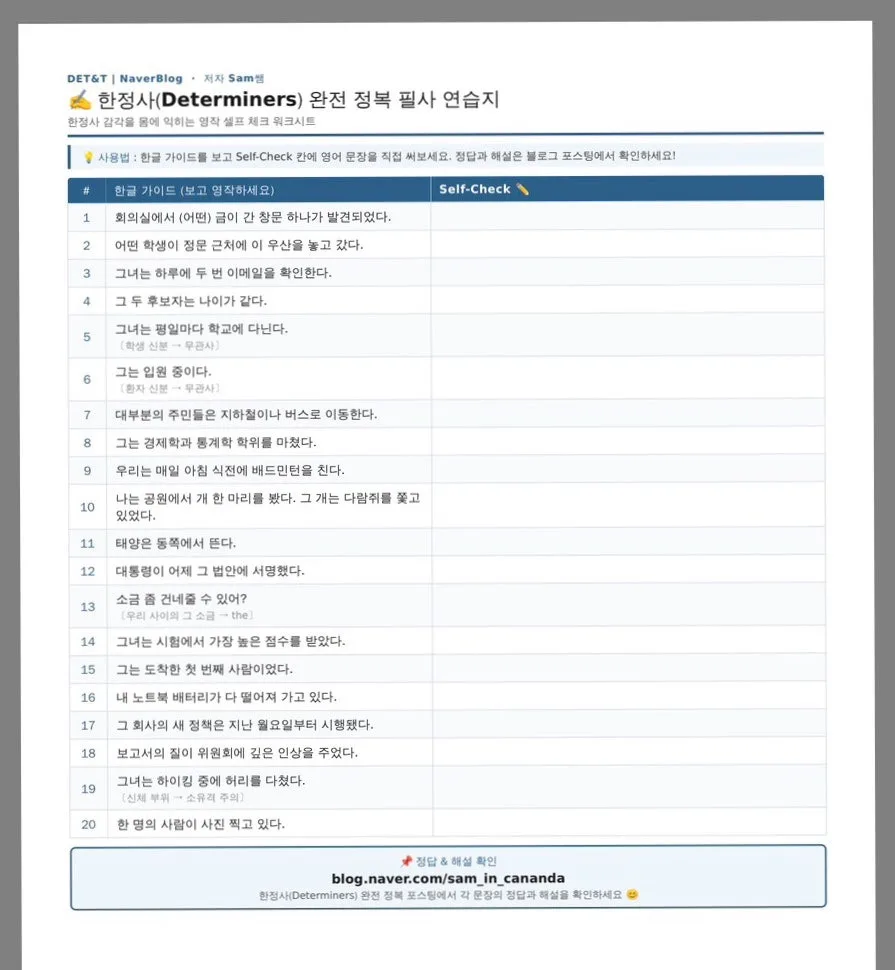
Determiners are words that precede nouns to provide specific information about quantity, specificity, or possession. They function as a crucial bridge between your thoughts and the nouns that express them. For Korean learners, grasping determiners is vital because English relies heavily on them to convey meaning. Unlike Korean, which often omits subjects or objects when context is clear, English requires determiners to specify whether you're talking about a general concept or a specific item. For instance, the Duolingo English Test (DET) frequently assesses determiner usage across various sections like 'Write about a Photo' and 'Read and Complete,' with errors leading to point deductions. Understanding the 'Sam쌤's Cowboy 3-Step Theory' can help: determiners first signal quantity (one, many), then specificity (known, unknown), and finally possession (mine, yours). This systematic approach clarifies which determiner to use before a noun, significantly boosting your comprehension and expression.
'A/An' Mean More Than Just 'One': Exploring Their Nuances
Related Articles
Many learners mistakenly believe 'a' and 'an' solely mean 'one.' However, these indefinite articles carry much richer meanings in English, essential for mastering the language. To excel in tests like the DET, understanding the four primary senses of 'a/an' is key. Firstly, they denote 'arbitrariness,' referring to any unspecified item, like in 'A cracked window was found,' meaning some window, not a specific one. Secondly, they indicate an 'unspecified subject,' such as in 'A student left this umbrella,' implying any student. Thirdly, 'a/an' signifies distribution or rate, meaning 'per' or 'each,' as in 'twice a day' (twice per day). Finally, they can express 'identity' or sameness, similar to 'of the same age.' For DET's 'Write about a Photo,' practicing starting sentences with 'A person is...' or 'A building is...' helps avoid common errors like omitting the article or using 'the' incorrectly.
When to Use the Zero Article (No Article) and Avoid Errors
While articles are often necessary, there are specific situations where omitting them—using the zero article—is correct and even required. A primary instance is when referring to the 'original purpose' of a place. For example, 'She goes to school' implies she attends as a student, whereas 'She goes to the school' might mean she's visiting the building for another reason. Similarly, 'He is in hospital' refers to being a patient, while 'He is in the hospital' suggests visiting someone. Other common uses for the zero article include modes of transportation ('by subway'), academic subjects ('study history'), and names of sports or meals ('play soccer,' 'have breakfast'). Understanding these exceptions is crucial for accurate English communication and performing well on standardized tests.
DET Exam Focus: Common Determiner Errors and How to Avoid Them
The Duolingo English Test (DET) places significant emphasis on determiner accuracy. Errors in articles and other determiners can appear in various question types, impacting your score. Common mistakes include omitting 'a/an' before singular countable nouns, using 'a' instead of 'the' when specificity is required, or vice-versa. For instance, in 'Write about a Photo,' describing a scene might involve identifying specific objects ('the car') versus general types ('a car'). In 'Read and Complete,' filling in blanks often requires choosing the correct article based on context. To prepare, focus on identifying whether a noun is specific or general, known or unknown to the listener/reader, and whether it's singular or plural. Practicing with exercises that specifically target these determiner nuances will significantly improve your performance on the DET and overall English proficiency.
Possessive Determiners: Clarifying Ownership in English
Possessive determiners, such as 'my,' 'your,' 'his,' 'her,' 'its,' 'our,' and 'their,' are essential for clearly indicating ownership or association with a noun. They function similarly to articles by specifying which noun is being discussed. For example, instead of saying 'a book,' you would say 'my book' to show it belongs to you. This distinction is vital in English, where clarity of possession is often expected. In Korean, possessive markers like '-의' (ui) are used, but the structure differs. Mastering possessive determiners helps avoid ambiguity and makes your English more precise. They are frequently tested in contexts requiring descriptive writing or sentence completion, ensuring you can accurately attribute items or concepts to their rightful owners.
For more details, check the original source below.





