Mastering the nuances of expressing 'want to' in Japanese is crucial for beginners. This 2026 guide breaks down the difference between したい (shitai) and しようと思う (shiyou to omou) to instantly boost your basic Japanese conversation skills.
Japanese 'Want To': What's the Difference Between したい and しようと思う?
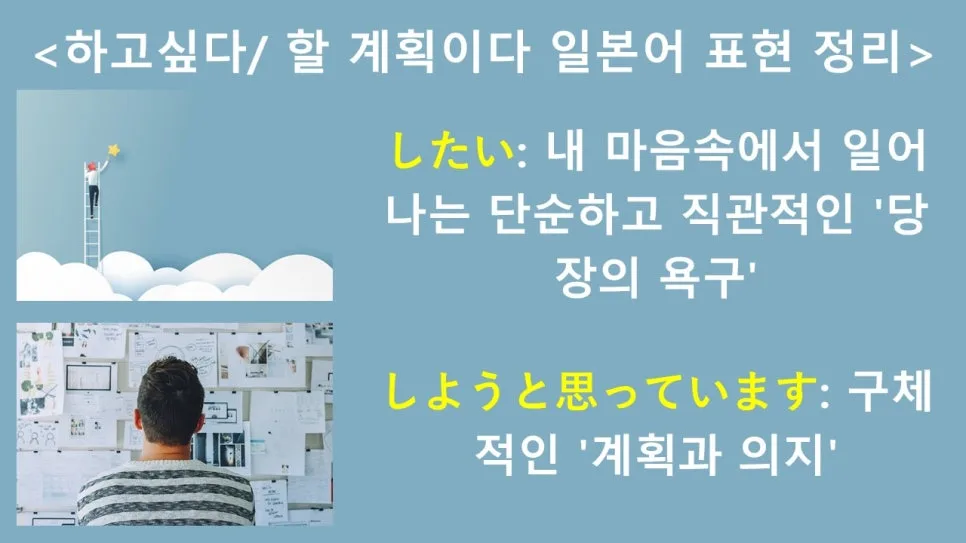
One of the first expressions Japanese learners encounter is how to say 'I want to do something.' However, many beginners mistakenly use only したい (shitai) and miss the subtle but important differences between it and しようと思う (shiyou to omou). In everyday Japanese, these two phrases carry distinct meanings and are used in different contexts. したい expresses an immediate, spontaneous desire or wish originating from within oneself. In contrast, しようと思う is used when you've been considering something, have made a concrete plan, or have decided with a sense of resolve. Clearly understanding this distinction is key to elevating your foundational Japanese conversation skills. For example, if you suddenly crave ice cream, you'd say 'I want to eat ice cream' (アイスクリームが食べたい - aisukuriimu ga tabetai). But if you've planned to meet a friend on the weekend, you'd naturally say 'I plan to meet a friend on the weekend' (週末に友達に会おうと思う - shuumatsu ni tomodachi ni aou to omou). Remember, したい leans towards momentary feelings and desires, while しようと思う focuses on more concrete plans and intentions.
Japanese Verb Conjugation: Mastering the ます (Masu) Form
To effectively use Japanese verbs, mastering the conjugation to the ます (masu) form is essential. Japanese verbs are broadly categorized into three groups: Group 1, Group 2, and Group 3. Each group follows a different set of rules for this conjugation. Group 1 verbs, also known as godan verbs, typically end in a 'u' sound. To change them to the masu form, you change the final 'u' sound to its corresponding 'i' sound and add 'masu'. For instance, the verb 'iku' (to go) becomes 'ikimasu' (I go/will go). Group 2 verbs, or ichidan verbs, usually end in 'ru'. For these, you simply drop the final 'ru' and add 'masu'. For example, 'taberu' (to eat) becomes 'tabemasu' (I eat/will eat). Group 3 verbs are irregular and consist of only two verbs: 'suru' (to do) and 'kuru' (to come). These conjugate to 'shimasu' (I do/will do) and 'kimasu' (I come/will come), respectively. Understanding these conjugation rules is a fundamental step in Japanese language learning, and with consistent practice, you'll naturally become proficient.
Expressing Instinctive Desires: How to Use Japanese したいです
The Japanese expression したいです (shitai desu) is incredibly useful for conveying your immediate desires or wishes. This phrase is appropriate when you want to express a simple 'I want to do X right now' without any specific plans or deep contemplation. For instance, if you're feeling hungry, you might say 'I want to eat' (食べたいです - tabetai desu). If you feel like watching a movie, you'd say 'I want to watch a movie' (映画が見たいです - eiga ga mitai desu). It's important to note that while したいです expresses a desire, it doesn't necessarily imply a concrete plan to fulfill that desire. It's more about the feeling itself. For more complex situations involving plans or intentions, しようと思う is the more suitable expression.
Planning and Intention: Using しようと思う in Japanese
When you've moved beyond a simple desire and are considering a future action or have made a decision, しようと思う (shiyou to omou) becomes the go-to phrase. This expression signifies a plan, an intention, or a resolve to do something. It implies that you've thought about the action and have decided to proceed. For example, if you've decided to study Japanese diligently this year, you would say 'I intend to study Japanese diligently this year' (今年は日本語を一生懸命勉強しようと思う - Kotoshi wa Nihongo o isshoukenmei benkyou shiyou to omou). It's often used to communicate your future actions or decisions to others. Unlike したい, which can be a fleeting feeling, しようと思う suggests a more deliberate mental process. This phrase is crucial for discussing future plans and commitments in Japanese conversations.
Common Pitfalls and Tips for Japanese Learners
A common mistake for beginners is using したい for all situations where they want to express a desire. While したい is correct for immediate wants, using it for planned actions can sound immature or even incorrect. For instance, saying 'I want to go to Japan' (日本に行きたい - Nihon ni ikitai) is fine if it's a general wish, but if you've already booked your tickets and are set on going, you might say 'I plan to go to Japan' (日本に行こうと思う - Nihon ni ikou to omou). Another tip is to pay attention to the particles used. While したい often follows the object with が (ga), it can sometimes be used with を (wo) depending on the nuance. For しようと思う, the particle を (wo) is more commonly used with the object of the intended action. Understanding these subtle differences will greatly enhance your fluency and accuracy in Japanese.
For more details, check the original source below.





