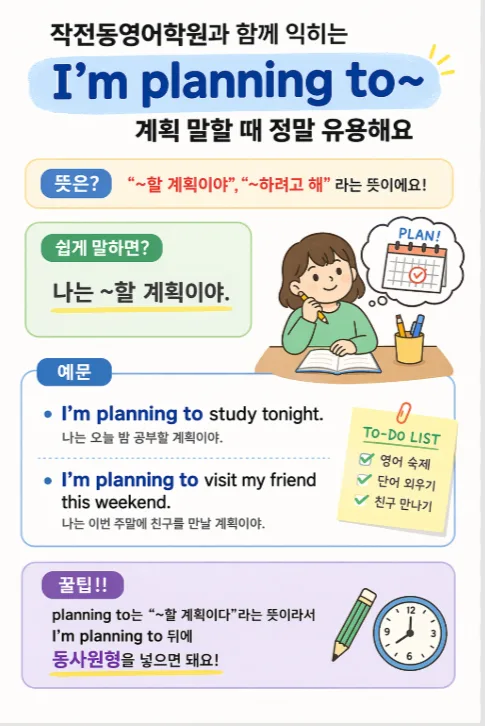
The English phrase 'I'm planning to~' is your go-to for expressing future intentions and plans, translating to '~할 계획입니다' in Korean. It's an essential tool for naturally communicating your schedule, goals, and upcoming events in everyday conversations, making it a key phrase for English learners aiming for fluency.
What Exactly Does 'I'm Planning To~' Mean?
'I'm planning to~' translates to 'I'm going to plan' or 'I intend to do,' signifying future actions. This phrase follows the structure 'I'm planning to + base verb,' allowing you to clearly convey future plans without complex grammar. For instance, 'I'm planning to study English tonight' is a practical example you can use immediately. Utilizing this expression helps you easily inform others about your intentions, significantly boosting your English speaking skills. It's particularly useful for discussing weekend activities, academic goals, travel arrangements, or fitness objectives, making it highly adaptable for beginners looking to improve their conversational English.
What Are Similar Expressions to 'I'm Planning To~', and How Do They Differ?
A common phrase similar to 'I'm planning to~' is 'I'm going to~.' Both express future plans, but 'I'm going to~' is more general, while 'I'm planning to~' emphasizes that a plan has been made. For example, 'I'm going to study tonight' simply states a future action, whereas 'I'm planning to study tonight' implies a deliberate decision and preparation. While both are grammatically correct, using 'I'm planning to~' adds nuance when you want to highlight the specificity or intention behind your plan. This distinction is crucial for more precise communication, especially when discussing scheduled events rather than spontaneous decisions. For instance, when talking about long-term goals like 'I'm planning to save more money this year,' this phrase effectively conveys a deliberate strategy.
What Are Effective Ways to Master the 'I'm Planning To~' Phrase?
Consistent daily practice is key to mastering 'I'm planning to~.' Try converting your own plans into English sentences three times a day. Start with simple intentions, like 'I'm planning to drink more water today' upon waking up. You can also practice with everyday goals, such as 'I'm planning to finish my work early.' Focusing on frequently used, simple sentences will build your confidence and fluency more effectively than tackling complex structures initially. This consistent effort is vital for improving your overall English speaking ability and making the phrase a natural part of your vocabulary.
What Should Be Considered When Using the 'I'm Planning To~' Phrase?
When using 'I'm planning to~,' remember it primarily denotes future plans, so it's best suited for discussing upcoming actions rather than established facts. Like 'I'm going to~,' it requires a base verb to follow; 'I'm planning to go' is correct, while 'I'm planning to going' is not. Additionally, if your plans are uncertain or subject to change, consider using alternatives like 'I might~' or 'I'd like to~' for greater accuracy. Being mindful of these points will help you use the 'I'm planning to~' expression more precisely and effectively in your English conversations.
Use the 'I'm planning to~' phrase to confidently express your plans in English.