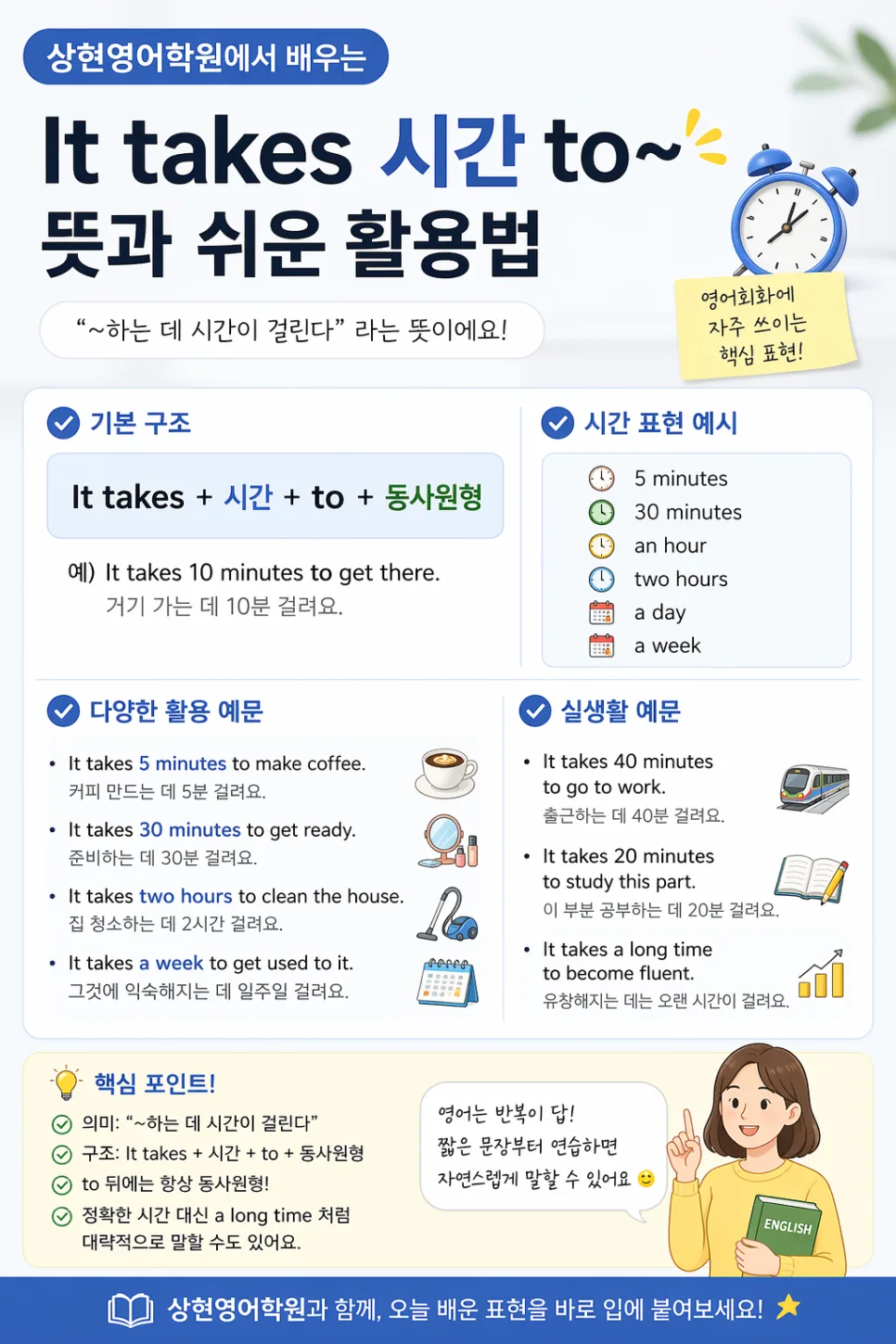
The most common way to express 'it takes time' in English is the 'It takes + time + to + verb' structure. Mastering this pattern will help you speak more fluently in everyday conversations. For example, 'It takes 10 minutes to get there' means it requires ten minutes to reach a destination.
How Long Does It Take? Mastering 'It Takes Time To~'
When you want to say how long something takes in English, using the 'It takes' construction is natural. While Korean might say '시간이 걸린다' (time is taken), English specifies 'It takes' followed by the duration and the action. For instance, 'It takes an hour to finish this work' conveys that completing the task requires one hour. Commonly used time expressions include '5 minutes,' '30 minutes,' 'an hour,' 'two hours,' 'a day,' and 'a week,' which you can plug into the 'It takes' sentence structure.
In real-life scenarios, this phrase is useful for discussing commute times, travel durations, study periods, or preparation times. You can say, 'It takes 40 minutes to go to work,' or 'It takes 20 minutes to study this part.' You can also use approximate terms like 'a long time' when a precise duration isn't necessary, as in 'It takes a long time to become fluent.'
Why is the 'It Takes Time To~' Pattern Important?

The key to this expression is that 'to' must always be followed by the base form of the verb. For example, 'It takes 10 minutes to cook dinner' is the correct and natural way to say it. Many learners get confused about the verb form after 'to,' but remembering to always use the base verb simplifies things. Memorizing fundamental sentences like 'It takes 10 minutes to get there,' 'It takes an hour to finish it,' and 'It takes a lot of time to learn English well' allows for flexible application in similar situations. In English conversation, mastering frequently used patterns like this is more crucial than constructing complex sentences.
How to Practice 'It Takes Time To~' Expressions
The 'It takes time to~' phrase is highly practical for daily conversations, making it beneficial to learn and use immediately. Starting with shorter phrases is an effective practice method. For instance, repeatedly saying 'It takes 10 minutes to~,' 'It takes an hour to~,' and 'It takes a day to~' will make these expressions sound much more natural. English doesn't need to be intimidating; it's best to start with the basics and gradually incorporate practical phrases.
For more details, check the original source below.





