Mastering the Korean present progressive is essential for describing ongoing actions and states, primarily using two key forms: '~go itda' and '~neun jung'. This guide breaks down the differences and proper usage of these common expressions, updated for 2026, to elevate your Korean fluency.
What's the Difference Between Korean Present Progressive '~go itda' and '~neun jung'?
The Korean present progressive tense indicates an action or state currently in progress, mainly expressed through '~go itda' and '~neun jung'. While often interchangeable in everyday conversation, '~go itda' generally describes an ongoing action, whereas '~neun jung' can emphasize being in the middle of a process. For instance, 'Students are reading a book' can be translated as '학생들이 책을 읽고 있습니다' (haksaengdeuri chaegeul ilgo itseumnida) using '~go itda', or '학생들이 책을 읽는 중입니다' (haksaengdeuri chaegeul ingneun jungimnida) using '~neun jung'. Both convey the same meaning in most contexts. Understanding and using both forms will significantly boost your Korean conversational skills.
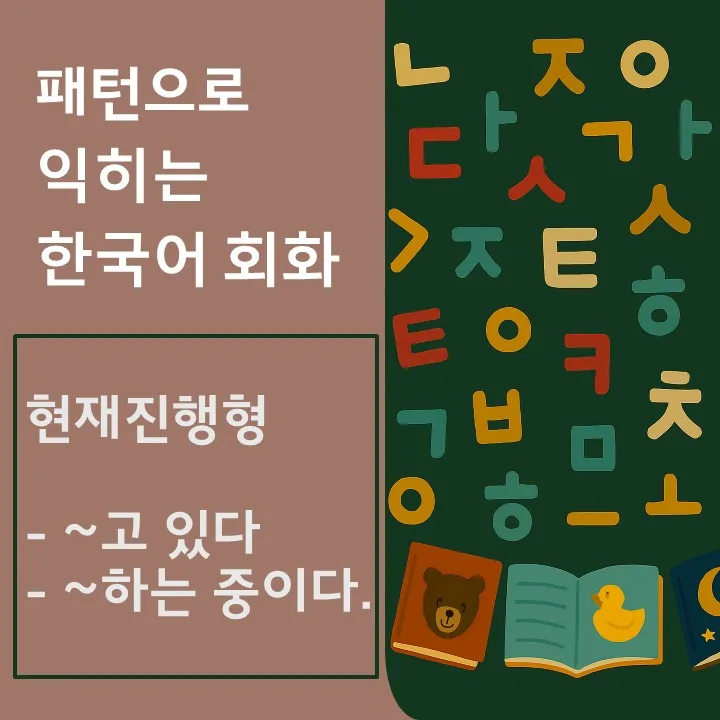
These expressions are invaluable for vividly describing current situations.
Why is Using Present Progressive with State Verbs Awkward in Korean?
Similar to English, Korean tends to avoid using the present progressive tense with 'state verbs'—those describing feelings, conditions, or inherent qualities. Verbs like '좋아하다' (joahada - to like), '알다' (alda - to know), '이해하다' (ihaehada - to understand), and '필요하다' (piryohada - to need) describe continuous states rather than temporary actions. Saying 'I am liking this movie right now' (나는 이 영화를 지금 좋아하고 있다 - naneun i yeonghwareul jigeum joahago itda) sounds unnatural. Instead, the simple present tense, 'I like this movie' (나는 이 영화를 좋아한다 - naneun i yeonghwareul joahanda), is the natural choice. In contrast, 'action verbs' like '읽다' (ikda - to read), '먹다' (meokda - to eat), and '공부하다' (gongbuhada - to study) readily accept the present progressive form. Therefore, distinguishing between verb types is crucial when applying the present progressive.
How Can I Effectively Practice Korean Present Progressive?
To truly master the Korean present progressive, practice combining various action verbs with the '~go itda' and '~neun jung' endings, simulating real conversations. Use common verbs from your Korean classes or study groups to construct sentences. For example, with the verb '하다' (hada - to do), you can create phrases like '공부하고 있다' (gongbuhago itda - studying) or '운동하고 있다' (undonghago itda - exercising), and their '~neun jung' equivalents. Similarly, for '가다' (gada - to go), you can say '학교에 가고 있다' (hakgyoe gago itda - going to school) or '가는 중이다' (ganeun jungida - in the process of going). Consistent practice with diverse verbs and these endings will solidify your understanding and fluency.
Practicing with a variety of verbs significantly enhances your skill development.
What Should I Watch Out For When Using Korean Present Progressive?
The primary pitfall when using the Korean present progressive is the combination with state verbs, as previously mentioned. Using state verbs like '알다' (alda - to know), '가지다' (gajida - to have), or '믿다' (mitda - to believe) in the progressive tense can lead to awkward phrasing or altered meanings. For instance, while 'I know that fact' (나는 그 사실을 알고 있다 - naneun geu sasireul algo itda) is natural, 'I am in the process of knowing that fact' (나는 그 사실을 알고 있는 중이다 - naneun geu sasireul algo inneun jungida) sounds odd. Additionally, when verbs end in certain vowels or consonants, specific conjugation rules apply to ensure natural-sounding Korean. Always ensure your verb conjugations are correct to avoid sounding unnatural to native speakers.
For more details, check the original source below.





