
In 2026, understanding Korean date terms like 'Jak-il' (yesterday), 'Geum-il' (today), and 'Myeong-il' (tomorrow) is crucial for navigating business and formal communication. These terms, along with 'Jeon-il' (the day before), 'Dang-il' (that specific day), and 'Ik-il' (the following day), are based on a reference point, often 'today' or a specific event. Mastering these nuances ensures clear communication and avoids misunderstandings, especially in professional settings.
Jak-il, Geum-il, Myeong-il: Understanding Today-Based Korean Date Terms 2026
You'll often encounter phrases like 'Geum-il jung bogo' (report within today) or 'Myeong-il ho-ui' (meeting tomorrow) in Korean business contexts. These expressions use 'Jak-il', 'Geum-il', and 'Myeong-il' to refer to yesterday, today, and tomorrow, respectively, relative to the current moment. For instance, 'Jak-il' means yesterday, 'Geum-il' means today, and 'Myeong-il' means tomorrow. When you see 'Geum-il cheori wanryo' (complete within today), it means the task must be finished by the end of the current day. These terms are frequently used in official documents and business communications, making their precise understanding vital for preventing misinterpretations and fostering efficient collaboration.
Jeon-il, Dang-il, Ik-il: Precisely Defining Event-Based Korean Date Terms 2026
When referring to dates relative to a specific event or a past date, rather than the current moment, Korean uses 'Jeon-il', 'Dang-il', and 'Ik-il'. 'Jeon-il' signifies the day immediately preceding the reference date, 'Dang-il' is the reference date itself, and 'Ik-il' is the day immediately following it. For example, 'Gyeoyak dang-il' (on the day of the contract) refers to the specific date the contract was made. 'Jumun ik-il baesong' (next-day delivery) means the product will arrive the day after you place your order. These terms are commonly used in contexts involving appointments, contracts, and deliveries, clearly defining timelines relative to a specific anchor point. 'Ik-il' functions similarly to 'tomorrow' but is anchored to a specific event, differentiating it from the general 'Myeong-il'.
Mastering Korean Date Terms: A Complete Guide to Jak-il, Geum-il, Myeong-il, Jeon-il, Dang-il, Ik-il 2026
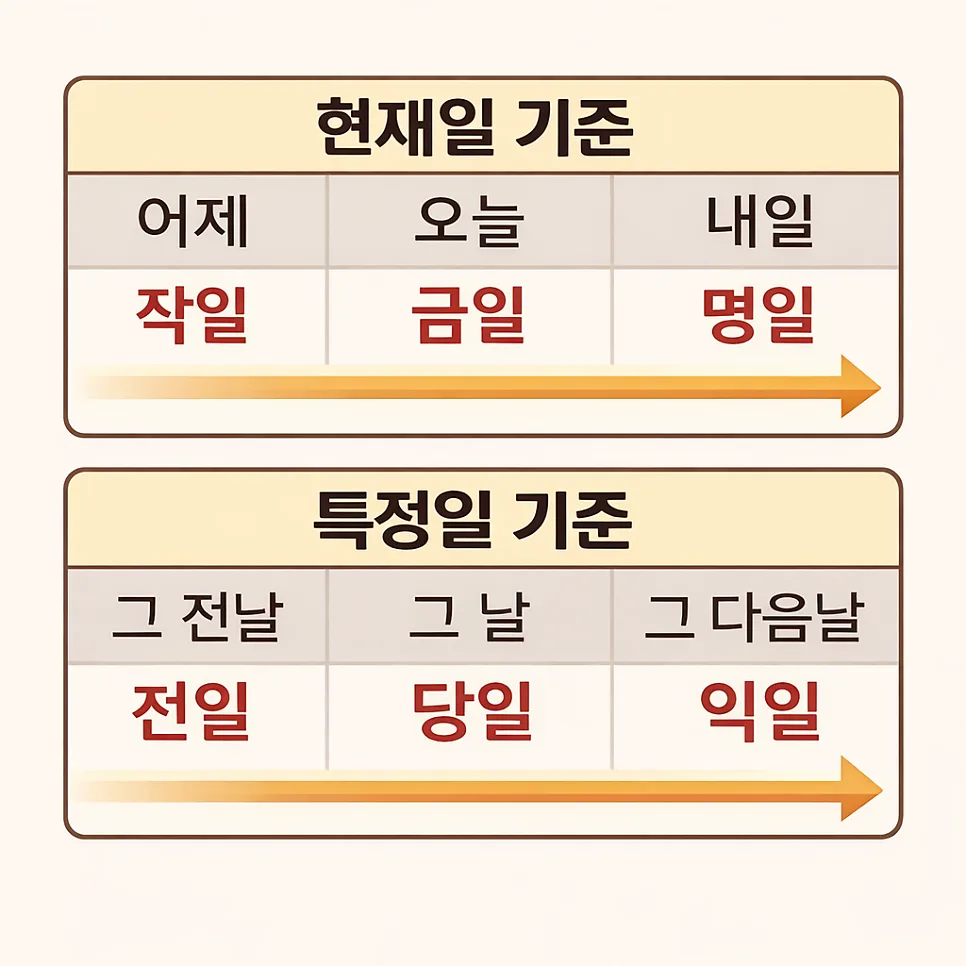
Korean date-related Hanja terms can sometimes be confusing. A common mistake is mistaking 'Geum-il' for Friday; however, 'Geum' (今) means 'now' or 'today', making 'Geum-il' simply 'today'. Similarly, 'Ik-il' is often used like 'tomorrow' but specifically means the day after a reference point, as in 'Jumun ik-il baesong' (delivery the day after ordering). It's crucial to recognize the reference point: 'Jak-il', 'Geum-il', and 'Myeong-il' are based on the present moment, while 'Jeon-il', 'Dang-il', and 'Ik-il' are tied to a specific event or date. Clarifying these distinctions helps minimize confusion in business communications.
Avoiding Pitfalls: Common Mistakes with Korean Date Terminology 2026
The most frequent error when using Korean date terms is confusing 'Geum-il' with Friday. Remember, 'Geum-il' means 'today'. Another point of confusion is 'Ik-il', which, while meaning 'the next day', is typically anchored to a specific event or action, such as in 'Jumun ik-il baesong' (delivery the day after your order). These terms are prevalent in formal documents and business settings, so understanding their precise meanings is essential for professional effectiveness. If you anticipate any confusion, opting for simpler Korean native words like 'eoje' (yesterday), 'oneul' (today), and 'naeil' (tomorrow) can be a safer communication strategy.
Learn the precise usage of Korean date terms for clear communication.





