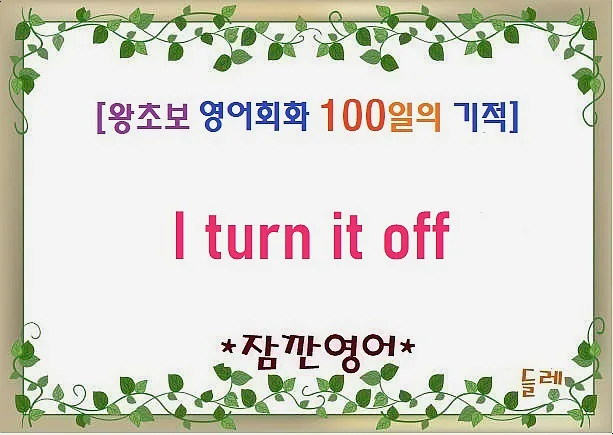
In 2026, the phrase 'I turned it off' has evolved beyond simply indicating an action of switching something off. It's now a versatile expression used to describe the cessation of electronic devices, lights, or even specific functions. This guide will break down its various contexts, from accidental shutdowns to battery-saving measures, and provide clear examples for American English speakers.
What Exactly Does 'I Turned It Off' Mean?
The English phrase 'I turned it off' literally translates to 'I made it into an off state,' but in natural American English, it simply means 'I switched it off.' While the verb 'turn' originally implied rotating a switch, its usage has expanded to encompass any method of shutting down a device, whether by pressing a button, tapping a screen, or using a voice command. This applies to a wide range of electronics like TVs, computers, lights, and air conditioners. It can even be used for actions like closing a faucet. This expression is incredibly common in daily life, making its accurate meaning and usage crucial for effective communication. For instance, 'Please turn off the TV' is a standard request you might hear in public spaces or at someone else's home.
When Do Americans Use 'I Turned It Off'?
In everyday American life, 'I turned it off' is used in numerous situations. The most frequent scenario involves powering down electronics that are no longer in use. For example, you might say, 'I turned it off before going to bed' when switching off your TV or lights. If your device's battery is low, you might state, 'I turned it off. My battery was really low.' It's also used to apologize for accidentally shutting something down: 'Sorry, I turned it off by mistake.' As you can see, 'I turned it off' covers both intentional shutdowns and those that happen unexpectedly. Understanding the context is key to grasping the full meaning.
What's the Difference Between 'Turn Off' and 'Turn Down'?
While both are related to adjusting devices, 'turn off' primarily means to stop a device's operation completely or cut its power, whereas 'turn down' refers to reducing the intensity of something, like sound or light. For example, 'Please turn down the TV' is a request to lower the volume, not to switch the TV off entirely. These two phrases, though seemingly similar, carry distinct meanings and should not be confused. Remember: 'turn off' means to 'switch off' or 'stop,' while 'turn down' means to 'reduce' or 'lower.' Grasping this subtle difference will significantly enhance your ability to speak and understand American English more accurately.
Pronunciation Tips and What to Watch Out For with 'I Turned It Off'
To pronounce 'I turned it off' like a native speaker, focus on the stressed words 'turned' and 'off,' linking them naturally with a rhythm close to 'I turn-dit-off.' Pay attention to how the 'd' sound at the end of 'turned' blends with the 't' sound at the beginning of 'it,' creating a smooth 'dit' sound. Similarly, the 't' in 'it' connects with the 'o' in 'off.' This linking, or 'liaison,' helps create a fluid sound. Avoid pausing abruptly between words, as this can make your pronunciation sound unnatural. Practicing with various examples will help you become more comfortable with the natural flow of the phrase. Since 'turn off' can be paired with many different nouns, familiarizing yourself with diverse sentence structures is highly recommended.
For more details, check the original source below.