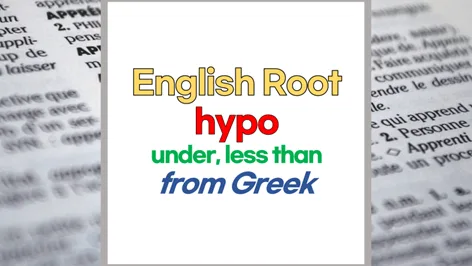
The English root 'hypo' originates from the Greek word 'hupo,' meaning 'under,' 'below,' or 'less than.' This fundamental root is crucial for understanding key English words like 'hypocrisy,' 'hypocrite,' and 'hypothesis.' Mastering word roots remains a powerful strategy for enhancing vocabulary in 2026.
The Dual Meaning of 'Hypo': 'Under' and 'Hidden'
The English root 'hypo' stems from the Greek 'hupo,' with its most basic meaning being 'under' or 'below.' However, this physical sense of 'under' often extends to abstract meanings like 'hidden' or 'disguised.' For instance, 'hypocrisy' describes a state of pretending to have virtues or beliefs that one does not actually possess, implying that the truth is 'hidden underneath.' This illustrates how the 'under' meaning of 'hypo' can be interpreted as 'what lies beneath the surface.' Understanding these dual meanings helps unlock the depth and nuance of words. Exploring words containing 'hypo' can significantly expand your vocabulary and comprehension.
Hypocrisy and Hypocrite: 'Under' Meets 'To Distinguish'

'Hypocrisy' and 'hypocrite' combine the root 'hypo' (under) with 'cris' or 'crit' (to distinguish, to judge). This signifies the act of distinguishing between outward appearance and inner reality, essentially 'hiding' the truth 'underneath' a facade. In ancient Greece, this concept was referred to as 'hypokrisis,' derived from 'hypokrinesthai,' meaning 'to answer.' Initially related to an actor's performance of mimicking others' words and actions, the term evolved to denote a morally deceptive attitude. Therefore, a 'hypocrite' is not merely someone who 'distinguishes,' but rather someone who 'disguises' their true self 'underneath' a false front. Grasping this etymological background clarifies the negative connotation inherent in these words.
Hypothesis: 'Under' Meets 'To Place'
'Hypothesis' is formed by combining 'hypo' (under) with 'thesis' (to place, to put). It refers to something 'placed underneath' as the 'foundation' or 'basis' for an argument or theory. A hypothesis is a tentative explanation or assumption that is considered likely to be true, though not yet proven. The Latin term 'hypothesis' itself means 'foundation' or 'basis,' highlighting its role as a critical starting point for scientific inquiry or logical reasoning. Since a hypothesis can be tested, refined, or rejected, it carries an inherently provisional nature, like something 'placed underneath' temporarily. Understanding the etymology of 'hypothesis' deepens our appreciation for its significance in scientific and logical processes as a 'provisionally placed explanation' awaiting validation.
Key Considerations for Learning 'Hypo' Vocabulary
When studying words containing the root 'hypo,' it's essential to go beyond rote memorization and grasp how the core meaning of 'under,' 'below,' or 'hidden' is extended and applied in different contexts. For example, 'hypotenuse' (the side opposite the right angle in a right-angled triangle) relates to the side 'underneath' or forming the base in certain geometric constructions, while 'hypothermia' describes a state where body temperature falls 'below' normal. For abstract terms like 'hypocrisy,' understanding the specific context is crucial. Since not all words with 'hypo' carry negative connotations—consider 'hypotenuse' or 'hypodermic' (under the skin)—it's vital to learn the precise meaning and usage of each word. While etymology aids comprehension, contextual understanding remains paramount for accurate language use.
Explore more 'hypo'-related vocabulary and detailed etymological insights.





