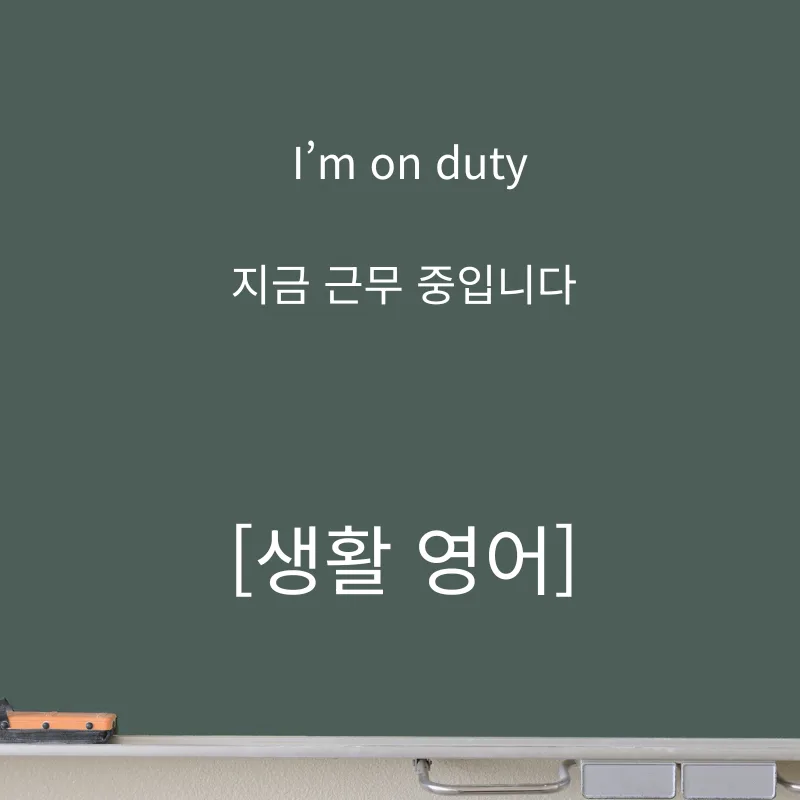
In 2026, the English phrase 'I'm on duty' signifies more than just being busy; it's a key expression for politely indicating you're currently working and responsible. It's especially useful in professional settings like offices, hospitals, or in roles like police and military where shift work is common. Use it to gracefully decline invitations or explain why you can't step away from your responsibilities.
When Should You Use 'I'm on Duty'?
In professional life, you'll often receive unexpected requests or invitations. Simply saying 'I'm busy' might not fully convey your situation. However, 'I'm on duty' clearly communicates that you're currently engaged in your work responsibilities and cannot be readily available. This phrase is particularly vital in environments with shift work, such as hospital emergency rooms, police stations, or military posts. For instance, if a friend invites you out for dinner and you're working the night shift at the hospital, saying, 'I'd love to, but I'm on duty tonight,' naturally explains your unavailability and helps them understand your situation better.
What Are Similar English Expressions for 'On Duty'?
There are several ways to express that you're working, depending on the context. 'I'm at work right now' is a general statement indicating you are currently at your workplace. Similarly, 'I'm currently working' conveys the same meaning. If your work involves scheduled shifts, 'I'm on shift right now' is appropriate, specifying your designated work period. When your work is finished, you can say, 'I'm off duty now.' Using these phrases interchangeably with 'I'm on duty' allows for more precise and natural communication. For example, if a colleague asks, 'Can you cover my shift tomorrow?' and you already have a scheduled shift, you can reply, 'Sorry, I'm on duty tomorrow.' This clarifies your availability based on your work schedule.
What Should You Be Careful About When Using 'I'm on Duty'?
The most important thing to avoid is a literal translation of 'duty' as 'obligation' or 'task.' In English, 'duty' can have various meanings depending on the context, but 'on duty' is an idiomatic expression meaning 'in a state of working.' Therefore, when using this phrase, emphasize the nuance of being in a responsible work period. While 'I'm on duty' provides a more specific reason for unavailability than 'I'm busy,' it's best to use it judiciously. Overusing it for minor requests might sound awkward or make the other person feel uncomfortable. Use it when you genuinely need to convey that you are committed to your work responsibilities.
Can You Provide Real-Life Conversation Examples Using 'I'm on Duty'?
Let's look at how 'I'm on duty' is used in a real conversation. Friend A suggests dinner: 'Hey, want to grab dinner tonight?' Friend B replies, 'I'd love to, but I'm on duty tonight.' Friend A might respond, 'Oh, I didn't realize you had a shift today.' Friend B could then clarify, 'Yeah, I’m covering the night shift at the hospital.' Friend A, understanding, says, 'That sounds tough. Let’s plan for another day.' Friend B adds, 'Thanks for understanding. I’ll be free tomorrow evening.' This exchange shows how 'I'm on duty' effectively communicates unavailability while inviting understanding and suggesting future plans. The phrase can also be used to refer to the person in charge, such as, 'The manager on duty will be able to assist you.'
Discover more usage tips in the original article.