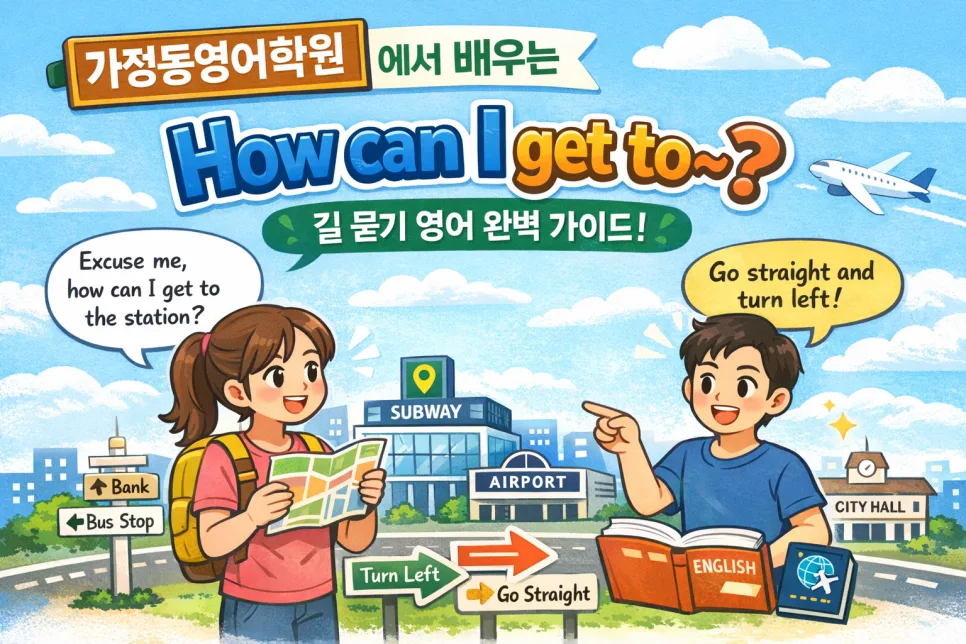
Mastering the English phrase 'How can I get to~?' is essential for navigating new places, whether you're traveling or just exploring your own city. This fundamental question allows you to confidently ask for directions, making any journey smoother. It's a cornerstone for beginners learning English conversation and a vital tool for anyone wanting to explore Korea or the US.
What Does 'How Can I Get To~?' Mean and How Is It Used?
The phrase 'How can I get to~?' directly translates to 'How can I arrive at~?' and is the most practical way to ask someone for directions to a specific destination. Its primary advantage lies in its simple structure, making it easy for beginner learners to grasp and use immediately. The basic format is 'How can I get to + [Place]?', and by simply changing the destination, you can adapt it to countless situations. For instance, 'How can I get to the station?' means 'How do I get to the train station?', and 'How can I get to the airport?' is used to ask for directions to the airport. This straightforward construction makes it an incredibly useful expression for those starting their English speaking journey.
What Are Real-Life Examples of Using 'How Can I Get To~?' for Directions?
The 'How can I get to~?' phrase can be applied in various real-life conversations. Beyond just asking for directions to stations or airports, you can inquire about specific locations like 'How can I get to the museum?' or 'How can I get to the nearest convenience store?'. To sound more polite when asking for directions, especially from strangers, preface your question with 'Excuse me,'. For example, 'Excuse me, how can I get to the bus stop?' is a polite and natural way to ask. These expressions are particularly valuable when traveling abroad or needing assistance from locals, significantly boosting your practical English speaking skills.
How Should You Respond to 'How Can I Get To~?' Questions?
Once you've learned how to ask for directions, it's equally important to know how to provide them. Basic directional answers include 'Go straight.' (Continue forward.), 'Turn left.' (Make a left turn.), and 'Turn right.' (Make a right turn.). You can also use phrases like 'It’s on your left.' (The destination will be on your left.) or 'It’s near here.' (It's close by.) to give a general sense of location. For example, if someone asks, 'How can I get to the library?', you could respond with 'Go straight and turn right. It’s on your left.' This allows for short, effective directional exchanges and solidifies your understanding of English conversation.
What Should You Be Mindful of When Learning 'How Can I Get To~?'?
While the 'How can I get to~?' phrase itself is quite simple, there are a few nuances to consider for effective use. Firstly, pay attention to the use of articles ('a', 'an', 'the') and plural forms when mentioning places. For instance, you'd use 'the station' to refer to a specific, known station, but 'a station' if asking about any station in general. Secondly, avoid asking about overly complex or abstract locations, as this can confuse the person you're asking. Instead of 'How can I get to the place where we met last week?', it's more effective to say 'How can I get to the cafe on Elm Street?'. Always maintain a polite demeanor when asking for directions, incorporating words like 'Excuse me' or 'Please' to ensure a positive interaction.
Discover more English phrases at LumiEnglish.