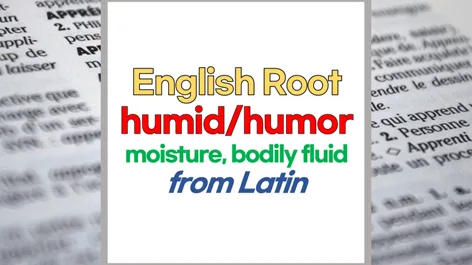
Did you know the English words 'humor' and 'humid' share a surprising Latin root related to moisture? Both stem from the Latin verb 'humere,' meaning 'to be moist' or 'to have fluid.' This shared origin explains how 'humor' evolved to mean not just 'moisture' or 'bodily fluid' but also 'mood' and 'wit,' while 'humid' consistently refers to physical dampness. Understanding this etymological link can unlock a deeper appreciation for these common English words.
What's the Latin Root of Humor and Humid?
The surprising truth is that both 'humor' and 'humid' trace their origins back to the Latin word 'humere,' which means 'to be moist' or 'to have fluid.' The related Latin noun 'humor' literally meant 'liquid,' 'fluid,' or 'moisture.' This foundational meaning is directly linked to the English word 'moisture' and the concept of 'bodily fluid.' In ancient Roman and Greek medicine, it was believed that the balance of four key bodily fluids (blood, phlegm, yellow bile, and black bile) determined a person's health, personality, and mood. This connection between bodily fluids and disposition naturally led to 'humor' taking on the meaning of 'mood,' 'temperament,' or 'disposition.' This is the primary pathway through which 'humor' began its journey toward its modern meanings.
How Did 'Humor' Come to Mean 'Mood' and 'Wit'?

The evolution of 'humor' from 'bodily fluid' to 'mood' and then to 'wit' is a fascinating linguistic journey rooted in ancient medical theories. As mentioned, the concept of the four humors (bodily fluids) was central to understanding health and temperament in classical antiquity. An imbalance in these humors was thought to cause illness and affect one's emotional state. Therefore, 'humor' became synonymous with a person's prevailing disposition or mood. Over time, a cheerful or positive disposition, often associated with a balanced state of humors, began to be linked with lightheartedness, amusement, and eventually, the ability to be funny or witty. This is how 'humor' acquired its dual meaning: the state of one's feelings and the quality of being amusing or comical.
What Does 'Humid' Mean in English?
Unlike 'humor,' the word 'humid' has maintained a much closer connection to its original Latin root. Derived directly from the Latin adjective 'humidus' (meaning 'moist' or 'damp'), 'humid' consistently refers to the presence of moisture in the air or atmosphere. You'll commonly hear it used to describe weather conditions, such as 'humid weather' or 'high humidity.' While 'humor' branched out into abstract concepts like mood and wit, 'humid' stayed grounded in its physical meaning of dampness. The related noun, 'humidity,' specifically refers to the amount of water vapor in the air, a crucial factor in meteorology and everyday comfort.
Tips for Learning Words Related to Humor and Humid
When learning vocabulary related to 'humor' and 'humid,' focus on understanding their shared etymological root in 'moisture' and 'fluid.' Remember that 'humor' expanded to encompass abstract concepts like mood and wit, often linked to the ancient theory of bodily fluids. In contrast, 'humid' primarily denotes physical dampness. Pay attention to the different parts of speech: 'humorous' is an adjective meaning 'funny' or 'witty,' while 'humour' (or 'humor' in American English) is the noun referring to 'wit,' 'amusement,' or 'mood.' Studying these words by grouping them around the core root 'humor' and exploring their distinct meanings and applications in context will significantly enhance your retention and understanding. For instance, try creating sentences that use 'humorous' to describe a joke and 'humid' to describe a summer day.
For more etymology insights, check the original source.





