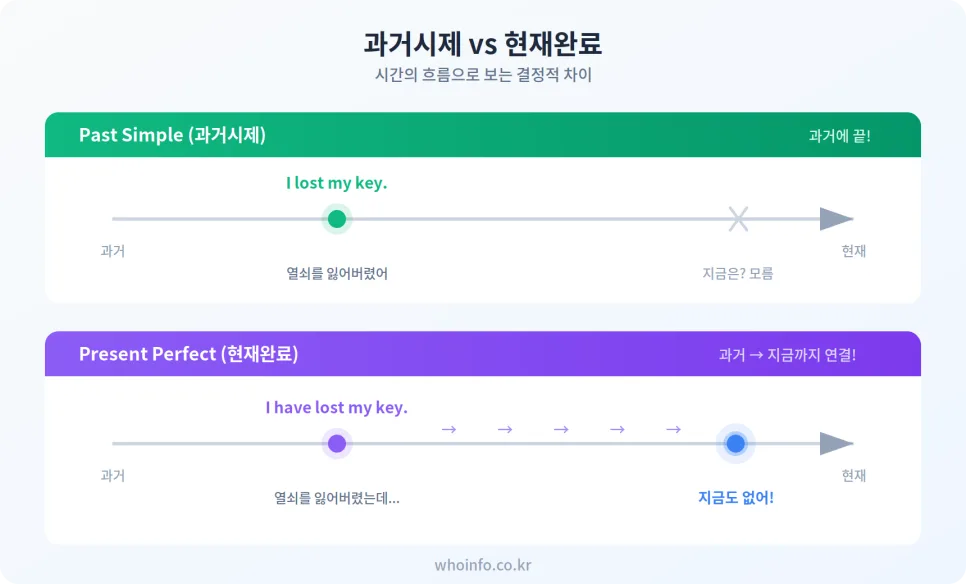
Confused about the difference between the Korean present perfect (have + pp) and the past tense? We'll break down the key distinctions for 2026, focusing on how past actions connect to the present. Master this core English grammar concept to elevate your fluency.
What's the Core Concept of Present Perfect (Have + PP)?
The most crucial keyword for understanding the present perfect (have + pp) is 'connection.' While the simple past tense describes events completed at a specific point in the past, the present perfect links past actions to the present. For example, 'I lost my key' is ambiguous; you might have found it by now, or you might still be looking. However, 'I have lost my key' clearly indicates that the state of having lost the key continues into the present. The present perfect emphasizes how past experiences, completions, continuations, or results are relevant *now*. Think of the simple past as a snapshot of a past moment, while the present perfect is like a video showing the flow from the past up to the present.
How to Differentiate Past Tense and Present Perfect
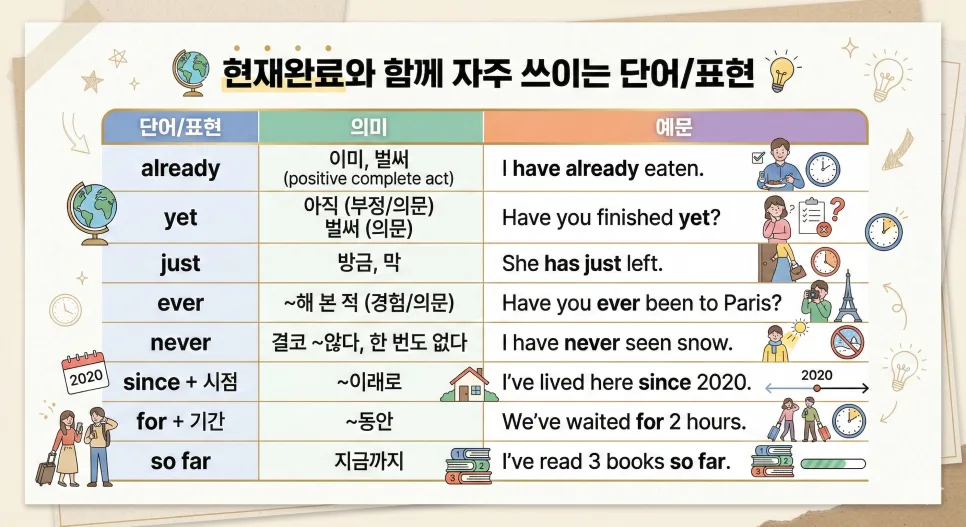
The easiest way to distinguish between the past tense and the present perfect is by looking at the accompanying time expressions. The simple past tense is typically used with phrases that pinpoint a specific past moment, such as 'yesterday,' 'last week,' 'in 2020,' 'ago,' or 'when + past event.' These phrases clearly mark the action as belonging to a finished past period. In contrast, the present perfect often pairs with expressions that indicate duration, completion, or experience up to the present, like 'already,' 'yet,' 'just,' 'ever,' 'never,' 'since,' and 'for.' For instance, 'She visited Japan last year' refers to a single completed trip in the past. However, 'She has visited Japan three times' highlights her experience of visiting Japan, which has occurred up to the present moment. Recognizing these time cues is key to selecting the correct tense.
What Are the Four Main Uses of the Present Perfect?
The present perfect tense can be broadly categorized into four main uses. First, the 'completion' use, as in 'I have just finished my homework,' signifies an action that was recently completed. It frequently appears with 'just,' 'already,' and 'yet.' Second, the 'experience' use, such as 'She has visited Japan three times,' indicates that someone has had a particular experience at least once before now. Common adverbs here include 'ever,' 'never,' 'before,' 'once,' and 'twice.' Third, the 'continuation' use, like 'We have lived here since 2015,' shows an action that began in the past and continues into the present. 'Since' and 'for' are the primary indicators for this usage. Fourth, the 'result' use, exemplified by 'He has gone to Paris,' implies that a past action has a present consequence. In this case, his going to Paris means he is not here now.
What Common Mistakes Do Beginners Make with the Present Perfect?
The present perfect tense is a common stumbling block for English language learners, especially those starting out. Grasping the concept alone doesn't always translate to knowing when to use it in real-time conversation or writing. Many learners struggle to differentiate the subtle nuances between the past tense and the present perfect. For example, the distinction between 'I lost my key' and 'I have lost my key' can be unclear. To overcome this, it's highly effective to study the concept alongside memorizing common adverbs used with each tense. For instance, associating 'yesterday' with the past tense and 'since' with the present perfect can significantly reduce errors. Practicing with diverse examples and working through exercises is crucial for applying this knowledge. Utilizing resources like video lessons or quizzes tailored to your learning style can also be beneficial.





