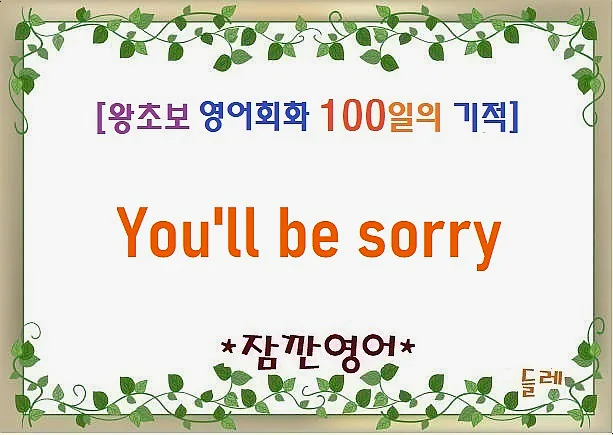
This guide provides a comprehensive look at the English phrase 'You'll be sorry' for 2026, covering its exact meaning and practical applications. This expression is used to warn or advise someone that they will regret a certain action or decision in the future.
When to Use 'You'll Be Sorry' in English Conversations
The phrase 'You'll be sorry' is versatile and can be applied in various situations to emphasize that a person will regret their current choices if they don't change them. For instance, if a friend is neglecting their studies before an important exam, you might say, 'You'll be sorry you didn't study hard,' to highlight the future consequences. This expression effectively communicates the outcome of someone's actions, going beyond a simple warning. It can even be used humorously among close friends to lighten the mood while still conveying a point.
Understanding the Nuance and Pronunciation of 'You'll Be Sorry'
The core of this expression lies in the word 'sorry.' In this context, 'sorry' doesn't just mean 'apologetic' but rather 'regretful' or 'feeling remorse.' Therefore, 'You'll be sorry' translates to 'You will regret it.' When pronouncing it, the emphasis should be on 'sorry,' creating a natural rhythm similar to 'yool-bee-SOH-ree.' For example, when saying, 'Don’t quit now. You’ll be sorry later,' smoothly connecting 'later' emphasizes the future point of regret. Mastering this precise nuance and pronunciation is key for natural communication with native English speakers.
Learning 'You'll Be Sorry' Through Real-Life Examples
Let's explore how 'You'll be sorry' is used in actual conversations. If someone is about to lie, you can warn them by saying, 'You’ll be sorry if you lie,' highlighting the potential repercussions. To someone considering giving up on a challenging endeavor, you could offer encouragement with, 'Don’t quit now. You’ll be sorry later.' Even in a dining scenario, you might tell a friend overeating, 'Eat that much? You’ll be sorry tomorrow,' prompting them to consider the discomfort that follows. These examples demonstrate the wide-ranging applicability of the 'You'll be sorry' expression.
Important Considerations When Using 'You'll Be Sorry'
While 'You'll be sorry' is a useful phrase, it's important to use it cautiously. It can sometimes sound like a strong warning or even a threat, so consider your relationship with the person and the context of the conversation. Using it in formal settings or with people you've just met might lead to misunderstandings. Additionally, this phrase primarily focuses on future regret. If you want to express regret about past actions, it's more appropriate to use a different sentence structure, such as 'You'll be sorry you didn't...' Therefore, choosing the right expression for the specific situation is crucial.
Learn more English expressions by checking the original source.