
To achieve a high score of 130+ on the Duolingo English Test (DET), mastering the Fill in the Blanks section is crucial. This segment is designed to assess your fundamental grammar and vocabulary skills within a tight timeframe, playing a key role in your overall score.
What's the Strategy for the Duolingo English Test Fill-in-the-Blanks Section to Reach 130 Points?
The Fill in the Blanks section on the DET is characterized by its rapid pace, requiring you to assess grammar and vocabulary simultaneously within just 20 seconds per question. This section is vital for securing a baseline score, and mistakes here can significantly impact your results, making it essential to get them right. Success demands not only a solid grasp of basic grammar rules but also a strong understanding of frequently used collocations and academic vocabulary. Questions range from fundamental grammar like adding an 's' for third-person singular present tense verbs to identifying common phrases such as 'make a discovery' and distinguishing between easily confused words. For higher scores, particularly above 130, you'll need to accurately comprehend and utilize advanced academic vocabulary and expressions, like understanding the nuances of phrases such as 'question the validity of the data.' Therefore, memorizing words in isolation isn't enough; understanding their context and common usage patterns is key.
How Do Fill-in-the-Blanks Strategies Differ by Score Range?
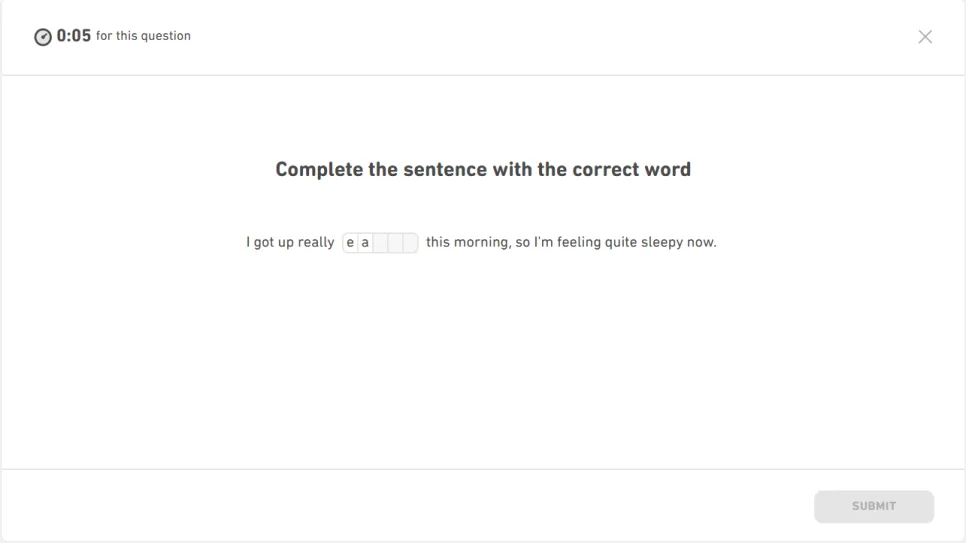
The approach to the DET's Fill in the Blanks section should be tailored to your target score. If you're aiming for the low 100s, focus on mastering basic grammar rules, such as correctly applying the third-person singular present tense. For scores in the 110s, prioritize learning frequently used collocations like 'make a discovery.' If your goal is 120+, pay close attention to words that are easily misspelled or mispronounced, like 'rhetoric.' For those aiming for 130 and above, a deep understanding and application of academic phrases, such as 'question the validity of ~' (to question the validity of something), are essential. Repeatedly studying these score-specific key phrases and grammar points, and practicing under timed conditions similar to the actual test, is the most effective path to improvement.
What Are Effective Learning Strategies to Improve DET Fill-in-the-Blanks Scores?
To effectively boost your score in the DET's Fill in the Blanks section, a systematic approach is necessary. Firstly, commit to consistent practice by transcribing and reading aloud 1-2 sentences daily. This multi-sensory method—engaging sight, hearing, and speech—is highly effective, considering the DET tests reaction speed as much as knowledge. Secondly, repeatedly practicing with past exam questions is crucial for short-term score gains, as the DET often recycles question structures. Thirdly, focus on learning and internalizing common collocations, such as 'make a decision,' 'draw a conclusion,' and 'question the validity,' to the point of automatic recall. Finally, don't just solve problems and move on; actively internalize the material through transcription and reading aloud. This consistent, repetitive training is what builds the automatic response capability the DET requires.
How Can I Utilize the DET Fill-in-the-Blanks Practice PDF?
To hone your skills for the DET's Fill in the Blanks section, utilize a practice PDF containing 40 questions with detailed explanations, organized by score level. This resource accurately mirrors the actual DET format and focuses on frequently tested collocations. The explanations go beyond simply providing answers, detailing why incorrect options are wrong, which aids in creating effective error logs. The PDF is structured with 10 questions for the 100-point range, 10 for the 110-point range, 10 for the 120-point range (advanced vocabulary), and 10 for the 130-point range (exam difficulty). This allows you to concentrate your study on your current level and target score. Treat this material not just as a practice test, but as a vital training tool for score improvement.
For more details, check the original source below.





