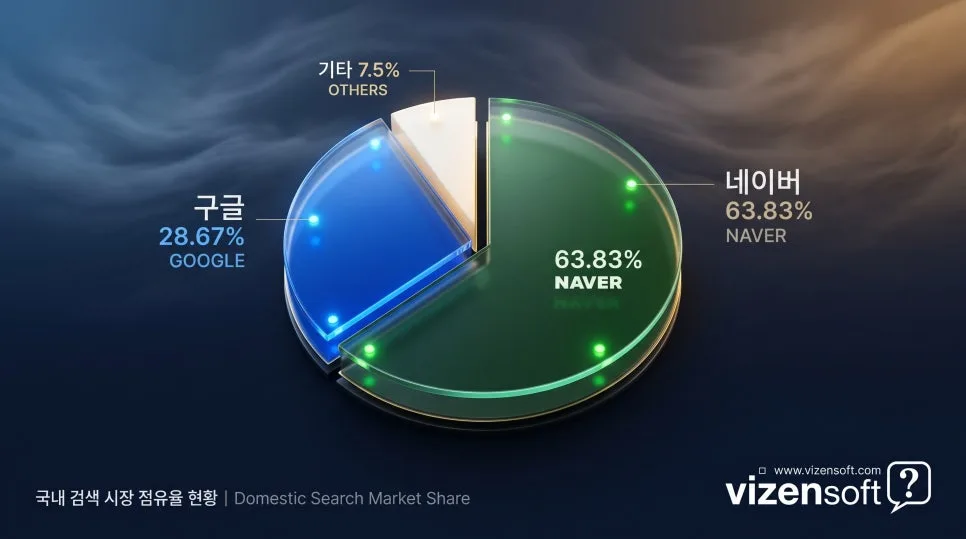
The AI search war's core battleground is whether Naver's dominant 70% domestic search market share can withstand Google's AI offensive. By 2026, advancements in AI technology will fundamentally reshape the search engine landscape, impacting how businesses and users interact with information.
AI Search Era: Is Naver's 70% Market Share Safe?
South Korea's search market is at the epicenter of a technological upheaval driven by AI. Google has officially entered the fray with 'Gemini in Chrome,' officially launching in the Korean market and challenging Naver's long-standing dominance. While Naver currently holds an impressive 63-70% market share, Google has steadily increased its presence over the past decade. Adding to the competition, Kakao is integrating its AI 'Kakao AI' into its popular KakaoTalk messenger, creating a three-way AI race. This isn't just about market share; it signals that AI capabilities will dictate the future of search engines.
Why AI Search is Reshaping Corporate Digital Strategies
Search engines are no longer just tools for finding information; they are the gateways to the digital ecosystem. The entity that dominates search gains control over advertising, e-commerce, content distribution, and data collection. Naver has leveraged its vast Korean language content database and local ecosystem to maintain its high market share. However, AI search threatens to dismantle these defenses. AI models are rapidly learning from extensive Korean data, lowering the barrier for global players. Google's 'Gemini in Chrome,' in particular, functions as an AI agent within the browser, offering instant information summarization and comparison without requiring tab switches. This innovation revolutionizes the traditional search experience and demands a fundamental re-evaluation of corporate website traffic, SEO strategies, and content marketing approaches.
AI Search Optimization (AEO): A New Marketing Paradigm

In the age of AI search, traditional SEO (Search Engine Optimization) strategies alone are insufficient. AEO (AI Engine Optimization), a strategy focused on tailoring content for AI search engines, is becoming essential. Businesses must prioritize creating structured, fact-based content that AI can easily summarize and cite. Furthermore, it's crucial to reduce reliance on search traffic by strengthening proprietary channels and diversifying digital strategies, such as building CRM systems. Kakao's integration of 'Kakao AI Search' within KakaoTalk demonstrates the potential for conversational AI search to become a mainstream method of information consumption. This signifies a shift from goal-oriented searches to more natural, integrated information discovery within daily life, requiring businesses to adapt to this evolving marketing paradigm.
Strategies for Businesses and Developers in the AI Search Era
The rise of AI search necessitates immediate strategic reviews for both corporate marketers and IT developers. Marketing professionals should focus on developing AEO strategies, producing structured content, and enhancing owned channels beyond traditional SEO. IT developers and service planners need to bolster their skills in integrating AI search APIs, designing conversational UI/UX, and monitoring platform-specific AI search API changes for optimization. For instance, tracking Naver's 'AI Tab' official launch and its impact on market share, alongside the speed of improvement in Google Gemini's Korean language processing, will be key indicators of future search market shifts. Additionally, Kakao's AI monetization strategies and their potential ripple effects warrant close attention.
AI Search: What Should You Be Cautious About?
As AI search becomes more sophisticated, users may increasingly consume information summarized by AI rather than visiting specific websites. This could lead to a significant decrease in corporate website traffic, making a re-evaluation of SEO strategies urgent. Moreover, while AI learns from vast datasets, it can sometimes provide inaccurate or biased information. Therefore, businesses must focus on producing reliable, fact-based content that AI can confidently cite, while simultaneously recognizing the importance of direct customer engagement through their own channels. Personalized AI search results can also reinforce information biases or confirmation bias, making it crucial to present a balanced range of perspectives.
For more details on the changes in the AI search era, check the original source below.