Before diving into Korean apartment interior design consultations, understanding floor plans is crucial. Knowing how to read them and communicate your needs effectively to designers can transform your renovation experience, making the process smoother and more aligned with your vision. This guide breaks down the essentials for US homeowners interested in K-interior trends.
Why Are Floor Plans Essential for Korean Interior Design Consultations?
Many homeowners embarking on their first apartment renovation, especially those drawn to the clean lines of Korean interior design, often feel overwhelmed when consulting with professionals. A common hurdle is not knowing how to interpret a floor plan or feeling lost when terms like structural walls or plumbing locations are discussed. However, grasping basic floor plan elements can significantly enhance your consultation. For instance, understanding the difference between load-bearing and non-load-bearing walls, or recognizing potential plumbing constraints, allows you to have a more informed discussion. This knowledge empowers you to better articulate your desires and understand the feasibility of design changes. By learning to read a floor plan, you can align with your designer more effectively, ensuring you're both working towards the same aesthetic and functional goals for your home.
Where to Find Floor Plans and What Key Information to Look For
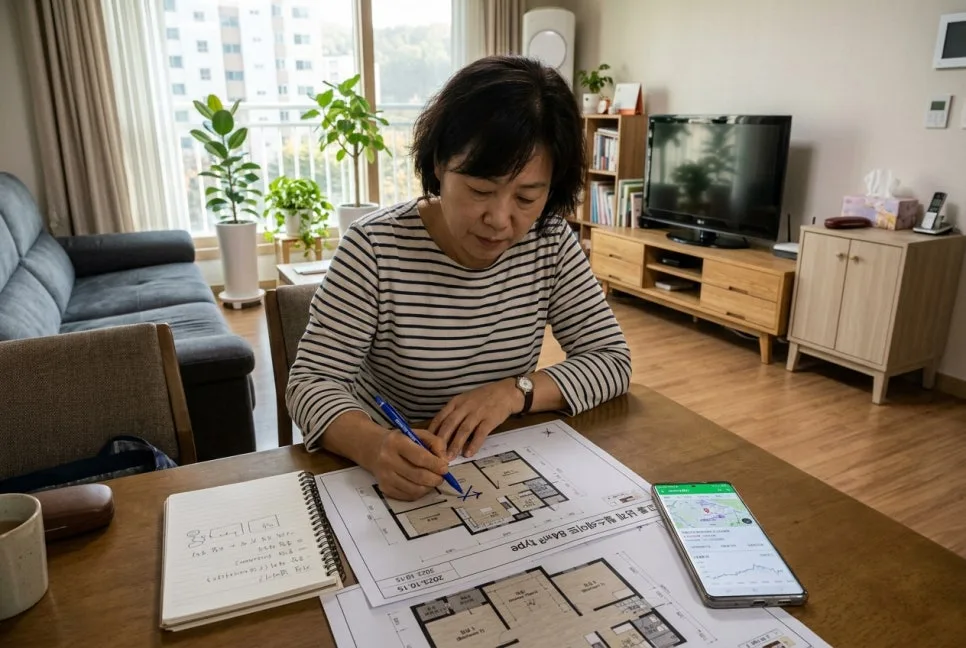
The easiest way to obtain an apartment floor plan in Korea is by searching on platforms like Naver Real Estate (similar to Zillow or Redfin in the US) for the specific apartment complex. Most complexes have floor plans available for different unit sizes. If you can't find it online, you can contact the apartment's management office and request a copy, which can often be sent via fax or as a photo. When you first look at a floor plan, it might seem complex, but focus on these key areas for interior design purposes. First, note the wall thickness: thicker lines often indicate structural walls (load-bearing walls) that cannot be removed, while thinner lines might represent non-structural partition walls that could potentially be moved or removed. Second, identify plumbing locations, especially around bathrooms and kitchens, usually marked with dotted lines or small circles; this impacts the feasibility and cost of relocating fixtures. Third, observe the balcony boundaries, often shown with dashed or double lines, which are important for understanding potential expansion areas. Finally, assess the layout and proportions of rooms like bedrooms and the living area to gauge the potential for space optimization or open-concept designs.
Understanding Common Korean Interior Design Terms

Familiarizing yourself with common terms used in Korean interior design consultations will help you navigate discussions more confidently. A 'structural wall' (내력벽, naeryeokbyeok) is a load-bearing wall essential for the building's integrity and cannot be removed. In contrast, a 'non-structural wall' (칸막이벽, kanmakibyeok or 경량벽, gyeongryangbyeok) is a partition wall that can potentially be removed or relocated after professional assessment. A 'pipe space' (PS) is a vertical shaft within walls, typically near bathrooms or kitchens, housing plumbing and usually off-limits for modification. The location of 'water pipes and gas pipes' is critical for kitchen and bathroom layouts; moving fixtures far from these points often requires extensive and costly floor work. Understanding the distinction between exterior and interior walls is also vital, especially when considering balcony expansions, as it impacts insulation and waterproofing requirements.
How to Effectively Communicate Your Interior Design Requests
Communicating your interior design vision clearly and effectively is key to a successful renovation. Start by visualizing the changes you want in your space, using the floor plan as a guide. For example, you might want to combine a bedroom with the living room to create a larger open area or remove a wall between the kitchen and living room for a more modern, open feel. Consider the practicalities: are your desired changes feasible given the structural walls and plumbing locations? If you're unsure about removing a specific wall, point it out on the floor plan and ask about its structural significance. It's also beneficial to establish a clear budget and prioritize your desired changes. For instance, stating, 'My top priority is maximizing storage space, and I'm willing to allocate 40% of my budget to it,' helps designers understand your needs better and propose tailored solutions. This preparation ensures your consultation time is used efficiently, minimizes misunderstandings, and leads to a more satisfying final result.
Important Considerations During Interior Design Consultations Based on Floor Plans
Even with a good understanding of floor plans, there are crucial points to keep in mind during your Korean interior design consultation. Firstly, don't assume a thin wall is always non-structural; always get professional confirmation. Secondly, thoroughly inquire about the additional costs and timeline associated with relocating plumbing, as it can significantly increase the project's complexity and expense. Thirdly, if you're considering balcony expansion, ensure that proper insulation and waterproofing measures are implemented to prevent future issues like condensation or leaks. Fourthly, obtain quotes from multiple reputable interior design firms and carefully compare the details, including the scope of work and the quality of materials specified, to ensure you're getting fair value. Finally, always review the contract thoroughly before signing, ensuring all agreed-upon terms regarding the scope, timeline, cost, and warranty are clearly documented. For complex projects, seeking advice from an independent interior design consultant might be beneficial.
For more details, check the original source below.