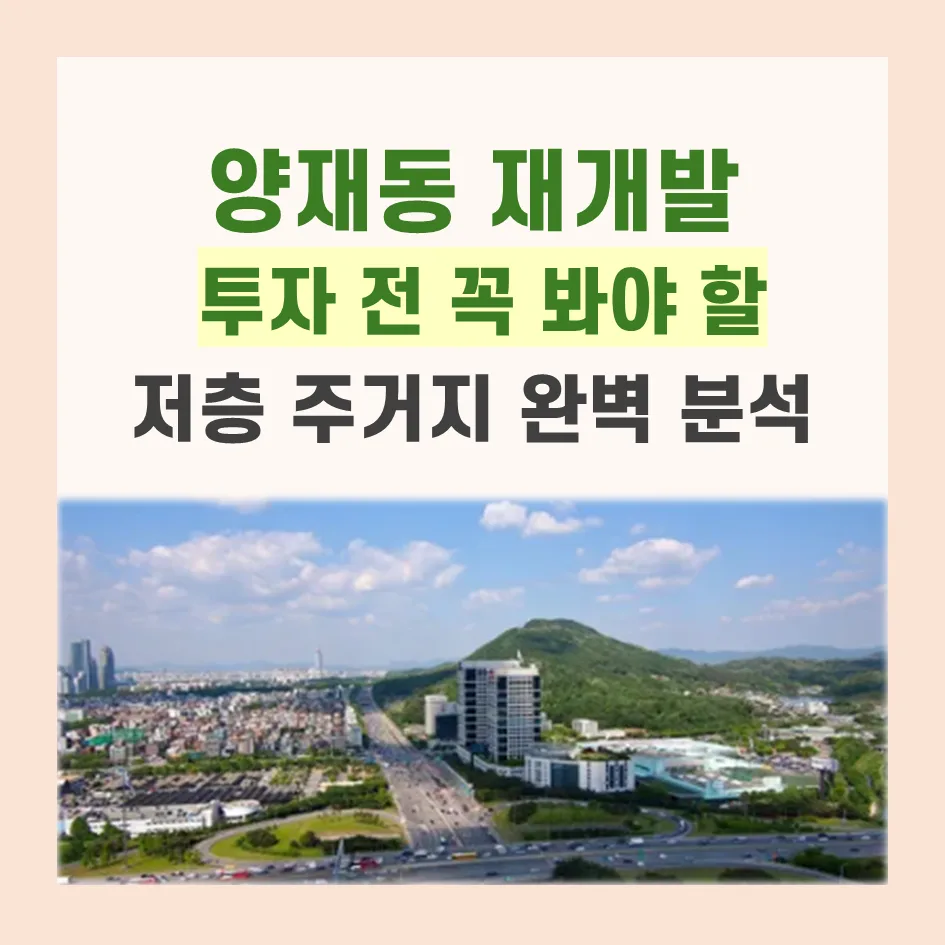
Thinking about investing in the Yangjae-dong redevelopment? As an experienced investor, I've analyzed the future value of low-rise residential areas in Seocho-gu and the current progress of Yangjae-dong's Moa Town initiative. This guide will help you make a successful investment decision by 2026.
Why Yangjae-dong Redevelopment Deserves Your Attention Now
In today's volatile real estate market, finding a secure investment can be challenging. However, for investors seeking both stability and future value, Seocho-gu, particularly Yangjae-dong's last remaining low-rise residential zones, is a prime area to watch. Yangjae-dong already boasts excellent transportation links, but its future potential is even more exciting. With the Shinbundang Line and Line 3 passing through Yangjae Station, and the Shinbundang Line's Yangjae Citizen's Forest Station, you can reach Gangnam Station in under 5 minutes and Pangyo Techno Valley in 10-15 minutes, offering superb transit-oriented development (TOD) benefits. The confirmation of the GTX-C line stop will transform the area into a major transportation hub, expected to drive increased foot traffic and land value appreciation. These locational advantages are key drivers for the investment value of Yangjae-dong's redevelopment projects.
What Factors Are Boosting Yangjae-dong's Future Value?
The primary engine behind Yangjae-dong's sustained value growth is its robust job market. The area is home to the headquarters of major corporations like Hyundai Motor and Kia Motors, as well as R&D centers for LG Electronics and KT, creating a strong base of high-income professionals. The Seoul Metropolitan Government plans to develop this area into a hub for advanced industries like AI and biotech, further enhancing its appeal as a residential base. The district also benefits from proximity to prestigious schools in Seocho-gu and the renowned Gangnam Academy Street, attracting families. Excellent medical facilities, including Gangnam Severance Hospital and Seoul St. Mary's Hospital, along with convenient shopping options like Costco, E-Mart, and Shinsegae Department Store (Gangnam Branch), complement the area's superb living environment. Furthermore, the presence of natural spaces like Yangjaecheon Stream and Yangjae Citizen's Forest adds to its desirability.
Yangjae-dong Redevelopment: Scarcity Premium Amidst Supply Shortage
Over the next three years, the supply of new housing in Seocho-gu is expected to be extremely limited. Following basic supply and demand principles, with steady demand and a shortage of new units, the value of Yangjae-dong's redevelopment projects, which will eventually become new apartments, is likely to see a significant premium due to scarcity alone. Currently, existing apartments like Hanshin Hue Plus are trading between approximately $1.1 million to $1.3 million (₩1.5-1.8 billion), and older complexes like Yangjae Woosung are selling for $1.5 million to $1.8 million (₩2.0-2.5 billion), with prices around $480 per square foot (₩45 million per pyeong) for older units showing a consistent upward trend. Once redeveloped into modern apartments, these properties are expected to quickly align with and surpass the value of existing complexes, capturing a new construction premium.
Yangjae-dong Moa Town Progress and Investment Strategy
Yangjae-dong's redevelopment timeline is accelerating, aligning with Seoul City's proactive urban renewal initiatives. Specifically, the Moa Town project in Yangjae 2-dong is progressing across seven zones. Zone 1 has already been designated as a Moa Town site after achieving a 70% resident consensus. While Zones 2 and 6 were initially deferred, they are preparing for another attempt, and other zones are also moving forward. Successful investors in real estate always stay one step ahead. The key strategy involves identifying and capitalizing on regulatory loopholes and securing early-stage opportunities. For Yangjae-dong redevelopment, maximizing returns means entering during the undervalued pre-designation phase. Investment strategies will vary based on individual circumstances, so consulting with experts and making informed decisions based on the latest information is crucial.
Tags
💬Frequently Asked Questions
What are the key investment points for Yangjae-dong redevelopment?
What is the current status of Yangjae-dong's Moa Town initiative?
What should I be cautious about when investing in Yangjae-dong redevelopment?
Original Source
Read the Korean original