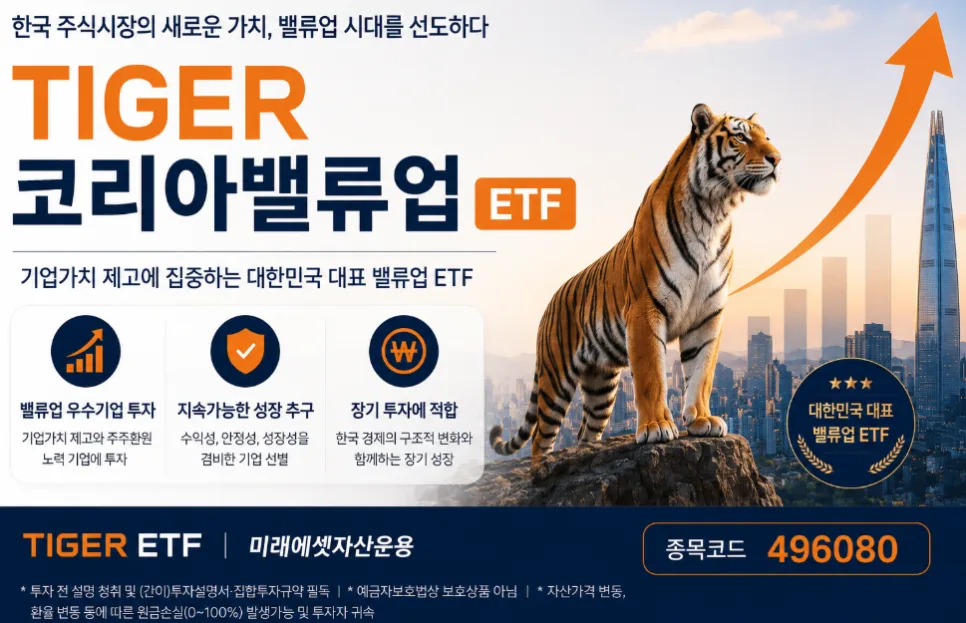
The TIGER Korea Value-Up ETF is a compelling investment for 2026, offering diversified exposure to 100 top South Korean blue-chip stocks with monthly dividend payouts. Boasting a low total expense ratio of 0.08% annually and accessibility within retirement accounts, it presents an attractive option for US investors seeking Korean market exposure.
What Stocks Are in the TIGER Korea Value-Up ETF? (2026 Holdings)
At the heart of the TIGER Korea Value-Up ETF are the 100 blue-chip stocks selected for the 'Korea Value-Up Index.' This index goes beyond simple market capitalization, focusing on qualitative factors like market representativeness, profitability, shareholder returns, low Price-to-Book Ratio (PBR), and strong Return on Equity (ROE). This means the ETF holds companies that are not only financially sound but also committed to enhancing shareholder value. Prominent holdings often include giants like Samsung Electronics, SK Hynix, Hyundai Motor, Kia, Celltrion, and Shinhan Financial Group, provided they meet the index's stringent criteria. With a maximum weighting of 15% per stock, the ETF also mitigates the risk associated with individual company performance, offering a more balanced investment approach. This diversified portfolio aims to capture the overall growth of the South Korean economy through its leading, shareholder-friendly corporations.
What Are the Selection Criteria for the Korea Value-Up Index?
The Korea Value-Up Index, managed by the Korea Exchange (KRX), meticulously evaluates companies based on financial health and their commitment to increasing shareholder value. Key criteria include ▲market representativeness, ▲profitability, ▲shareholder returns, ▲low PBR, and ▲high ROE. The goal is to identify companies that are not just profitable but also actively communicate with shareholders and strive for long-term value appreciation. For instance, Samsung Electronics and SK Hynix are recognized for their competitive edge in the AI semiconductor market and HBM technology, while Hyundai Motor and Kia are noted for their future growth potential in electric vehicles and robotics. Celltrion's inclusion is supported by the stability of its biosimilar business and strong R&D capabilities, and Shinhan Financial Group is acknowledged for its consistent dividend policy and efforts to improve ROE. This broad selection across various industries allows investors to gain exposure to the overall growth trajectory of the Korean stock market.
TIGER Korea Value-Up ETF: Dividend and Expense Ratio Details
The TIGER Korea Value-Up ETF is structured as a monthly dividend-paying product, distributing payouts on the last business day of each month. The actual dividend amount can fluctuate monthly, influenced by the dividend income from its constituent stocks and the overall performance of the index. These dividends are subject to a 15.4% dividend income tax in South Korea. However, investors can significantly benefit by holding this ETF within tax-advantaged accounts like a retirement savings account (similar to a US IRA or 401(k)) or an Individual Savings Account (ISA), deferring or reducing tax liabilities. Furthermore, the ETF's total expense ratio is remarkably low at 0.08% annually. For a $10,000 investment, this translates to approximately $9 in annual fees, making it a cost-effective choice for long-term investors compared to many other ETFs.
What Should Investors Consider Before Investing in the TIGER Korea Value-Up ETF?
The future performance of the TIGER Korea Value-Up ETF is intrinsically linked to the performance of its underlying 'Korea Value-Up Index' components. Given the significant weighting of major semiconductor companies like Samsung Electronics and SK Hynix, the ETF's trajectory is closely tied to the global semiconductor market trends. Positive developments in South Korea's 'Value-Up Program' and increased corporate shareholder return initiatives could provide a tailwind. However, investors must also be mindful of macroeconomic factors such as global interest rate fluctuations, geopolitical tensions (e.g., US-China trade relations impacting tech), and currency exchange rates. It is crucial to understand these potential influences and the inherent volatility of individual stock performance before making an investment decision. This information is for educational purposes only and does not constitute financial advice. Always conduct your own due diligence or consult with a qualified financial advisor to determine if this investment aligns with your personal financial goals and risk tolerance.
For more details, check the original source below.