The AI chip market is poised for a seismic shift in 2026, driven by the dual advancements of Samsung's cutting-edge 2nm process technology and OpenAI's revolutionary Duct-tape AI. This convergence of hardware and software innovation is accelerating the AI value chain, creating new opportunities and challenges for investors. This article provides an in-depth analysis of these key technologies and offers strategic investment insights. This is not financial advice. Consult a licensed financial advisor.
Why Samsung's 2nm Process Won Tesla's AI6 Chip Contract
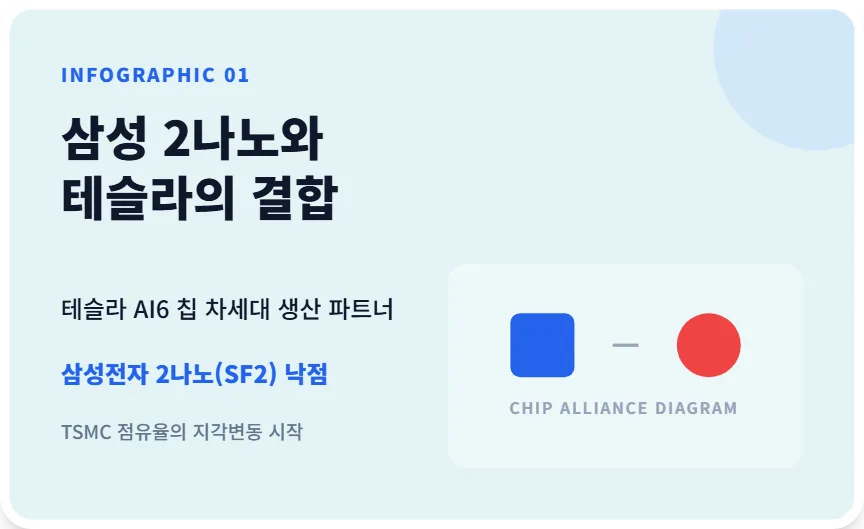
Elon Musk recently revealed that Tesla's next-generation autonomous driving chip, AI6, will be exclusively manufactured using Samsung Foundry's 2nm process. This marks a significant shift, as major tech companies are increasingly diversifying their chip production away from TSMC and towards Samsung. Samsung's Gate-All-Around (GAA) technology is reaching maturity, enabling the production of high-performance, low-power chips that global giants demand. With Samsung's Taylor, Texas facility ramping up production, the company is projected to achieve profitability in its foundry business by 2026, a crucial milestone that could lead to a significant re-evaluation of its stock. Samsung's 3rd-gen GAA 2nm (SF2) process is set to exclusively produce Tesla's AI6 chips, bolstering Samsung's position in the foundry market. In contrast, TSMC aims for pilot production of its N2 process, utilizing nanosheet FETs, in the latter half of 2025. This intense technological competition is reshaping the AI semiconductor landscape.
OpenAI's Duct-tape AI: Revolutionizing In-Image Text Generation
On the software front, OpenAI's upcoming image generation model, tentatively named Duct-tape AI (or potentially ChatGPT Image V2), is generating significant buzz. Even in its private testing phases, it's demonstrating capabilities that far surpass existing models. Its most groundbreaking feature is a dramatic improvement in rendering text within images with unprecedented accuracy and naturalness. Unlike previous models that often misspelled words or distorted characters, Duct-tape AI can generate clear, coherent text even in high-resolution images. The ability to seamlessly integrate complex Korean characters—with their intricate combinations of consonants and vowels—without distortion is particularly exciting for users in Korea. This advancement is expected to revolutionize visual content creation, especially for advertising posters, web UI designs, and any application where text is a critical element.
According to LMSYS Arena AI testing results, Duct-tape AI outperforms Google's Nanobana model in text rendering and UI design capabilities. It excels in the realism of text integrated into photorealistic images. For comparison, Duct-tape AI offers top-tier text accuracy and hyperrealism, Nanobana provides high-level text accuracy primarily for English with a focus on smooth illustrations, and DALL-E 3 offers mid-level text accuracy with a focus on creative art styles.
AdTech Platform and the Sovereign AI Market
Samsung Foundry's ecosystem is expanding, and AdTechnology's ADP 620 platform is emerging as a key player, particularly in the burgeoning Sovereign AI market. Sovereign AI refers to AI systems developed and controlled by individual nations to ensure data privacy, security, and national interests. The ADP 620 platform utilizes a chiplet architecture, allowing for flexible integration of various AI accelerators. This modular design is crucial for building customized AI solutions that meet the specific needs and regulatory requirements of different countries. As nations increasingly prioritize data sovereignty, the demand for such adaptable and secure AI hardware solutions is set to surge. AdTechnology's strategic positioning within Samsung's foundry network provides a significant advantage in capturing this growing market segment.
Synergy and Future Investment in the AI Value Chain
The simultaneous evolution of hardware manufacturing, exemplified by Samsung's 2nm process, and advanced AI software like OpenAI's Duct-tape AI, is creating a vertically integrated AI value chain. This synergy accelerates innovation across the board, from chip design and fabrication to AI model development and deployment. Companies that can master multiple stages of this chain are poised for significant growth. For instance, the combination of Tesla's AI6 chip (hardware) and potential future AI software integrations signifies a move towards more cohesive AI systems. Investors looking to capitalize on the AI boom should focus on companies that demonstrate strength across this entire spectrum, from foundational chip manufacturers to cutting-edge AI developers and specialized platform providers like AdTechnology. Understanding these interconnected advancements is key to navigating the future of AI investment.
Key Considerations for AI Market Investment in 2026
As we look towards 2026, the AI market will likely be defined by this trend of vertical integration. Companies that can offer end-to-end solutions—from chip design and manufacturing to AI model development and application—will hold a competitive edge. This includes semiconductor giants like Samsung, AI research leaders like OpenAI, and specialized hardware/software integration platforms. The rise of Sovereign AI also presents a unique opportunity for companies capable of providing tailored, secure AI infrastructure. Strategic investments should therefore target key players across the entire AI value chain, recognizing the symbiotic relationship between advanced hardware capabilities and sophisticated AI software. This holistic approach is essential for identifying the most promising investment opportunities in the rapidly evolving AI landscape.
For more details, check the original source below.