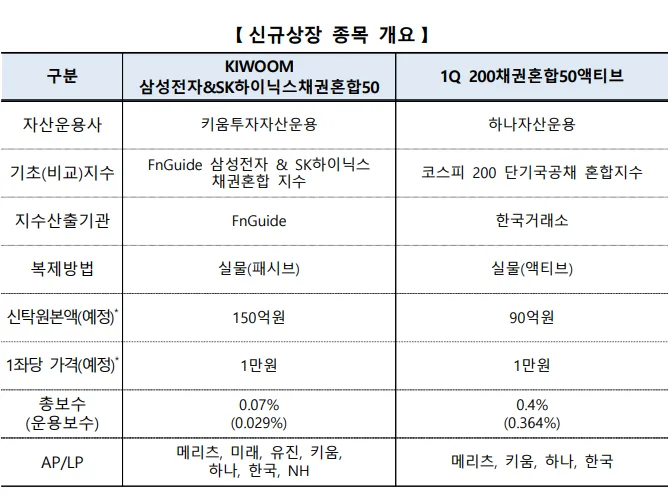
On April 21, 2026, four new Exchange Traded Funds (ETFs) from Kiwoom Asset Management, Mirae Asset Management, Hana Asset Management, and Shinhan Asset Management are set to list on the Korea Exchange. Investors interested in diversifying their portfolios with Korean market exposure should pay close attention to these new offerings, which aim to provide targeted investment strategies across various sectors and asset classes.
What are the new ETFs launching in 2026?
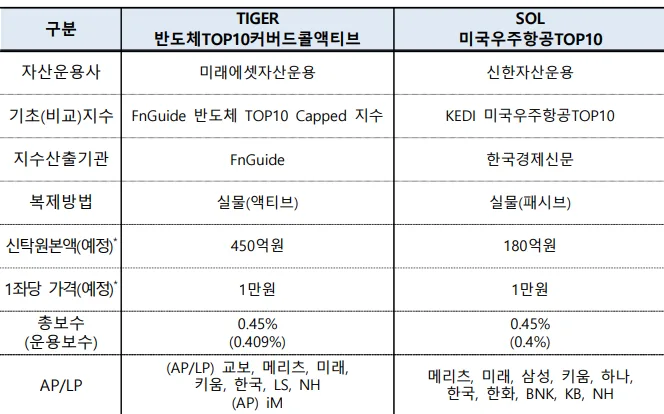
On April 21, 2026, the Korea Exchange will welcome four new ETFs from prominent South Korean asset managers: Kiwoom Asset Management, Mirae Asset Management, Hana Asset Management, and Shinhan Asset Management. This brings the total number of listed ETFs in South Korea to 1,096. Kiwoom Asset Management's 'Samsung Electronics & SK Hynix Bond Hybrid 50' will invest 50% in short-term government bonds and 50% in Samsung Electronics and SK Hynix stocks, aiming for a balance of stability and growth. Mirae Asset Management's '1Q 200 Bond Hybrid 50 Active' is an actively managed fund that allocates 50% to KOSPI 200 index components and 50% to government and public bonds, seeking to outperform the benchmark.
What are the investment strategies and considerations for the new ETFs?
Related Articles
Among the new listings, TIGER Semiconductor TOP10 Covered Call Active ETF invests in ten major South Korean semiconductor companies, employing an active strategy that may utilize options on individual stocks or the KOSPI 200. The SOL US Aerospace TOP10 ETF is a passive fund focused on leading U.S. aerospace companies. When considering these ETFs, investors should evaluate management fees, the potential for changes in underlying holdings, and tracking differences from their respective indices. Active ETFs, in particular, depend on the fund manager's skill, and covered call strategies can offer additional income but may cap upside potential if the underlying assets surge. Furthermore, currency-unhedged ETFs expose investors to foreign exchange rate fluctuations. Beyond the stated expense ratios, be aware of potential additional costs like index licensing fees and trading expenses. Investors can review detailed product information daily through the provided Net Asset Value (NAV) breakdowns.
For more details, check the original source below.





