On March 11, 2026, the South Korean stock market saw the KOSPI index surge nearly 2%, driven by institutional buying and strength in semiconductor stocks. However, the KOSDAQ experienced a slight dip due to profit-taking in battery-related companies. The day's trading was influenced by mixed signals from falling oil prices and geopolitical risks, creating a volatile trading environment.
Why Did the KOSPI Rise on March 11, 2026?
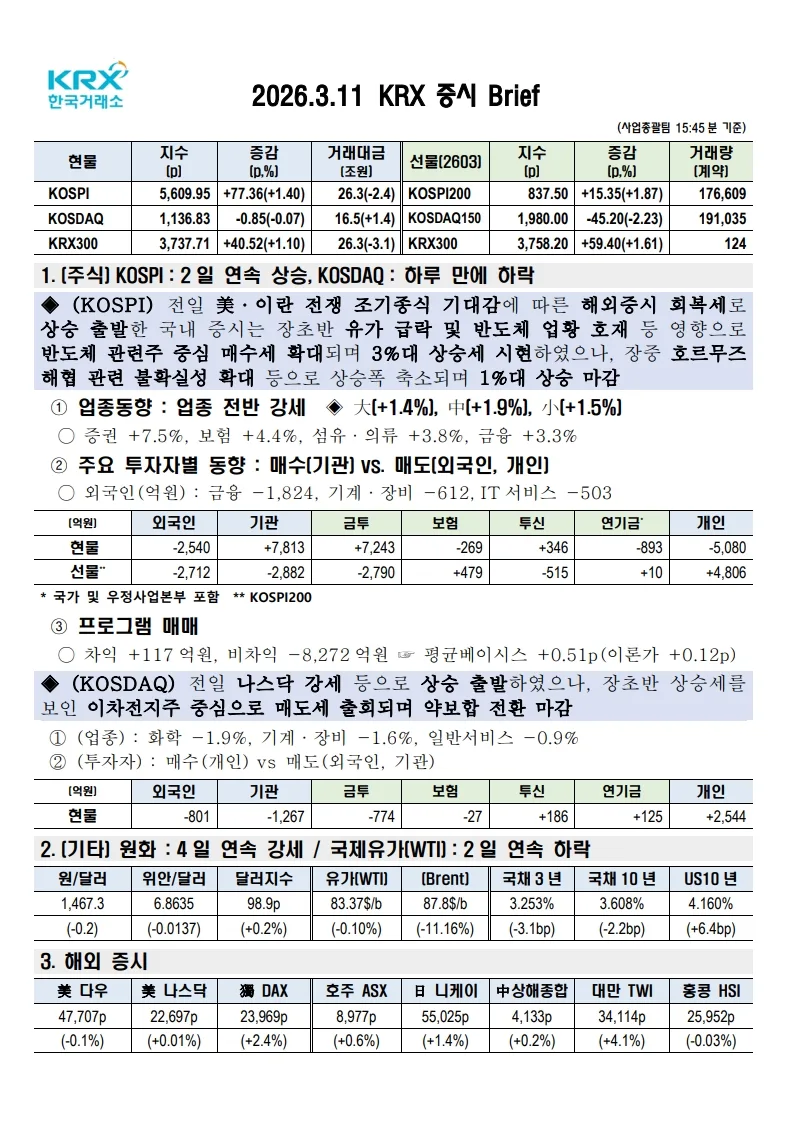
The KOSPI index closed at 5,609.95 on March 11, 2026, marking a 77.36-point (1.40%) increase and extending its winning streak to two consecutive trading days. Early trading benefited from a recovery in overseas markets and declining international oil prices, which fueled strong buying momentum, particularly in semiconductor-related stocks. Institutional investors were key drivers, injecting approximately $580 million (₩781.3 billion) into the market, significantly boosting the index. Sectors like securities, insurance, and finance saw substantial gains of 7.5%, 4.4%, and 3.3%, respectively, reflecting broad market strength. This robust institutional buying provided the primary upward thrust for the KOSPI.
What Caused the KOSDAQ's Flat Performance?
In contrast, the KOSDAQ index finished at 1,136.83, down 0.85 points (0.07%), reversing earlier gains to close slightly down. While initial trading showed promise, influenced by a positive Nasdaq performance, the index faltered as individual investors began taking profits from recently surged battery-related stocks. This profit-taking pressure, coupled with selling from foreign and institutional investors who offloaded $60 million (₩80.1 billion) and $95 million (₩126.7 billion) worth of stocks respectively, weighed down the KOSDAQ. The pullback in the battery sector, a significant component of the KOSDAQ, dampened overall investor sentiment.
Key Financial Market Indicators Influencing the Day
The financial markets on March 11, 2026, presented a mixed picture. The Korean Won strengthened against the US Dollar for the fourth consecutive day, closing at ₩1,467.3 per USD. This appreciation is favorable for foreign investors but could pose challenges for Korean exporters. International oil prices continued their decline, with WTI settling at $83.37 per barrel and Brent crude at $87.80, acting as a drag on energy stocks. U.S. Treasury yields remained elevated, with the 10-year yield at 4.160%. These currency and oil price fluctuations are critical factors for investors to consider when formulating their strategies.
What Should Investors Watch Out For?
A key takeaway from the day's trading was the re-emergence of geopolitical risks. Reports concerning the Strait of Hormuz caused intraday trading volatility, potentially leading to further fluctuations in oil prices and global stock markets. Additionally, the profit-taking observed in KOSDAQ's battery sector highlights the need for caution regarding valuation concerns and potential pullbacks in high-growth stocks that have seen rapid price increases. Individual investors should closely monitor the trading patterns of institutional and foreign players, alongside macroeconomic indicators and geopolitical developments, to make informed decisions. Consulting with a financial advisor is recommended for personalized portfolio adjustments.
For more details, check the original source below.