As the KOSPI index experiences sharp declines after hitting record highs, individual investors are increasingly turning to inverse ETFs, often called 'Gobbus' in Korea. This strategy is driven by fatigue from rapid gains and concerns about market corrections, leading to a highly volatile environment where extreme profits or losses are possible.
What Caused the KOSPI's Plunge After Breaking 8000?
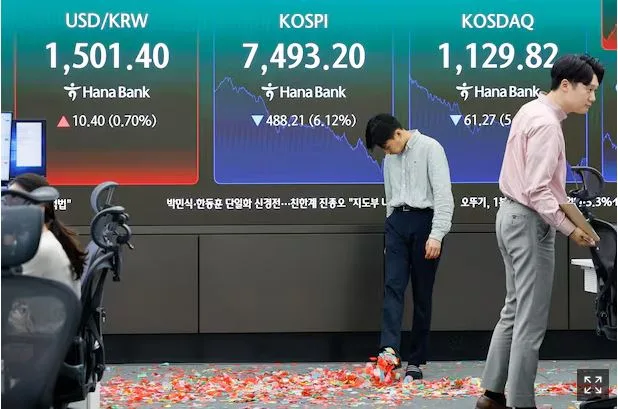
On the 15th, the KOSPI index reached a historic milestone, surpassing 8000 points for the first time in its trading history, peaking at 8046 intraday. However, this surge was short-lived. As profit-taking selling pressure mounted in the latter half of the trading day, the index plummeted over 6% within a single day, falling back into the 7000-point range. This dramatic intraday swing between a record high and a sharp decline highlights the market's extreme volatility. Financial analysts attribute this phenomenon to 'rally fatigue,' suggesting that the rapid ascent of the market led to investor caution and expectations of a correction. Indeed, discussions about overheating and potential short-term pullbacks had been ongoing in the market.
Why Are Individual Investors Flock to 'Gobbus ETFs'?
Surprisingly, even as the market was experiencing an upward trend, individual investor funds flowed not into bullish ETFs, but into inverse ETFs, or 'Gobbus,' which bet on market declines. For instance, the representative product, 'KODEX 200 Futures Inverse 2X,' saw over 320 billion KRW (approximately $240 million USD) in inflows last week alone. A 'Gobbus' ETF is structured to generate profits when the KOSPI index falls. Even during periods when the KOSPI surged towards the 7000-point mark, individual investors consistently purchased Gobbus ETFs, signaling their bets on a market downturn. This behavior indicates that investors are not merely following market trends but are actively preparing for market volatility based on their own assessments. This trend underscores a shift towards investors using their own judgment to hedge against market fluctuations rather than passively following the herd.
What Should You Consider When Investing in Inverse ETFs?
While inverse ETFs offer the potential for profit during market downturns, there are several crucial points to consider. Firstly, with leveraged inverse ETFs, losses can be amplified if the underlying index rises, leading to significant financial damage if the market direction is misjudged. Secondly, they can experience tracking errors if held long-term, making them generally more suitable for short-term trading. Thirdly, rapid market swings can result in unexpected and substantial losses. Therefore, it's essential to fully understand the product's structure and risks before investing. For example, conversely, leveraged ETFs focused on the IT and semiconductor sectors saw returns exceeding 40% in just one week, demonstrating that while correct market calls can yield high profits, incorrect ones can lead to severe losses in such extreme conditions. Consequently, a cautious approach and rigorous risk management are paramount when investing in inverse ETFs.
Conversely, What Were the Returns for Investors Betting on the Upside?
In stark contrast to inverse ETFs, investors who strongly bet on the market's upward trajectory achieved substantial gains. Particularly, leveraged ETFs focused on the IT and semiconductor sectors recorded explosive returns. For instance, the 'TIGER 200 IT Leverage' ETF delivered over a 40% return in just a single week. Additionally, ETFs related to HBM (High Bandwidth Memory) semiconductors also garnered significant attention for their high returns. These results illustrate that the current market is characterized by polarization, where focusing on specific sectors or trends can lead to high short-term profits. However, this also implies that misjudging the market direction can result in significant losses. Therefore, investors must clearly recognize these market characteristics and make investment decisions prudently based on their risk tolerance and investment style.
Why Is There Still Significant Dry Powder in the Market Amidst Volatility?
Despite the recent sharp fluctuations in the KOSPI, the amount of capital ready to enter the stock market remains substantial. Current investor deposits exceed 130 trillion KRW (approximately $96 billion USD), suggesting that even if the market enters a correction phase, buying pressure could re-emerge at any time. In essence, investors have not abandoned the market but are engaged in a strategic waiting game, assessing 'when to re-enter.' This situation highlights that the current market environment emphasizes not only stock-picking skills but also mental fortitude. In extreme volatility, where historic rallies and sharp declines can occur within the same day, individual investors' anxiety is understandably heightened, leading to a cautious approach and the accumulation of significant waiting funds.
For more details, check the original source below.