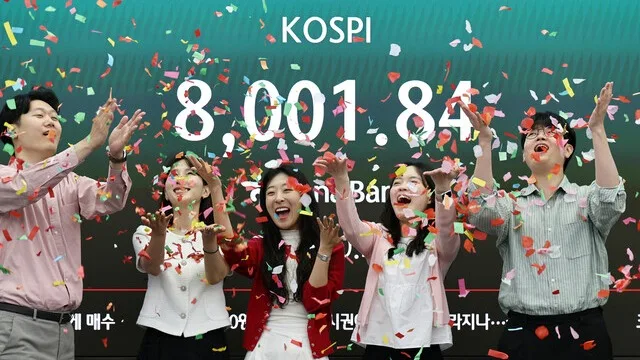
The most critical takeaway from the KOSPI's surge past 8000 points, followed by a sharp downturn, is the contrasting investor behavior. While many retail investors bet on the index's rise, a massive amount of capital flowed into inverse ETFs, which profit from market declines. This signals a significant shift in market sentiment and risk management strategies for 2026.
Why Did $25 Billion Flow into Inverse ETFs After KOSPI Hit 8000?
In just the last four trading days, the 'KODEX200선물인버스2X' (KODEX 200 Futures Inverse 2X) ETF saw an astonishing inflow of approximately 34.49 trillion KRW (around $25 billion USD). This dwarfs the inflows into the second-ranked 'KODEX Inverse' ETF by over 15 times. This particular ETF is designed to profit when the KOSPI 200 index falls, and despite a -31% return during that period, investor interest surged. This indicates more than just a reaction to short-term volatility; it reflects a strong sentiment anticipating a market downturn. Experienced investors often use inverse products for risk management amidst signs of market overheating.
KOSPI's 8000 Point Rally & Crash: Investor Choices Revealed
The KOSPI index achieved a historic milestone, surpassing 7000 points for the first time on November 6th and then hitting the 8000 mark just nine days later. However, after touching 8000 points on November 15th, the index experienced a sharp decline of over 6%, amplifying market anxieties. Amidst this rapid volatility, while individual investors tended to bet directly on the index's rise, the ETF market showed a contrary trend. The overall ETF net assets increased by 39 trillion KRW ($29 billion USD), with the majority of this growth concentrated in inverse ETFs. ETFs like 'TIGER200선물곱버스' (TIGER 200 Futures Inverse) also saw inflows of over 1.04 trillion KRW ($780 million USD), with the top three inflow-receiving ETFs all being inverse products. This suggests a market perception of a short-term peak and concerns about a potential correction.
Beyond Inverse ETFs: Where Else Did Capital Flow in 2026?
In addition to the massive inflows into inverse ETFs, significant capital also flowed into ETFs focused on large-cap semiconductor stocks. The 'SOL A반도체TOP2플러스' (SOL A Semiconductor TOP 2 Plus) ETF attracted 480.2 billion KRW (approx. $360 million USD), and the 'RISE 삼성전자SK하이닉스채권혼합50 ETF' (RISE Samsung Electronics SK Hynix Bond Mixed 50 ETF) received 429.1 billion KRW (approx. $320 million USD). This aligns with the analysis that the KOSPI's rally was largely driven by expectations of an improving semiconductor industry cycle. It also indicates a selective investment strategy, focusing on individual blue-chip stocks within promising sectors. This trend suggests that market participants are prioritizing concentrated investments in high-growth sectors or specific companies over broad market exposure, potentially signaling a future market driven by specific themes or industries.
Navigating Inverse ETF Investments During a KOSPI Downturn
With the KOSPI index experiencing a sharp rally followed by a potential downturn, interest in inverse ETFs is understandably high. However, investing in inverse ETFs carries substantial risks and requires careful consideration. Firstly, inverse ETFs are generally not suitable for long-term holding. While they aim to profit from falling market prices, unexpected market upturns can lead to significant losses. Secondly, leveraged inverse ETFs can experience tracking errors due to compounding effects, especially over extended periods, diverging from the performance of the underlying index. Therefore, before investing, it is crucial to thoroughly understand the product's structure and associated risks, and to assess whether it aligns with your personal investment goals and risk tolerance. Consulting with a financial advisor is also recommended to ensure informed decision-making based on your individual circumstances.
For more details, check the original source below.