In the era of "Bitu" (debt-fueled investing) reaching 36 trillion KRW (approx. $26 billion USD), this guide from an experienced investor details how to manage downside risk amidst FOMO (Fear Of Missing Out). Despite the KOSPI index hitting 7,000, the massive 36 trillion KRW in margin debt poses a significant threat. Prioritize securing cash and restructuring your portfolio for survival.
Is the KOSPI 7,000 Surge a Structural Illusion?
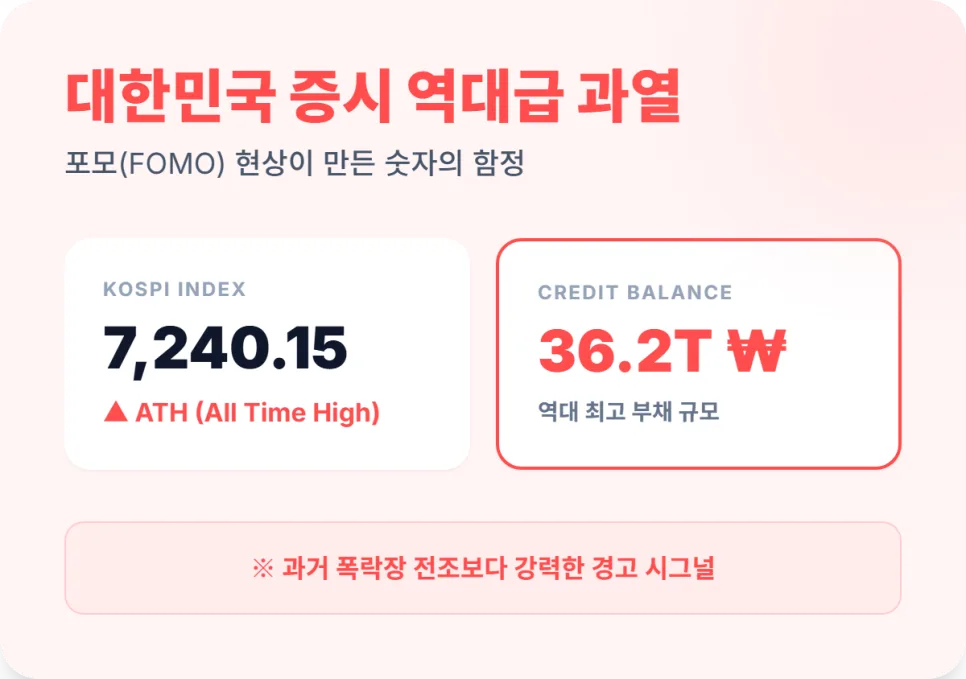
The current KOSPI index surge to 7,000 points may be a statistical distortion driven primarily by a few large-cap stocks like Samsung Electronics and SK Hynix. These giants constitute half of the total market capitalization, leaving the actual perceived index closer to 4,100 points. This widening K-shaped recovery, where only a few sectors benefit, creates a systemic risk: a downturn in these dominant sectors could trigger a market-wide collapse. As illustrated in Table 2 (not shown), the index shows a significant decline when excluding semiconductor stocks. Therefore, blindly following index gains is risky; a thorough analysis of individual stock fundamentals and underlying market structures is crucial for informed investment decisions.
36 Trillion KRW in Margin Debt: The Reality of FOMO
Hearing about others' stock market successes can trigger FOMO, leading investors to fear falling behind. This psychological pressure has driven margin trading debt to a staggering 36 trillion KRW (approx. $26 billion USD). This surge reflects speculative behavior fueled by fear, rather than conviction-based investing. Aggressive margin trading, especially among Gen Z and Millennials, carries the severe risk of forced selling (known as "bandae매매" or reverse trading) if stock prices fall. As seen in Table 1 (not shown), younger investors often have a high proportion of margin debt relative to their income, making them extremely vulnerable to financial ruin if investments fail. In such overheated market conditions, preserving capital must be the absolute priority over chasing profits.
Analyzing the Paradox of VKOSPI Crossing 60
Despite the KOSPI index reaching historic highs, the VKOSPI (Korea Volatility Index) crossing 60 signals extreme market anxiety. This is a stark warning that the market is primed for panic selling at the slightest negative catalyst. Policy shifts, such as interest rate hikes or tax reforms, could trigger a much faster and steeper decline than anticipated. Smart money is already exiting positions, and it's time to critically evaluate the current euphoric optimism with objective data and avoid indiscriminate chasing of stocks at their peak.
Risk Management Strategies for Investor Survival
To survive in this high-volatility market, individual investors must first secure a cash reserve of at least 20-30% of their total assets. Cash acts as a powerful buffer during market downturns. Secondly, re-evaluate the fundamentals of your current holdings. Focus on quality stocks with independent revenue streams, rather than those merely riding the index's coattails. Immediately pay off any margin loans or leveraged trades to eliminate the risk of forced liquidation. Patience is key; consider buying undervalued quality stocks only after sufficient market corrections have occurred. This is not the time to jump on a moving train, but to pause, secure cash, and carefully select your investments.
For more details, check the original source below.