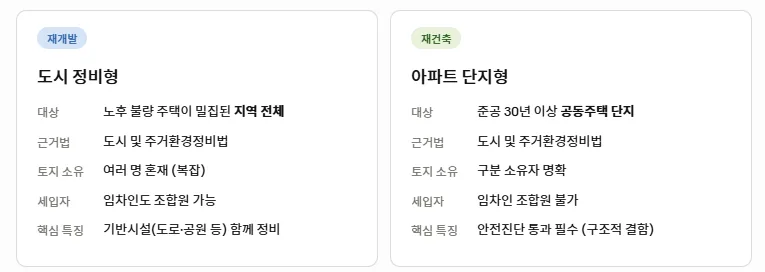
In 2026, understanding the nuances between Korean redevelopment (Jaegaebal) and reconstruction (Jaeguncheok) is key for savvy real estate investors. Redevelopment involves revitalizing an entire neighborhood, including infrastructure, and can take 15-20+ years. Reconstruction, typically focused on apartment complexes, is faster, averaging 10-15 years. This guide breaks down the investment difficulty and timelines for each.
What's the Difference Between Korean Redevelopment and Reconstruction?
While both redevelopment (Jaegaebal) and reconstruction (Jaeguncheok) aim to improve aging urban environments in Korea, their scope and execution differ significantly. Redevelopment is a comprehensive urban renewal project that goes beyond just demolishing old apartments; it includes upgrading infrastructure like roads and parks, transforming an entire district. This broad scope involves a diverse range of stakeholders, including landowners, building owners, tenants, and shopkeepers, making the process lengthy, often spanning 15 to over 20 years. Reconstruction, on the other hand, primarily focuses on demolishing and rebuilding existing apartment complexes. Since it mainly requires consensus among the apartment owners, the process is generally more streamlined and can be completed within an average of 10 to 15 years. Consequently, redevelopment is often characterized as 'high risk, high return,' while reconstruction offers relatively higher predictability for investors.
Who Leads Redevelopment and Reconstruction Projects?
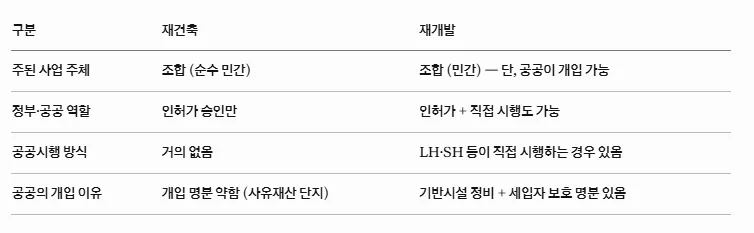
At their core, both redevelopment and reconstruction projects are spearheaded by resident-formed associations, known as 'combinations' (Johap). However, redevelopment projects, which include public infrastructure like roads and parks, often involve greater participation from government bodies or local municipalities. In recent years, public-private partnerships have become more common, with public institutions like LH (Korea Land and Housing Corporation) acting as direct project implementers. These public-led initiatives often offer benefits like increased building density ( 용적률 - Yongjeokryul) in exchange for a portion of the new units being designated as public rental housing. While this enhances the public nature of the projects, disagreements between private combinations and public entities can sometimes lead to delays. Reconstruction projects also frequently require coordination with public bodies regarding issues like mandatory affordable housing quotas or the placement of rental units, highlighting the importance of close communication and collaboration among all parties involved.
What Are the Steps in a Korean Redevelopment Project?
A typical redevelopment project in Korea follows a sequence: designation of the redevelopment zone → formation of a preparatory committee → approval of the resident association → project execution plan approval → relocation and demolition → construction commencement → unit sales and occupancy. Each phase can take anywhere from six months to over a year, assuming the project proceeds relatively smoothly. However, real-world examples, like the Bukahyeon redevelopment zone designated in 2007 which has yet to commence construction, illustrate that delays are common. Factors such as internal conflicts within the resident association, changes to the project plan, or administrative hurdles can significantly extend the timeline. Therefore, investors in redevelopment projects must be fully aware of this inherent uncertainty regarding project duration.
What Should Investors Watch Out For in Redevelopment and Reconstruction?
Investing in Korean redevelopment and reconstruction requires careful consideration of each project's unique characteristics. Redevelopment, due to its extensive scope and diverse stakeholders, carries a higher risk of delays or even project suspension. Investors need a long-term perspective and must acknowledge the project's inherent complexity. For reconstruction, while generally more predictable, the initial investment cost can be high, making it crucial to identify the optimal time to purchase property. Both types of projects can involve disputes among association members or potential legal challenges. It is essential to consult with real estate professionals and legal experts before making any investment decisions to navigate these potential risks effectively.
For more details, check the original source below.