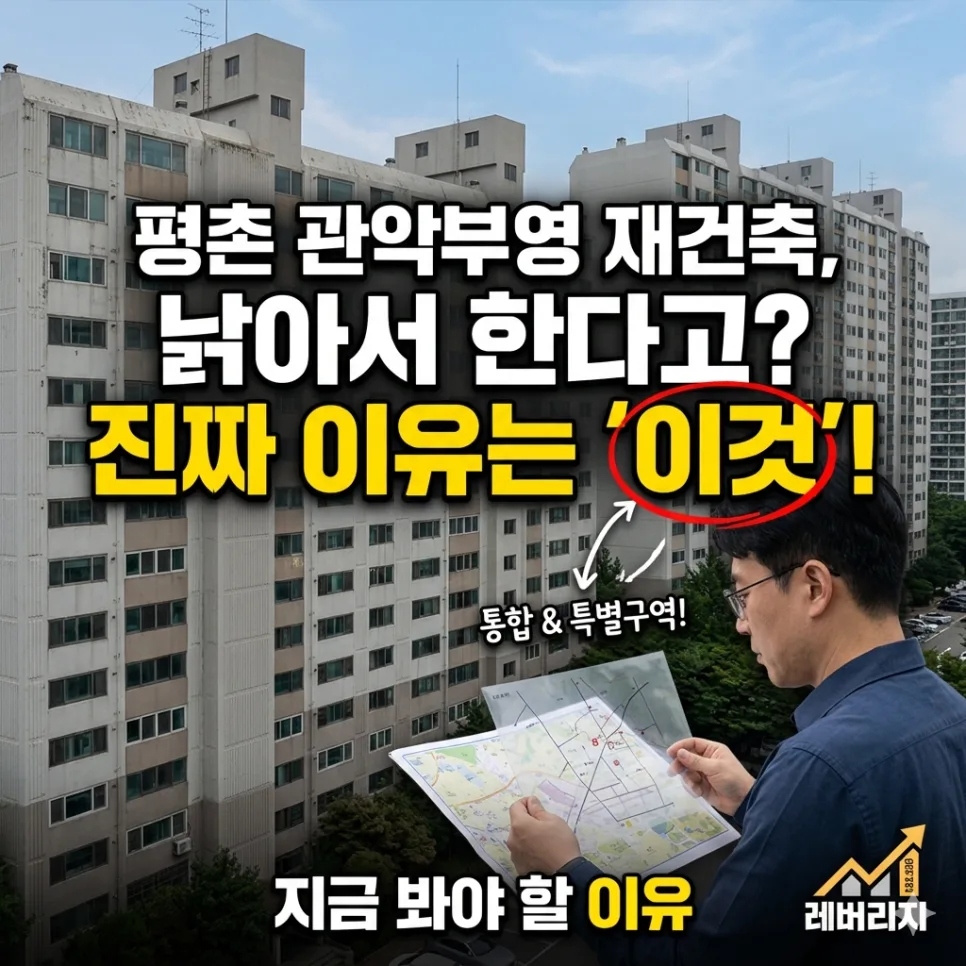
For US investors interested in South Korea's real estate market, understanding the redevelopment potential of older apartment complexes is key. The Gwankak Buyeong apartment complex in Anyang's Pyeongchon, part of the first-generation New Towns, is a prime example. Analyzing its potential for designation as a Special Redevelopment Zone by 2026, alongside the benefits of integrated redevelopment, offers a glimpse into Korea's urban renewal strategies.
What is the Gwankak Buyeong Apartment Complex?
Located in Pyeongchon, Anyang, Gyeonggi Province, the Gwankak Buyeong apartment complex was built in October 1993. With over 30 years of age, it falls under the category of first-generation New Town developments in Korea. It comprises 796 units and currently faces challenges common to older buildings, such as a low parking ratio of approximately 0.78 cars per household. From a redevelopment perspective, its age, its location within the Pyeongchon New Town redevelopment initiative, and the possibility of integrated redevelopment with neighboring complexes are crucial factors. For investors, understanding the broader context of redevelopment beyond just this single complex is essential, looking at how it fits into the larger urban planning narrative.
Gwankak Buyeong's Position in Pyeongchon's Redevelopment Wave
The renewed interest in Gwankak Buyeong's redevelopment is largely driven by Pyeongchon New Town's inclusion in the nationwide 'Old Town Redevelopment Project.' The city of Anyang has designated approximately 5.19 square kilometers, including Pyeongchon and Gwiin Village, as part of its urban redevelopment master plan through 2035. This initiative goes beyond individual building renovations, aiming for comprehensive urban renewal. Gwankak Buyeong, along with neighboring complexes like Gwankak Town and Gwankak Seongwon, is frequently discussed as a candidate for integrated redevelopment within this framework. Larger, integrated redevelopment zones often benefit from more comprehensive planning, improved infrastructure, and enhanced development feasibility, making a unified approach more impactful than individual projects. This process involves re-evaluating not just housing but also city-wide infrastructure like roads, parks, and schools.
What Are the Redevelopment Advantages for Gwankak Buyeong?
Gwankak Buyeong offers several distinct advantages from a redevelopment standpoint. Firstly, its location within the highly desirable Pyeongchon New Town provides access to excellent amenities. Pyeongchon is recognized for its well-developed educational facilities, commercial areas, transportation networks, and abundant green spaces. While not directly adjacent to the bustling Beomgye Station commercial hub, Gwankak Buyeong benefits from the overall quality of life in the area. Secondly, its age of over 30 years provides a clear justification for redevelopment. Issues like outdated facilities, insufficient parking, and inefficient layouts make residents eager for modern living standards. Thirdly, the potential for integrated redevelopment with adjacent complexes significantly enhances its value. As a standalone older complex, Gwankak Buyeong might have limited appeal, but combined with Gwankak Town and Gwankak Seongwon, it could become a substantial 'Pyeongchon First-Generation New Town Integrated Redevelopment Zone,' unlocking greater synergistic potential.
Key Considerations for Gwankak Buyeong's Integrated Redevelopment
Successfully pursuing integrated redevelopment for Gwankak Buyeong requires careful consideration of several factors. First, securing resident consensus is paramount. Integrated redevelopment involves multiple stakeholders with potentially differing interests, making higher resident approval rates crucial compared to single-complex projects. This necessitates active communication, resident information sessions, and consensus-building efforts. Second, a thorough analysis of floor area ratio (FAR) and development feasibility is essential. The potential FAR increase through integrated redevelopment must be analyzed alongside projected development costs and market conditions to create a viable project plan. Third, assessing the possibility of designation as a Special Redevelopment Zone is critical. Under the 'Old Town Redevelopment Act,' such designation can offer benefits like increased FAR and streamlined approval processes. Understanding if the Gwankak Buyeong area qualifies for this status within Pyeongchon's master plan is vital. Redevelopment outcomes can vary significantly based on individual circumstances, making consultation with real estate and urban planning experts highly recommended.
For more details, check the original source below.