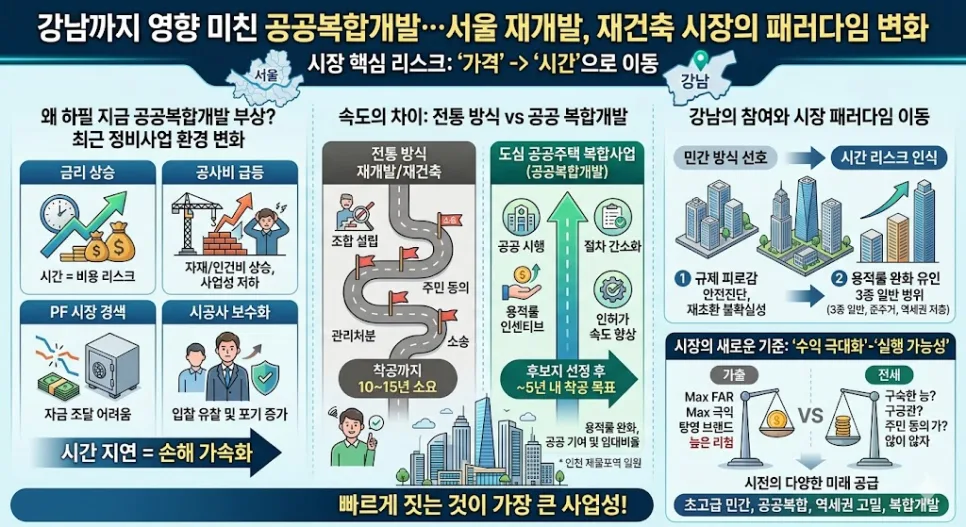
If you're looking to understand the evolving Seoul real estate market, particularly the rise of public-private mixed-use development (공공복합개발), this guide is essential. This approach is gaining traction, with resident proposals emerging even in affluent areas like Gangnam, signaling a significant shift in urban redevelopment strategies for 2026.
Why Is Public-Private Development Gaining Attention Now?
The landscape of urban redevelopment in Korea has dramatically shifted, bringing public-private mixed-use development (공공복합개발) back into the spotlight. While previously viewed as less profitable, current market conditions—including rising interest rates, soaring construction costs, and a strained real estate project financing (PF) market—mean that longer project timelines directly translate to greater financial losses. In this high-interest rate environment, project delays themselves become a major risk. Furthermore, construction companies are becoming more conservative due to escalating costs. Public-private development offers a compelling alternative by leveraging policy financing, streamlining permits, and utilizing public credit to ensure a more stable project progression. Successful examples, like the one near Jemulpo Station in Incheon, demonstrate relatively rapid project advancement.
What Are the Advantages of Public-Private Development Over Traditional Redevelopment?
Traditional redevelopment and reconstruction projects in Korea often involve lengthy and complex processes, including establishing resident associations, obtaining numerous consents, navigating permit approvals, and potential litigation, frequently extending timelines beyond a decade. In contrast, public-private mixed-use development aims to shorten these timelines significantly. The public sector takes on certain aspects of the project execution, simplifies association procedures, and offers incentives like increased floor area ratios (FAR) and expedited approvals. The government has set a target of commencing construction within approximately five years after candidate sites are selected, a pace that aligns with the market's urgent need to mitigate time-related risks. However, it's crucial to note that even with public involvement, securing sufficient resident consensus remains a critical factor for project success, and conflicts are not entirely eliminated.
Why Are Areas Like Gangnam Showing Interest in Public-Private Development?
The emergence of resident-led proposals for public-private development in traditionally private reconstruction-favored areas like Gangnam, Seocho, and Songpa marks a significant symbolic shift. Historically, these prime Seoul districts prioritized private reconstruction due to high profit potential and a general preference for market-driven projects. However, recent years have seen growing fatigue with stringent reconstruction regulations (such as safety inspections, excess profit recapture taxes, and mandatory public contributions). This, coupled with uncertainty about final costs, has led to project delays. Additionally, government policies aimed at easing floor area ratio restrictions in key Seoul areas have increased the appeal of public-private development. While this model offers incentives, it also entails greater public contributions, higher proportions of rental housing, and different profit-sharing structures compared to purely private ventures.
What is the Key Paradigm Shift in the Redevelopment Market?
In the past, the redevelopment market was heavily focused on 'maximizing profits'—achieving the highest floor area ratios, top sales prices, premium branding, and the greatest return on investment. However, the current environment, characterized by rising interest rates, escalating construction costs, and a tight PF market, has shifted the priority to 'feasibility.' The understanding is that a project with high potential profit is meaningless if it cannot be realistically completed within a reasonable timeframe. This change signifies a fundamental shift in the standards of the Seoul redevelopment market, moving beyond mere profit-seeking to emphasize stability and timely completion. Future projects will likely place greater importance on the certainty of execution over speculative profit margins. The optimal approach will vary based on individual circumstances, making consultation with experts advisable.
For more details, check the original source below.