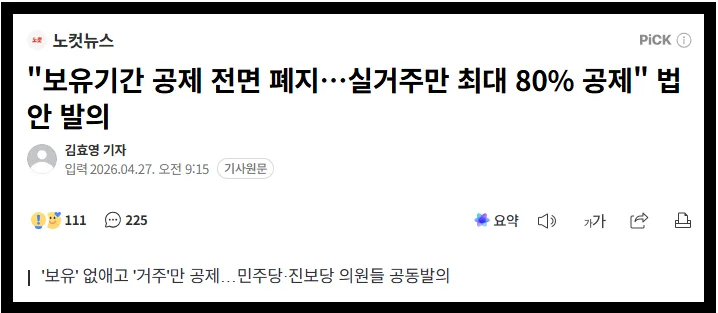
Proposed changes to South Korea's special tax deduction for long-term property holding (Jangtugeong) are causing significant market anxiety, particularly the discussion around mandatory residency requirements. These 2026 reforms aim to reduce deductions based on holding period alone and expand them for owner-occupiers, potentially disadvantaging long-term investors and those holding property in regional areas. As an experienced observer of the Korean real estate market, I've analyzed the potential impacts and concerns surrounding these proposed changes.
Why Are the Jangtugeong Reforms a Risky Idea?
The current discussions in the South Korean National Assembly center on reducing the tax benefits tied solely to the length of property ownership (Jangtugeong). Instead, the proposed reforms would introduce or expand deductions based on the duration of owner-occupancy, with higher rates for longer residency periods. While presented under the guise of protecting owner-occupiers, this approach dangerously categorizes various property holders—including long-term investors, those with property in regional areas, inheritors, and landlords—as speculative actors. This overlooks the diverse realities of property ownership in Korea. For instance, individuals working in Seoul but residing in regional areas due to family or educational reasons, or those who inherited property, may find themselves unfairly penalized. Such policies deviate from the principle that taxes should stabilize societal trends, not serve as tools for punitive enforcement.
Overlooking these complex realities and adopting an emotionally driven approach in policy-making can lead market participants to lose confidence in the predictability of government actions.
What Distrust Do Market Participants Feel About Owner-Occupancy Focused Reforms?
The shift towards prioritizing owner-occupancy in property tax policy, particularly concerning the long-term holding special deduction (Jangtugeong), risks creating significant market instability. Historically, policies that attempt to outmaneuver the market often prove ineffective or even detrimental. The core issue lies in the potential for these reforms to erode trust in policy predictability. When the government’s approach is perceived as punitive rather than stabilizing, it can lead to a chilling effect on transactions and a reduction in new housing supply. This ultimately harms genuine homebuyers and those who rely on the market for essential housing needs. The historical lesson that governments can indeed disrupt markets, even if they cannot control them, should serve as a crucial warning. Focusing solely on owner-occupancy can inadvertently punish long-term investors and those in regional markets, leading to decreased liquidity and potentially exacerbating housing shortages. This approach can foster distrust and make the market more volatile, ultimately hurting the very people the policies aim to protect.
Who Are the Biggest Victims of Reforms Punishing Long-Term Holdings?
Reforms that penalize long-term property holding disproportionately affect the middle class, who have typically managed their assets prudently over time. While sophisticated investors may find ways to navigate or circumvent new regulations, ordinary citizens who have diligently held onto their properties for years could face increased tax burdens due to policy shifts. This can include individuals who purchased property as a stable, long-term investment or those who inherited property and are not yet ready or able to sell. The lack of predictability in tax policy can create significant financial strain and uncertainty for these individuals. The core principle of fair taxation suggests that policies should be predictable and not retroactively disadvantage those who acted in good faith under previous rules. Punishing long-term, responsible ownership can discourage investment and lead to market stagnation, ultimately impacting the broader economy and individual financial security.
What Should Be Considered During Jangtugeong Reforms?
The most critical consideration during the reform of the special deduction for long-term property holding (Jangtugeong) is that policy must not overlook the market's inherent complexity. Simply differentiating benefits based solely on whether a property is owner-occupied ignores the diverse reasons people hold real estate. For example, individuals working in major cities but residing in regional areas, or those who have inherited property, cannot easily be categorized as speculators. Furthermore, abrupt policy changes can erode market participants' confidence, leading to transaction slowdowns. Therefore, policymakers must prioritize long-term market stability and predictability. Engaging with various stakeholders to understand their concerns and approaching reforms with caution are essential. Given that tax implications can vary significantly based on individual circumstances, consulting with a financial advisor is crucial for developing a personalized strategy.
English crawl path
Next English reads from this pilot cluster
Continue through the category hub, latest English stories, and related posts so this translated article is not an isolated URL.
Tags
💬Frequently Asked Questions
What should I check first in Korean Property Tax Changes 2026: Impact on Investors?
Does this Finance article link back to the Korean source?
Where can I find similar English stories?
English discovery path
Explore more English K-culture stories
Keep browsing the indexed English pilot cluster so Google and readers can move between this story, the category hub, and fresh discovery pages.
Original Source
Read the Korean original





