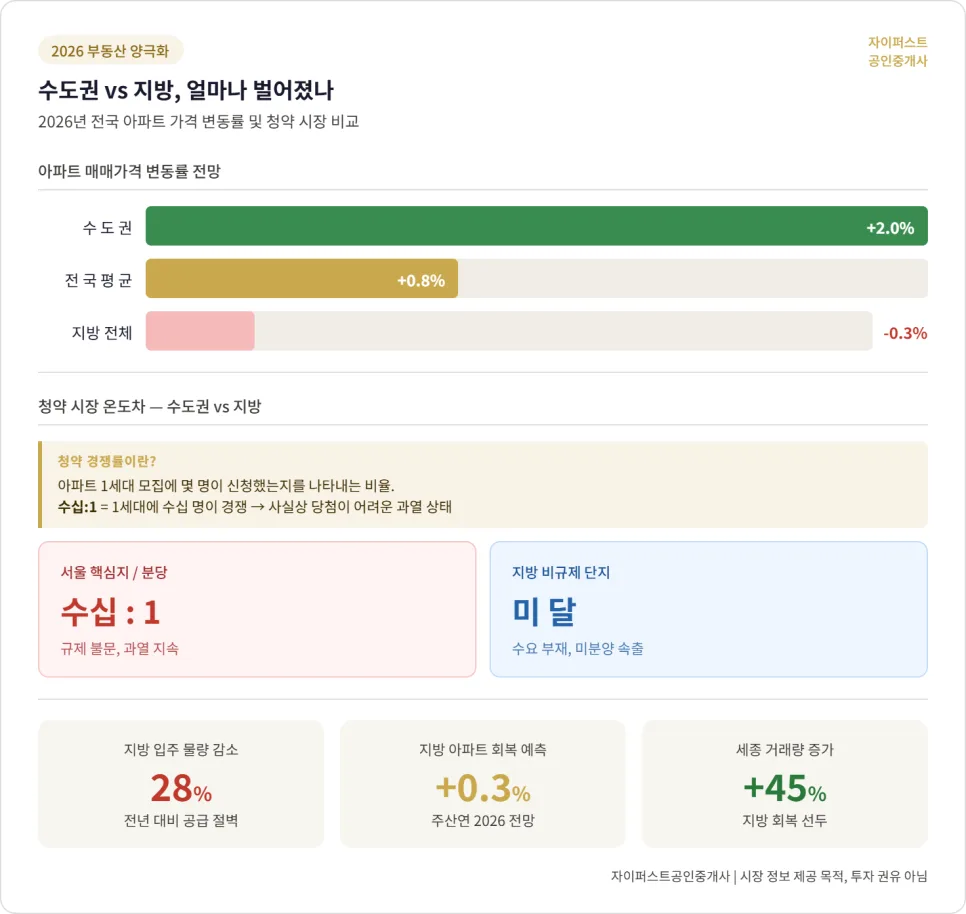
In 2026, the Korean provincial apartment market is expected to see widening polarization compared to the Seoul metropolitan area. With an average price increase of just 0.8% projected nationwide, the key to successful investment lies in identifying 'regions with a reason' for growth, rather than a blanket approach. This means focusing on areas with strong infrastructure, job opportunities, and population growth potential.
2026 Korean Apartment Market: How Big is the Gap with Seoul?
The national average apartment price increase is projected at around 0.8% for 2026. However, the Seoul metropolitan area is anticipated to see growth in the 2% range, while provincial areas may struggle to move beyond negative or stagnant price trends. This disparity is already evident in the subscription market, where prime Seoul and Bundang areas see fierce competition with dozens of applications per unit, while provincial, non-regulated developments often face undersubscription. Despite a significant drop of over 28% in provincial housing supply compared to the previous year, demand has not been sufficient to absorb it. This indicates that a broad recovery in the provincial apartment market is unlikely without targeted demand focused on specific, high-potential regions.
Why Focus on the Southern Gyeonggi Belt?
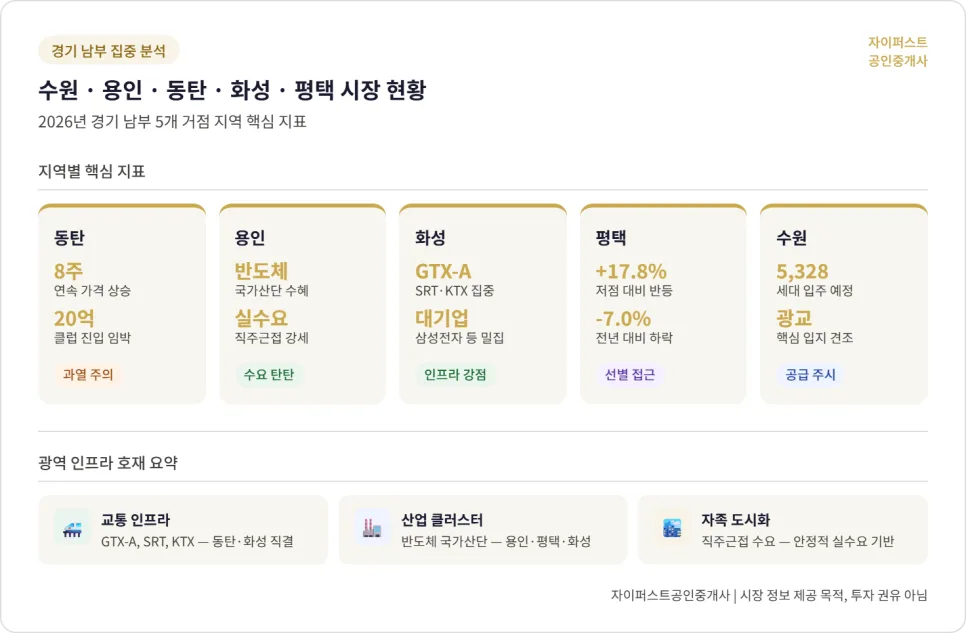
Within Gyeonggi Province, regional variations are substantial. Hwaseong Dongtan, in particular, has shown an eight-week streak of apartment price increases, nearing the '2 billion won club' (approximately $1.5 million USD). The expansion of transportation infrastructure like the SRT and GTX-A lines, coupled with strong demand from major corporations such as Samsung Electronics, enhances Dongtan's appeal as a self-sufficient city. Yongin is also attracting both end-user and investor demand, boosted by the development of a national semiconductor industrial complex. While Pyeongtaek has seen a rebound of over 17% from its low point, price recovery is slower than transaction volume growth, warranting a cautious approach. Suwon faces a short-term supply pressure with approximately 5,300 units scheduled for completion in 2026, but core areas like Yeongtong and Gwanggyo continue to maintain solid demand.
Provincial Metropolitan Cities: Which Areas Are Bottoming Out and Rebounding?
Among the provincial metropolitan cities, Sejong is showing remarkable performance with a 45% surge in transaction volume and a 4% price increase. Ulsan is also leading the recovery, posting the highest apartment price growth rate among the five major metropolitan cities. While some provincial cities are indeed showing signs of hitting bottom and rebounding, this is not indicative of a widespread recovery across all provincial apartments. Instead, it's concentrated in specific areas possessing key factors like transportation, industry, and population. Therefore, a selective approach is crucial when investing in provincial apartments, focusing on these 'regions with a reason.' For example, areas with planned transportation network improvements or large-scale industrial complex developments can be expected to have positive long-term impacts.
Provincial Apartment Investment: Risk Signals and Opportunity Factors
It's risky to dismiss investment in provincial areas solely based on their location, just as it's unwise to rush into purchases simply because a property is a distressed sale. Areas with strong end-user demand, like Dongtan and Yongin, can remain attractive long-term investment options. However, it's essential to consider that apartments in smaller provincial cities experiencing population decline may offer limited exit strategies for sellers, even at low distressed prices. As market polarization intensifies, investment decisions must be based on a thorough analysis of regional economic conditions and population trends. Focusing on areas with a balanced combination of transportation, industry, and population, and adopting a medium-to-long-term holding perspective, is the core strategy for successful provincial apartment investment in 2026. This is not financial advice. Consult a licensed financial advisor.
For more details, check the original source below.





