
Looking to maximize your tax savings in 2026? An ISA (Individual Savings Account) can be your secret weapon. These accounts allow you to invest up to $135,000 USD (₩20 million KRW annually) with tax-free growth on your first $13,500 USD (₩2 million KRW) of earnings, and a low 9.9% tax rate on anything above that. This guide breaks down the best investment products to put inside your ISA for ultimate tax efficiency.
What is an ISA Account and Why is it Called a 'Universal Tax-Saving Account'?
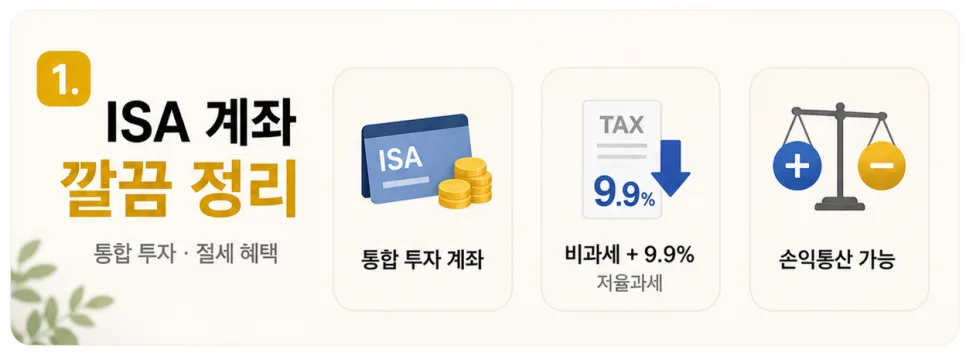
An ISA, or Individual Savings Account, is a versatile financial tool in Korea that consolidates various investment products under one umbrella, offering significant tax advantages. Unlike standard investment accounts where financial gains are taxed at a hefty 15.4%, ISA accounts provide a tax-free threshold. For the general type (일반형), you can earn up to approximately $1,350 USD (₩2 million KRW) tax-free. Earnings beyond this amount are taxed at a preferential rate of 9.9%. This structure makes ISAs incredibly beneficial for long-term wealth building. Personally, I've found it instrumental in reducing my tax burden on dividends, allowing my investments to grow more effectively.
How Do You Open an ISA Account and What Types Are Available?
ISA accounts are typically opened through securities firms, with the 'intermediary type' (중개형 ISA) being the most common and easily accessible via non-face-to-face (online) applications. When choosing a brokerage, it's wise to compare their promotional offers, fee structures, and overall reliability to find the best fit for your needs. The online account opening process usually involves downloading the firm's app, verifying your identity, completing an investment propensity test, and selecting your ISA type – often taking just 5-10 minutes. ISA accounts are categorized based on eligibility criteria, including General (일반형), Low-Income (서민형), and Farmer/Fisherman (농어민형), with specific income or total salary requirements for each. You must also not have been subject to comprehensive financial income tax in the previous three tax periods, and you can only hold one ISA account per person.
What Are the Top 4 Investment Products to Maximize Tax Savings in an ISA Account?
The true power of an ISA lies in strategically selecting which assets to hold within it. The key is to prioritize investments that incur higher taxes in a regular account. My top recommendation is **ETFs listed in Korea that track overseas markets**, such as those mirroring the S&P 500 (like KODEX USA S&P500) or the Nasdaq 100 (like TIGER USA Nasdaq100). These offer substantial tax savings on their distributions, which would otherwise be taxed at 15.4%. Secondly, consider **high-dividend ETFs focused on domestic stocks** (e.g., KODEX Dividend Growth). These provide regular income streams with reduced tax impact. Thirdly, **REITs ETFs** are attractive; while they offer high yields, their distributions are also subject to significant taxation, making them ideal for ISA inclusion. Finally, **bond ETFs** provide a stable income stream, and placing these within an ISA lowers the tax on their interest earnings, enhancing both portfolio stability and tax efficiency.
What Are Common Mistakes When Investing in an ISA Account and How Can They Be Avoided?
A frequent pitfall is failing to fully leverage the ISA's tax benefits. This can happen by placing assets that already enjoy tax exemptions in a regular account into the ISA, or by prioritizing low-tax assets over high-tax ones. Another common error is not maximizing the annual contribution limit or misunderstanding the implications of mid-term account termination. Remember, you can contribute up to approximately $13,500 USD (₩20 million KRW) annually, with a total limit of around $67,500 USD (₩100 million KRW), and unused portions can be rolled over to the next year. However, early termination can result in a 16.5% income tax penalty on previously exempted gains, so careful planning is crucial. It's essential to align your investment choices within the ISA with your personal financial goals and risk tolerance, ideally after consulting with a financial advisor.
Discover more ISA investment strategies in the original article.