While many are focusing on GS Global CEO Kim Sung-won's purchase of 40,000 company shares, they're overlooking the underlying 2026 earnings outlook and the growth potential of new business ventures. This article analyzes GS Global's current business landscape and future growth drivers to aid your investment decisions. This is not financial advice. Consult a licensed financial advisor.
GS Global's Diversified Portfolio Across 4 Business Segments by 2026
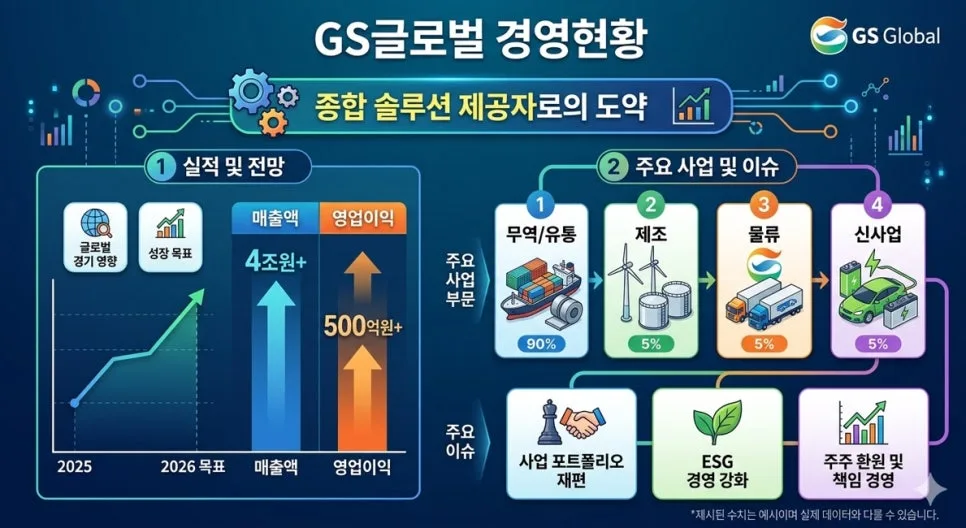
GS Global has established a stable business foundation by operating across four major areas: traditional trading and distribution (steel, petrochemicals, energy), logistics (including import vehicle PDI, handling, and transportation), new business initiatives, and manufacturing. Notably, its offshore wind foundation manufacturing through subsidiary GS E&C is emerging as a key future growth engine, boasting unique domestic competitiveness. GS E&C has secured exclusive business rights in Asia through a licensing agreement with SIF, a global leader, strengthening its position in the offshore wind market. This diversified business structure enhances resilience against external environmental changes and is expected to drive continuous growth through 2026. This is not financial advice. Consult a licensed financial advisor.
Offshore Wind and Solar Power Projects Poised for Government Policy Support in 2026
Amidst recent global geopolitical instability, the importance of energy security is paramount, positioning GS Global's offshore wind power business to benefit from government policies. Furthermore, in the solar power sector, the company is targeting the domestic and international markets as a 'full-line provider' by supplying high-output solar modules and inverters through partnerships with global leading manufacturers. GS Group itself plans to invest approximately 21 trillion KRW (roughly $15 billion USD) in eco-friendly energy and new businesses by 2026, which is expected to positively impact the growth of GS Global's related businesses. These renewable energy businesses have significant long-term growth potential and are gaining more attention in line with ESG management trends. This is not financial advice. Consult a licensed financial advisor.
CEO Kim Sung-won's Commitment: The Significance of the 40,000 Share Buyback
GS Global CEO Kim Sung-won's personal purchase of 40,000 company shares signals strong confidence from management in the company's future growth prospects. This move can be interpreted as an effort to achieve both enhanced shareholder value and strengthened responsible management. Having proven stable business capabilities by recording over 4 trillion KRW (approx. $3 billion USD) in revenue last year despite a global economic slowdown, this share buyback is expected to serve as a positive signal to investors. The company has set a revenue target of 4.6 trillion KRW (approx. $3.4 billion USD) by 2026 and plans to actively pursue a qualitative growth strategy focused on profitability alongside top-line expansion. This is not financial advice. Consult a licensed financial advisor.
Restructuring Electric Vehicle Business and Improving Profitability
GS Global has been importing and selling electric buses and the electric truck 'T4K' in collaboration with Chinese EV maker BYD. However, the company has focused on improving profitability by transferring the sales rights for the low-margin electric truck business to BYD Korea. This strategic restructuring of the business portfolio is evaluated as part of a strategy to pursue sustainable growth through efficient resource allocation, even amidst uncertain market conditions. Moving forward, GS Global is expected to concentrate further on strengthening core business capabilities and nurturing new ventures. This is not financial advice. Consult a licensed financial advisor.
Key Considerations for Investing in GS Global by 2026
Before investing in GS Global, several factors warrant consideration. Firstly, offshore wind and renewable energy businesses are susceptible to changes in government policy and global supply chain issues. Secondly, the traditional trading business can be sensitive to macroeconomic indicators such as exchange rate fluctuations and international oil prices. Thirdly, it may take time for new business initiatives to show tangible results, necessitating a long-term investment perspective. Therefore, it is crucial to fully understand these potential risk factors and make a prudent decision based on your individual investment profile and goals. Consulting with a financial professional is recommended. This is not financial advice. Consult a licensed financial advisor.
For more details, check the original source below.