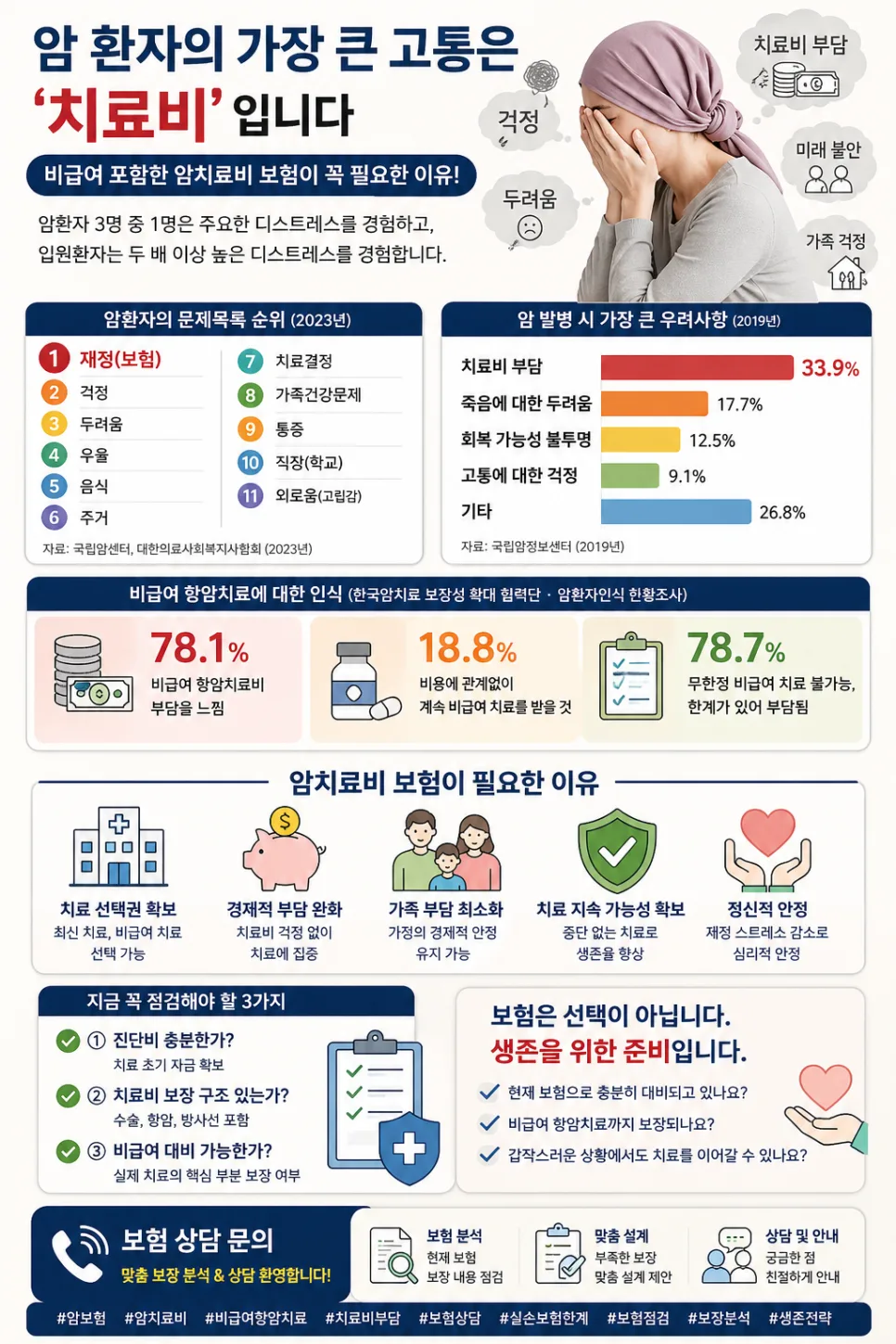
The biggest fear for many isn't death itself, but the overwhelming cost of cancer treatment. This guide breaks down the three essential coverage areas for cancer insurance in 2026, including crucial non-covered treatments, to help you secure your survival rate.
Is Treatment Cost More Feared Than Death by Cancer Patients?
Contrary to what many might assume, research from the National Cancer Center and the Korean Medical Social Workers Association in 2023 revealed that the primary source of distress for cancer patients isn't death or pain, but 'financial problems' related to treatment costs and insurance. Over one-third of outpatients experienced severe distress, a figure more than double for inpatients. This aligns with a 2019 National Cancer Information Center study, where 33.9% cited treatment costs as their biggest concern, significantly higher than the fear of death (17.7%). For many facing cancer, the economic burden is a more immediate and pressing reality than the disease itself.
Can Financial Means Dictate Cancer Treatment Choices?
Recent advancements in cancer treatment technology are remarkable, but they often come with a rising number of non-covered (non-reimbursable) medical expenses. Surveys indicate that 78.1% of cancer patients feel burdened by these non-covered treatment costs, and a staggering 78.7% reported difficulty continuing treatment due to financial limitations. This highlights a harsh reality: financial capability can directly influence a patient's ability to access life-saving treatments. Without adequate insurance, patients may face the agonizing decision to halt treatment, switch to less effective alternatives, destabilize their family's finances, or deplete their retirement savings. Therefore, to afford cutting-edge therapies like new drugs, targeted treatments, and immunotherapy, relying solely on basic health insurance (similar to US PPO/HMO plans) is insufficient. Comprehensive cancer insurance that covers these high-cost non-covered treatments is essential.
Why Cancer Insurance Should Be a Survival Strategy, Not Just Basic Coverage
The most critical aspect of cancer treatment is having access to the best available options, which is increasingly tied to financial resources. Consequently, the role of cancer insurance extends beyond simply covering medical bills; it empowers patients with 'treatment choice,' alleviates 'financial stress,' minimizes the 'burden on families,' and enhances the 'sustainability of treatment.' It's vital to review your current insurance policies to ensure they adequately cover non-covered cancer treatments. Beyond just having insurance, focus on three key elements: sufficient diagnosis benefits, a robust structure for covering surgery, chemotherapy, and radiation, and the potential to cover high-cost non-covered treatments. Lacking in any of these areas could lead to a situation where you have insurance but cannot access the care you truly need.
What Are the 3 Critical Checkpoints for Cancer Insurance Policies?
The structure of your cancer insurance is as important as having it. First, 'diagnosis benefits' are crucial for securing initial funds to manage the early stages of treatment. Second, the 'treatment cost coverage structure' should comprehensively cover surgery, chemotherapy, and radiation. Third, and most importantly, assess the 'potential for non-covered treatment coverage' to ensure it adequately addresses the high expenses associated with advanced therapies like new cancer drugs and targeted treatments. If any of these components are insufficient, you may face significant financial hardship during your treatment journey. It is wise to analyze your current policies with a financial advisor to identify any gaps and ensure you are fully prepared.
English crawl path
Next English reads from this pilot cluster
Continue through the category hub, latest English stories, and related posts so this translated article is not an isolated URL.
Tags
💬Frequently Asked Questions
What should I check first in Cancer Insurance 2026: Key Coverage for Survival Rates?
Does this Finance article link back to the Korean source?
Where can I find similar English stories?
English discovery path
Explore more English K-culture stories
Keep browsing the indexed English pilot cluster so Google and readers can move between this story, the category hub, and fresh discovery pages.
Original Source
Read the Korean original





